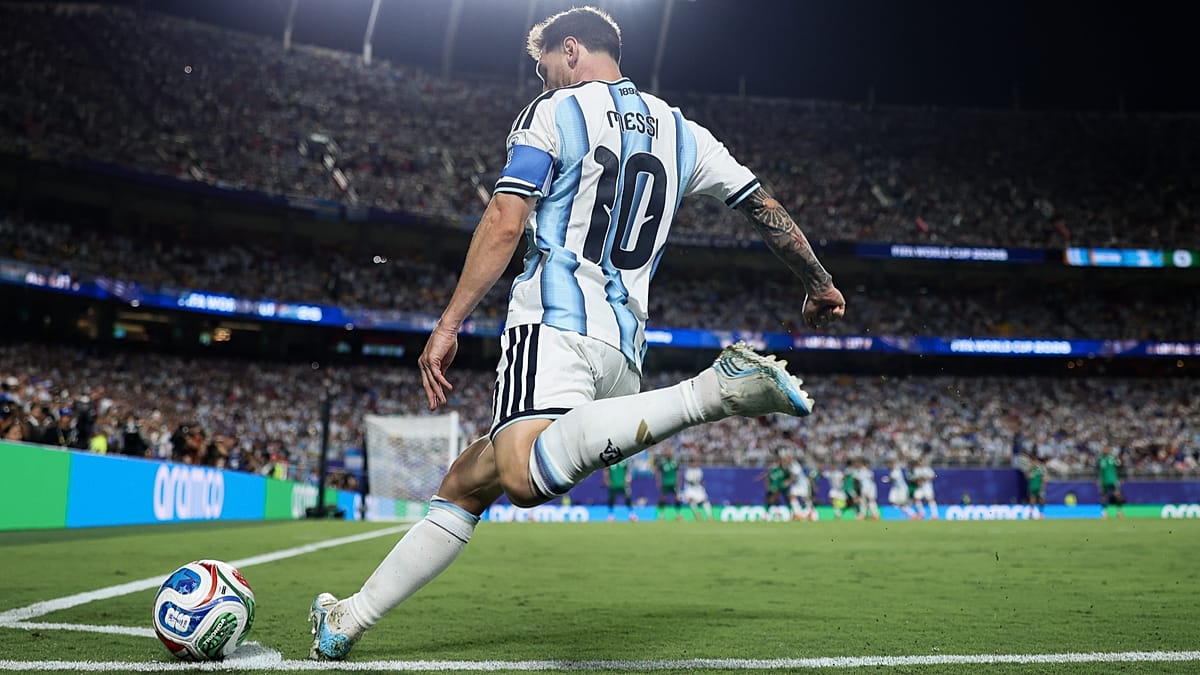
What does it take to photograph the greatest footballers on the planet, in action, on the world's biggest stage? For Getty Images photographer Alex Pantling, it's a blend of meticulous planning and split-second reaction. With over a decade behind the lens, Pantling has covered FIFA World Cups, Champions League nights, Formula 1, and the Olympic Games, capturing icons like Max Verstappen, Lionel Messi, Cristiano Ronaldo, Harry Kane, and 19-year-old sensation Lamine Yamal.
This summer's World Cup in North America gave him some of his most striking football images yet. Speaking to European Pulse, Pantling explained that the key to his craft is less about luck and more about being ready for the unexpected: "You can plan, you can have ideas in your head, but you've got to react when those ideas change in the moment."
From architecture to the touchline
Pantling's path into sports photography was hardly a straight shot. "Originally it was kind of a fluke, to be honest," he admits. At school, he wanted to study architecture, but the subject choices didn't align with his sporting interests, and the seven-year university course put him off. A suggestion to try photography led him to Nottingham Trent University, where he initially focused on art photography—still life, street scenes, and portraits.
It was a tutor from Italy who connected him with Julian Finney, a Getty photographer, and later with Michael Regan, one of the agency's top football shooters. That connection turned into work experience and eventually a full-time role. "I realised there was a job that combined my two passions: sport and photography," he says.
Planning versus instinct
In the high-stakes world of football photography, planning is essential, but flexibility is everything. "What you plan never actually happens—let's be honest," Pantling says. A coin toss can swap ends, rain can change the light, and a player's positioning can shift in an instant. "You might get to a game thinking you want to sit in a certain spot because of the light, or because you want to photograph a particular team attacking your side in the first half. Then the captains do the coin toss, they swap ends, or the rain comes—there are so many variables."
That unpredictability is part of the appeal. "I think that's why I love it. You never work the same day twice as a football photographer, because no game is the same. I might shoot Chelsea versus Tottenham again this year, but it won't be the same as last year or the year before."
The World Cup difference
Covering a World Cup, Pantling says, feels distinctly different from a Premier League match. "The Premier League is amazing—I might be a little biased being English, but I think it's the greatest football league in the world," he says. Yet the World Cup carries a unique emotional weight. "It's not just the Argentinas, the Englands, the Frances—I was lucky enough to be doing Curaçao, smaller countries like this, which were almost as enjoyable because of how much it meant to them to be there, and to their fans."
That emotional resonance is what sets the tournament apart. "You're still doing the same job, but the emotion and the feeling behind the pictures and games is completely different."
Nerves and the Messi moment
Even after years of experience, Pantling still feels the pressure before big games. "Take Messi, for example—you know he'll arguably be one of the greatest footballers to have ever lived, and in ten, twenty, thirty, forty years, people will look back on pictures of him playing. You've got the opportunity to take the pictures people are going to look at. I find that really exciting."
He recalls shooting the final of the Qatar World Cup, widely considered one of the greatest matches ever. "I was up in the stands, and I remember Messi scoring his first goal—the penalty—on my side of the pitch, and my hands were literally shaking, I was so nervous about missing the shot." That nervousness has eased with time, but it never fully disappears. "Getting the goal picture, the celebration, being in the right place—yes, they're always there."
One of Pantling's favourite images from this year's tournament is a cinematic portrait of Austria's David Alaba in the player's tunnel, where most of the frame is in darkness. The intention, he explains, was to capture the solitude and focus of a player before the storm. "We get such limited access to those moments," he says, "and the tunnel is a place where the noise of the stadium fades, and it's just the player and the moment."
For Pantling, the craft is about more than just technical skill—it's about telling the story of the game through a single frame. As he puts it, "You can plan, you can have ideas in your head, but you've got to react when those ideas change in the moment." That philosophy has carried him from the art studios of Nottingham to the world's most iconic stadiums, and it's what keeps his images fresh, even after a decade on the job.