Every four years, the FIFA World Cup produces moments that transcend sport. But behind the iconic images that define these tournaments are the photographers who risk everything to capture them. Getty Images photographers have been present at every major match, and here they reflect on the stories behind their most memorable shots from the past five finals.
Messi's crowning moment in Qatar
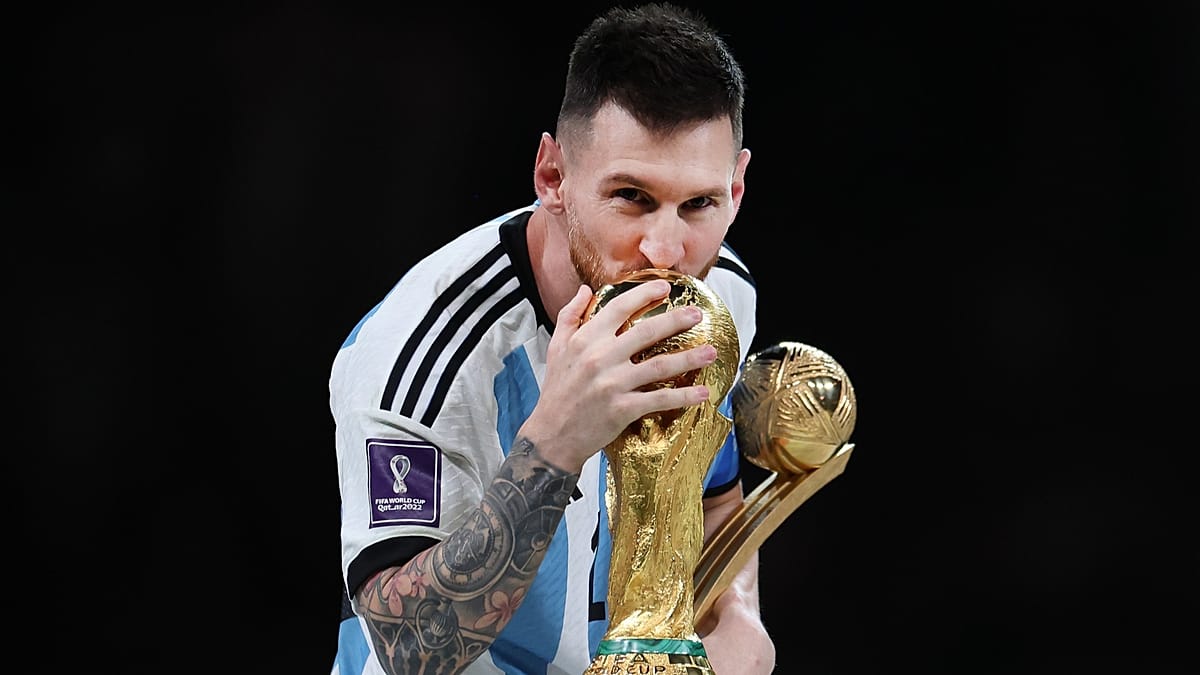
Shaun Botterill was positioned near the trophy presentation at Lusail Stadium on 18 December 2022, when Argentina defeated France in one of the most dramatic finals in history. But his favourite image came later, after the formal celebrations had ended.
“This photo was taken at least 30 minutes after the main trophy lift,” Botterill explains. “All the Argentina fans and photographers are waiting for Messi to go over to acknowledge the fans. All the Getty Images photographers had a loose plan of what we’d capture, but luck also kicked in with this picture.”
The result is a candid shot of Lionel Messi, arms outstretched and beaming, carried on the shoulders of former teammate Sergio Agüero. “This is the first moment he opened his arms with the biggest of smiles two metres in front of me, whilst I was looking up on a 24-70mm lens,” Botterill adds.
Atmosphere and access in Moscow
David Ramos was the only photographer allowed on the pitch after France’s 2018 final victory over Croatia at the Luzhniki Stadium. That exclusive access gave him a unique perspective on the aftermath.
“The fireworks had just finished and the rain had left smoke and haze hanging inside Luzhniki Stadium,” Ramos recalls. “As the light came through that haze, it created visible rays above Paul Pogba while he held the World Cup Trophy.”
Ramos deliberately kept the frame wide to show the scale of the stadium and the crowd. “The access allowed me to stay low and close, but the wider composition lets the atmosphere become part of the story,” he says. “For me, it feels less like a standard trophy picture and more like a surreal, emotional moment.”
Italy's impromptu celebration in Berlin
Michael Steele was covering the 2006 final in Berlin, where Italy beat France on penalties. He and colleague Shaun Botterill had secured prime positions for the trophy presentation, but the most striking moment came during the lap of honour.
“I was shooting tighter on a 400mm concentrating on the Italian captain Fabio Cannavaro, and as the players went on a lap of honour they suddenly started to reach out and touch the trophy en masse,” Steele says. He quickly climbed onto a metal barrier for extra height, despite other photographers tugging at his feet.
“The confetti and pyrotechnic smoke also adds to the picture,” he notes. “Trophy presentations can sometimes feel staged, but this felt like a more impulsive and natural way of a team coming together.”
The tackle that became folklore
Laurence Griffiths captured one of the most controversial moments in World Cup history: Nigel de Jong’s chest-high challenge on Xabi Alonso in the 2010 final between the Netherlands and Spain.
“There are moments in every FIFA World Cup that transcend the match itself and become part of football folklore,” Griffiths says. His image freezes the exact instant De Jong’s boot meets Alonso’s chest, a split second that sparked debate for years.
Referee Howard Webb showed only a yellow card, a decision many still question. “More than fifteen years later, the photograph remains one of the enduring visual symbols of South Africa 2010,” Griffiths adds.
Working from the catwalk
Matthias Hangst’s favourite shot from the 2018 tournament came from a unique vantage point: the stadium catwalk, 80 to 100 metres above the pitch. Only a small group of photographers are granted access, after rigorous safety training.
“The pressure is massive,” Hangst says. “You are standing above people’s heads, so if you drop even a single small thing, the consequences could be severe.” His image of England and Belgium players contesting a header captures the intensity of a match that, despite being a group-stage encounter, had significant implications for both teams’ paths in the tournament.
These photographs do more than document events; they shape how we remember them. As the next World Cup approaches, the work of these photographers will continue to define the visual legacy of the beautiful game.