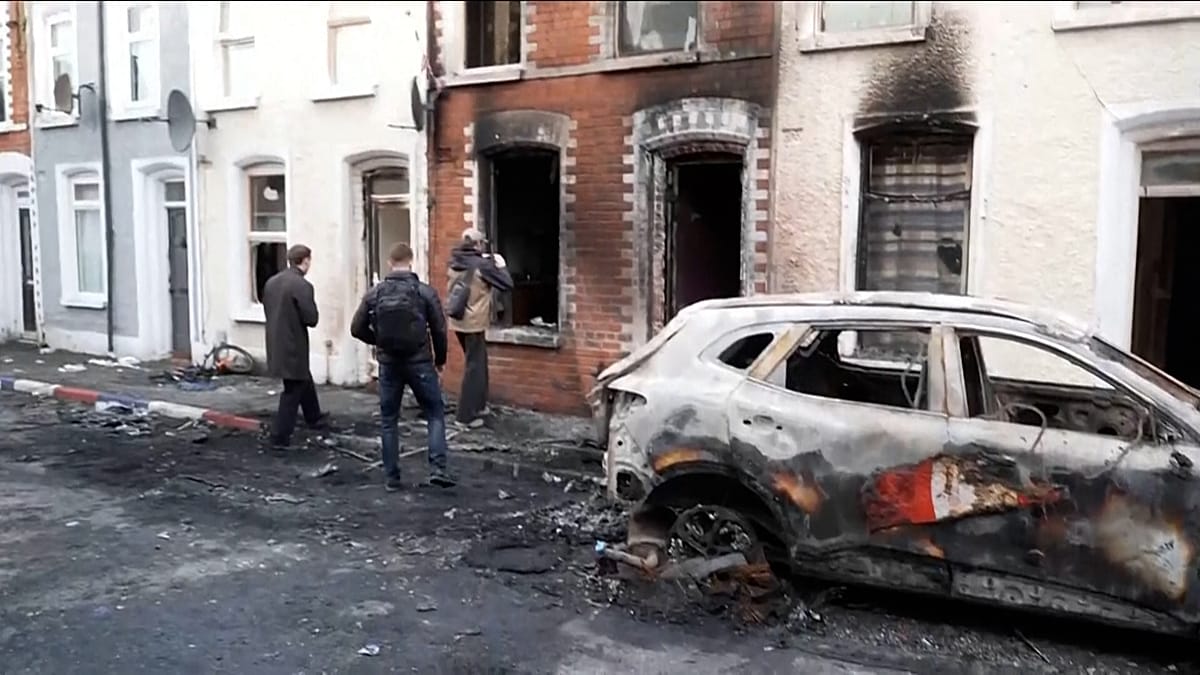
Belfast woke to scenes of destruction on 10 June after anti-immigration protests spiraled into violence across several parts of Northern Ireland. Homes were damaged, vehicles set ablaze, and families forced to flee their neighborhoods. The unrest marks a sharp escalation in tensions that have been simmering since a stabbing incident earlier this month.
Background to the Unrest
The violence erupted following protests organized by far-right groups, who have been using social media to rally supporters. The demonstrations were triggered by the arrest of a Sudanese man in connection with a brutal stabbing in Belfast, which left a local resident seriously injured. Far-right figures have seized on the incident to stoke anti-immigrant sentiment, calling for protests that quickly turned destructive.
According to local reports, the worst of the violence occurred in the south of the city, where masked individuals attacked homes believed to be occupied by immigrants. Firefighters were called to multiple scenes as buildings and cars were set alight. Police have confirmed that several families have been displaced and are receiving support from local authorities and community groups.
The Police Service of Northern Ireland (PSNI) has condemned the violence, describing it as "sickening" and "cowardly." Assistant Chief Constable Melanie Jones stated that officers are reviewing CCTV footage and social media posts to identify those responsible. "This was not a protest; this was a deliberate attack on people's homes and livelihoods," she said.
The unrest in Belfast is part of a broader pattern of far-right mobilization across the United Kingdom and Europe. Similar incidents have been reported in other UK cities, including Southampton, where violence erupted after the conviction of a Sikh man for murder. The European Pulse has previously covered how misleading videos have been used to push anti-immigration agendas, and the Belfast situation appears to follow a similar playbook.
Political Reactions and Community Response
Political leaders across Northern Ireland have united in condemning the violence. First Minister Michelle O'Neill called for calm, urging communities not to let extremists divide them. "The people of Belfast are resilient and compassionate. We will not allow a minority to terrorize our neighborhoods," she said in a statement.
Community organizations have mobilized to support affected families, providing temporary accommodation, food, and counseling. Local churches and interfaith groups have also issued statements denouncing the attacks and calling for solidarity with immigrant communities.
The violence has also drawn attention to the role of social media platforms in amplifying far-right rhetoric. Critics argue that algorithms on platforms like TikTok and Facebook have been used to spread hate speech and organize protests. This echoes concerns raised in other European contexts, such as the case of French families suing TikTok for algorithmic 'abuse of weakness'.
Broader European Context
The Belfast unrest is not an isolated incident. Across Europe, far-right groups have been exploiting local tragedies to push anti-immigration narratives. In Italy, for example, the brutal murder of four farm workers exposed the exploitation of migrant labor, as reported in our coverage of gangmaster violence. The pattern is consistent: a crime is committed, far-right figures amplify it online, and protests turn violent.
In Northern Ireland, the situation is further complicated by the region's delicate political balance. The Good Friday Agreement, which ended decades of sectarian conflict, has created a power-sharing government that is now being tested by new forms of division. The PSNI has warned that the violence could undermine the progress made since the peace process.
As Belfast begins the long process of recovery, questions remain about how to prevent such incidents from recurring. Community leaders are calling for stronger action against hate speech online, better integration policies, and more support for areas vulnerable to far-right recruitment. The European Pulse will continue to monitor developments in Northern Ireland and across the continent.