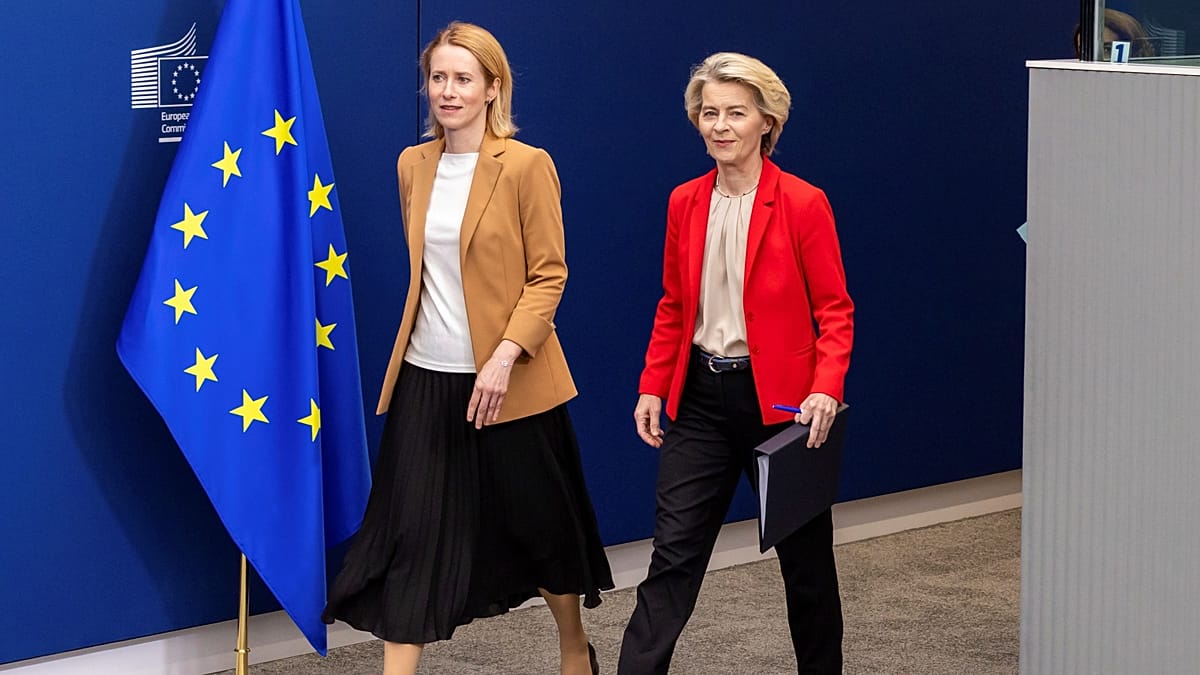
Germany and France have put forward a joint proposal to restructure the European Union's foreign policy machinery, placing the bloc's top diplomat, Kaja Kallas, more firmly under the authority of European Commission President Ursula von der Leyen. The plan, which will be discussed at an informal gathering of EU foreign ministers in Wicklow, Ireland, on Wednesday, is designed to tackle one of the Union's most persistent weaknesses: the institutional cacophony that often hampers its external action.
Under the current architecture, established by the Treaty of Lisbon, the High Representative for Foreign Affairs and Security Policy leads the European External Action Service (EEAS), coordinating and implementing foreign policy on behalf of the 27 member states. At the same time, the High Representative serves as a vice-president of the European Commission. This dual role was intended to bridge the gap between the Council and the Commission, but in practice it has created a complex and often unwieldy division of labour.
Key policy areas that shape international relations—trade, energy, climate, migration, and enlargement—fall largely within the Commission's remit, leaving the EEAS with limited material leverage. This imbalance has allowed von der Leyen to expand her own foreign policy footprint considerably, as seen in her response to Russia's full-scale invasion of Ukraine and her frequent trips to sign high-profile agreements. Her assertive approach has occasionally drawn criticism from national capitals, with some accusing her of overreach, even though EU leaders have often encouraged her to take the lead on global crises.
The Franco-German plan seeks to address this by giving Kallas a more hands-on role in coordinating foreign-related areas managed by the Commission's directorates-general, such as development aid (DG INTPA), humanitarian relief (DG ECHO), defence industry (DG DEFIS), and neighbourhood policy, which is currently split between DG ENEST (Eastern Europe) and DG MENA (Middle East, North Africa, and the Gulf). Trade, a high-stakes portfolio, could also be brought under this umbrella.
To support this new structure, the plan proposes creating a dedicated department for foreign policy within the Commission, reminiscent of the old DG RELEX, which was absorbed into the EEAS in 2010. In practice, Kallas would gain broader responsibilities inside the Commission, but the ultimate authority would rest with von der Leyen, mirroring the relationship between a prime minister and a foreign minister at the national level.
At the same time, the proposal would weaken the EEAS, which Kallas currently leads independently of the Commission president, to reduce the risk of institutional clashes. The reform would require amending the 2010 decision that established the EEAS, rather than the Treaty of Lisbon itself, and would need unanimous agreement from member states.
The initiative comes at a time of global turbulence that has exposed the EU's foreign policy vulnerabilities. While member states broadly agree that reform is necessary, they remain divided on the best path forward. In June, a French paper outlined three options: expanding the High Representative's powers, shifting them to the Commission, or shifting them to member states. The latter two would effectively hollow out the position.
The Franco-German proposal is likely to face resistance from smaller member states, which fear that concentrating power in the Commission could sideline their own voices. The plan also raises questions about the future of the EEAS and the balance between supranational and intergovernmental approaches to foreign policy.
As the EU grapples with challenges ranging from the war in Ukraine to instability in the Sahel, the need for a coherent and effective foreign policy has never been more urgent. The discussions in Wicklow will be a first test of whether the Franco-German vision can gain traction among the 27.
Reactions and implications
Diplomats in Brussels have expressed cautious interest, noting that the plan could streamline decision-making but also warning against undermining the High Representative's role. Some have pointed to the Icelandic referendum rejecting EU membership as a reminder that the bloc's external appeal is not guaranteed, and that internal coherence is essential.
Others see the proposal as a natural evolution of the EU's institutional setup, given von der Leyen's already dominant role in foreign affairs. The plan could also be seen as a way to give Kallas a more meaningful portfolio, while ensuring that the Commission president retains ultimate control.
However, the reform is far from certain. Any change to the EEAS decision requires unanimity, and several member states, particularly those with strong intergovernmental traditions, may push back. The coming months will reveal whether the Franco-German initiative can overcome these hurdles and deliver a more cohesive EU foreign policy.