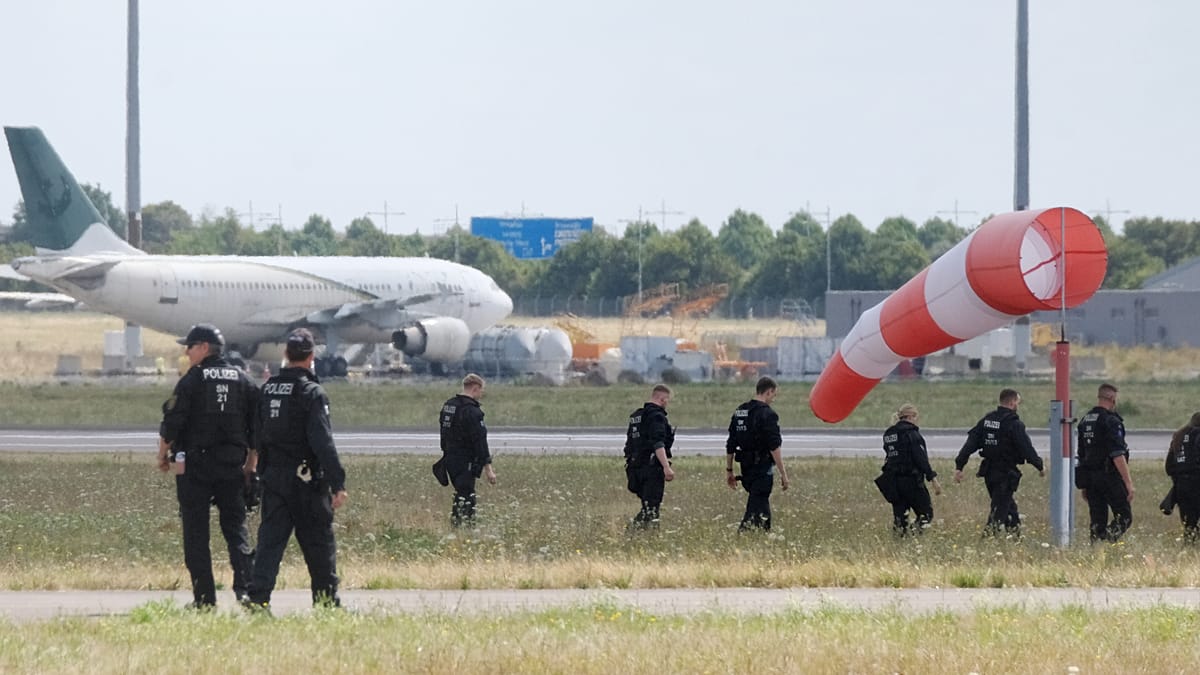
Germany is moving to bolster its defenses against hybrid attacks, with a new plan that includes a digital early-warning system and expanded counter-drone capabilities. The initiative, reported by Bild on Sunday, comes weeks after an attempted drone strike at Leipzig/Halle Airport that the government in Berlin has formally blamed on Moscow.
Interior Minister Alexander Dobrindt told the newspaper that Russian hybrid attacks had become a "daily reality" and were likely to intensify. He insisted, however, that Germany has the means to respond effectively.
Cyberdome and mobile drone units
According to Bild, citing information from the Interior Ministry, the centerpiece of the plan is a so-called "Cyberdome" — a network of digital sensors designed to detect and intercept hacking attempts in real time. The system would complement existing cybersecurity measures and provide a unified early-warning architecture for federal and state authorities.
The proposal also calls for expanding the federal police's mobile drone defense capabilities. "Rapidly deployable units" would be stationed in key cities such as Berlin, Munich, and Hamburg, tasked with protecting airspace above major transport hubs and critical infrastructure.
Artificial intelligence tools, including facial recognition, would be used more extensively to identify potential attackers. In addition, private companies would be granted the right to detect drones in their vicinity and "actively defend against them," the report said.
The Leipzig/Halle incident
The plan follows a serious security breach on 4 August, when a drone carrying explosives was discovered at Leipzig/Halle Airport, a major cargo hub. The incident forced runway closures and flight diversions, disrupting operations for hours.
On Tuesday, Foreign Minister Johann Wadephul announced that Berlin would take action against Russia as the "perpetrator of the hybrid attack in Leipzig." Measures include closing Russia's consulate in Bonn and its cultural center in Berlin, tightening border controls for Russian nationals, and increasing pressure on Russia's shadow fleet.
"The Russian general consulate in Bonn will be closed by 18 September," Wadephul said, adding that the steps were a direct response to Moscow's actions.
The Russian embassy in Germany rejected the accusations. Ambassador Sergey Nechayev "categorically rejected the accusations made by Berlin as unsubstantiated, absurd, and contrary to common sense," according to a statement. The embassy warned of "consequences," calling the German measures "an unprecedented escalation in Russian-German relations" for which the German government would bear full responsibility.
European Commission President Ursula von der Leyen expressed "full solidarity" with Germany, describing the Leipzig attack as having used "military-grade material" and being "carried out by Russian operatives on European Union soil." Her remarks echo a broader concern across the continent about Russian sabotage becoming the new normal.
The German plan is part of a wider European effort to counter hybrid threats. Denmark, for instance, has recently warned that Russia is preparing sabotage against its defense industry. The EU has also been stepping up its own cybersecurity and resilience measures.
Observers note that the effectiveness of the Cyberdome will depend on close cooperation between federal and state authorities, as well as with private sector partners. The plan is expected to be discussed in the Bundestag in the coming weeks, with funding and implementation timelines still to be determined.
As Germany moves to harden its defenses, the diplomatic fallout with Russia continues to escalate. The closure of Russian cultural institutions in Germany has already prompted reciprocal moves by Moscow against German cultural outposts, signaling that the confrontation is likely to deepen.