On Sunday, Berliners head to the polls to elect a new Abgeordnetenhaus, the city-state's parliament, in what is shaping up to be one of the most competitive races in years. The latest polls show the Left and the Christian Democratic Union (CDU) virtually tied at around 20-23%, with the far-right Alternative for Germany (AfD) at 18% and the Greens at 16%. The Social Democratic Party (SPD), which led the city for decades, has slumped to 10-12%, well below its 2023 result of 18.4%.
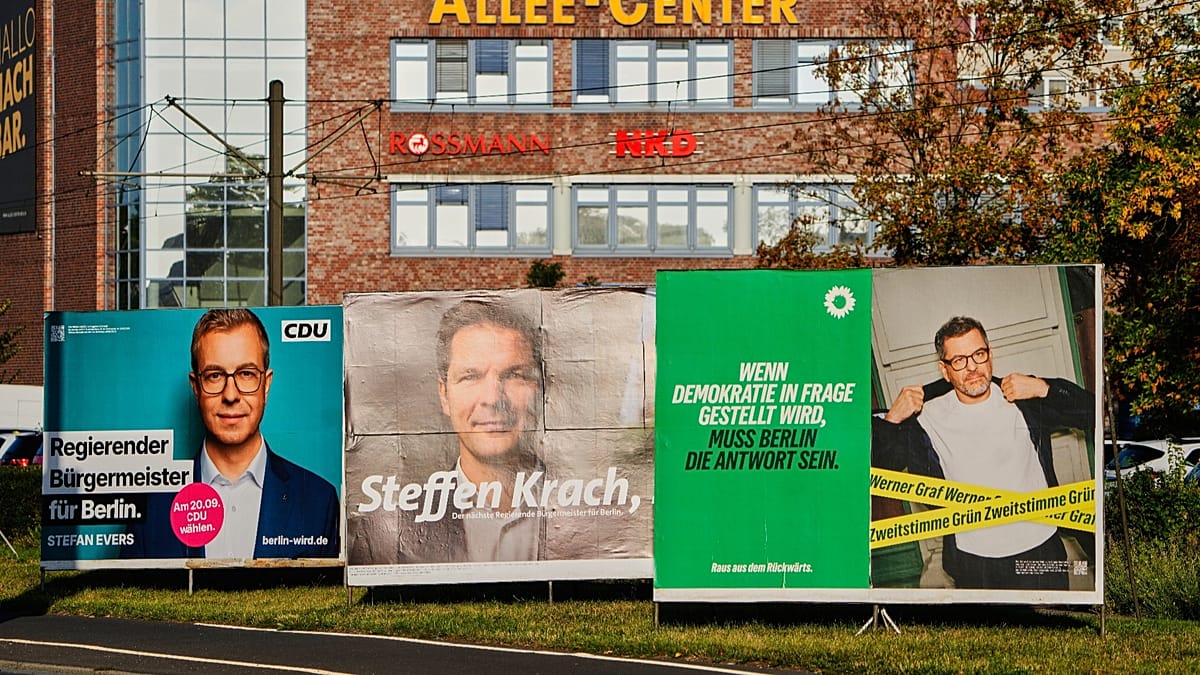
The outcome is far from certain, and the post-election landscape could take several forms. The current governing coalition of the CDU and SPD, known as black-red, would likely lose its majority. The CDU's campaign has been led not by incumbent Governing Mayor Kai Wegner, who stepped aside after months of criticism over his handling of a major power outage in January, but by Stefan Evers, the finance and culture senator. Evers has focused on law and order, administrative efficiency, and economic growth, promising to strengthen the police and judiciary, speed up approval processes, and digitise public administration.
Coalition arithmetic: a delicate puzzle
According to a ZDF projection published on 11 September, the Left stands at 23%, the CDU at 21%, the AfD at 17%, the Greens at 16%, and the SPD at 10%. On those numbers, both a Left-Green-SPD alliance and a CDU-Green-SPD coalition would command a majority. The BerlinTREND survey by Infratest dimap paints a similar picture: Left 21%, CDU 20%, AfD 18%, Greens 16%, SPD 12%. The arithmetic is tight, and the final composition of the parliament will depend on smaller parties crossing the 5% threshold.
The SPD is fighting to remain in government, but its campaign has been hampered by more than just poor polling. Its lead candidate, Steffen Krach, co-chair of the Berlin SPD, is under investigation by the Hanover public prosecutor over allegations linked to a €9,900 donation to the Berlin SPD. Krach denies any wrongdoing and continues to campaign under the slogan "Wieder Berlin" ("Berlin again"). The party's platform focuses on affordable housing, investment, and infrastructure, promising 100,000 new homes over the next legislative period and raising the share of social housing in new-build projects from 30% to 50%.
Housing: the defining issue
Housing is the central issue for nearly all parties. Berlin's Senate Department for Urban Development estimates that more than 100,000 new homes are needed immediately, with an additional 200,000 people expected to move to the city by 2040. That translates into a need for roughly 20,000 new homes per year. The CDU advocates faster construction and more homeownership, while the Greens emphasise common-good housing. The Left calls for bringing large housing portfolios into public ownership, a policy rejected by the AfD and the Free Democratic Party (FDP), which favour private construction and deregulation.
The Left has surged since the 2023 election, when it won just 12.2%. Now polling at 21-23%, it is one of the two strongest forces. Its lead candidate, Elif Eralp, has made rents and social policy her signature issues, calling for the socialisation of large housing stocks and stronger tenant protections. She also wants the state to play a bigger role in public transport, social benefits, and climate policy.
However, the Left's campaign has been overshadowed by a controversy over antisemitism and the Middle East conflict. At a campaign event organised by the Neukölln district branch in late August, rapper Dahabflex performed a song with lyrics including "Yalla Yalla Intifada, Westbank, Palestine, Gaza" and "Death to the IDF." CDU lead candidate Evers accused Eralp of not acting decisively enough against antisemitic tendencies in her party. Eralp rejected the accusation, stressing her commitment to combating antisemitism and protecting Jewish life. The Berlin Left has since adopted guidelines on dealing with antisemitism and, according to Eralp, the party's executive unanimously agreed that the performance was a mistake and that all forms of violence are rejected.
AfD on the rise
The AfD has also made significant gains, nearly doubling its vote share from 9.1% in 2023 to 17-18% in current polls. In the latest BerlinTREND survey, it reached 18%, making it the third-strongest force. The party's rise reflects broader discontent with the established parties, particularly over housing and security.
As Berliners cast their ballots, the city's political future hangs in the balance. The outcome will not only determine who governs the capital but also send signals ahead of the federal election in 2025. With the Left and CDU neck and neck, and the AfD and Greens close behind, the result could reshape the political landscape in Germany's most populous city. For more on regional dynamics, see our coverage of Sweden's centre-left victory and rising public transport costs across Europe.