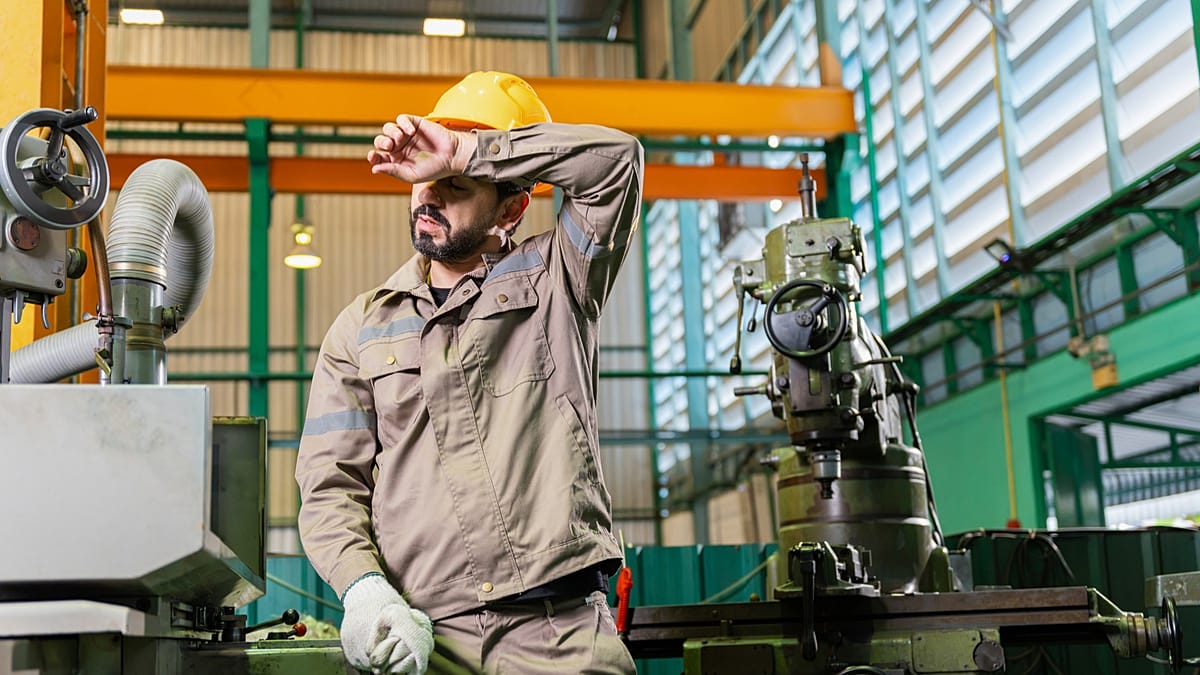
Health and safety at work has long been the foundation of decent employment, but as workplaces evolve, new pressures emerge while old ones linger. Across Europe, a quiet crisis is unfolding: nearly half of workers say their jobs are harming their mental health, yet the subject remains largely unspoken.
William Cockburn, executive director of the European Agency for Safety and Health at Work (EU-OSHA), told Euronews that the biggest barrier to progress is not a lack of solutions but a persistent reluctance to talk. “Whether we're asking employers or workers, they identify a reluctance to speak openly about mental health issues as the … main obstacle to actually taking action,” he said.
The numbers are stark. According to EU-OSHA, 45% of European workers face psychosocial risks on the job—long hours, intense workloads, emotionally demanding tasks—and 44% report severe time pressure or overload. The European Trade Union Institute (ETUI) estimates that work-related depression costs the EU more than €100 billion annually, once absenteeism, lost productivity, and healthcare and social costs are combined.
Despite the economic burden, stigma continues to slow change. Cockburn argues that mental health must be treated with the same seriousness as physical safety. “We identify hazards like long working hours, like adverse relationships at work … to an extreme you can go to bullying and harassment, violence or threats of violence,” he said. The approach, he insists, is to assess risks first and then adapt the workplace to minimise harm.
Prevention starts with risk assessment, not blame
Esther Lynch, general secretary of the European Trade Union Confederation (ETUC), stresses that prevention should focus on the workplace, not the individual. “We don't wait until people have a finger chopped off before we put guardrails in place,” she said. “We do a risk assessment and say what's the risk associated with the way this work is carried out and then we put the guardrails in place.”
That logic, long applied to physical hazards, is now being extended to psychological ones. Yet only 45% of workers say they are consulted about the stressful aspects of their jobs, according to EU-OSHA. Cockburn points out that “worker participation is a legal obligation under European law, but it's also a key success factor for successful interventions in health and safety at work.”
This week, the European Commission launched the Healthy Workplaces campaign, an initiative designed to help employers prevent, assess, and manage psychosocial risks. At the launch on Tuesday, Roxana Mînzatu, executive vice-president for social rights and jobs, framed the issue as a win-win: “When we invest in building and keeping healthy working environments, we improve not only people's well-being, we reduce sick leave and staff turnover; we improve performance, and we don't put pressure on our health systems.”
The campaign aims to break the silence that has long surrounded mental health in European workplaces. For Cockburn, the path forward is clear: treat mental health like any other safety issue—assess, adapt, and involve workers in the solution. Only then can Europe's workforce, already stretched by staff shortages and an ageing population, begin to recover.