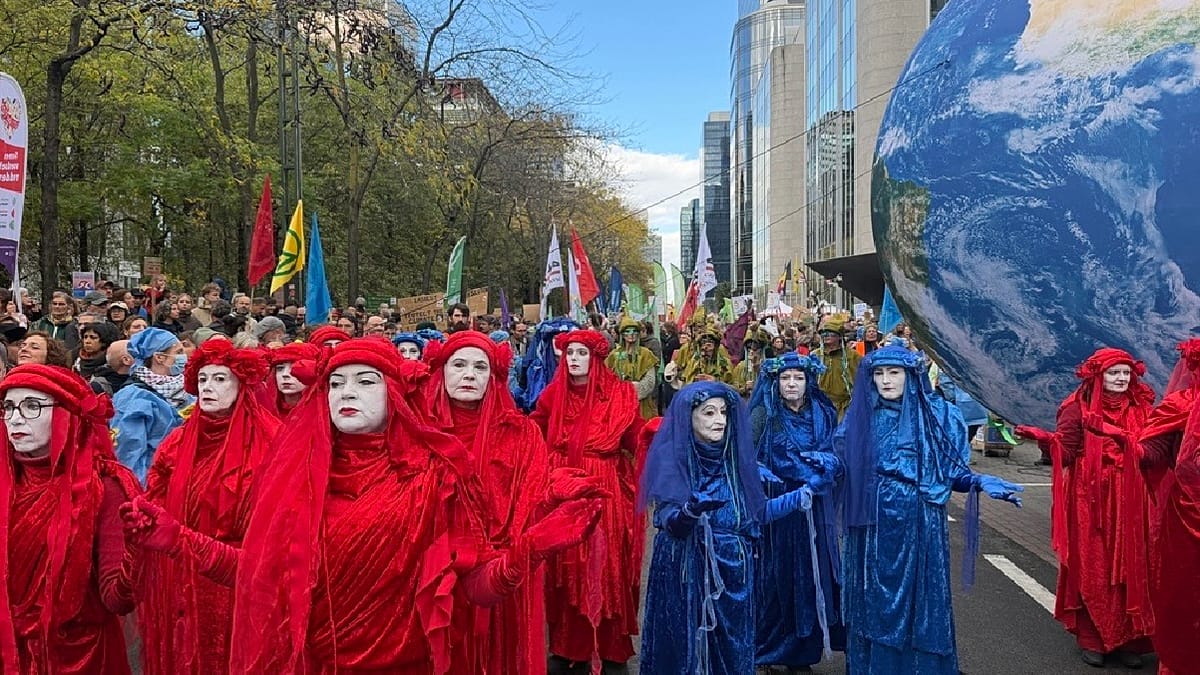
Tens of thousands of demonstrators filled the streets of Brussels on Sunday, converging on the European Union's institutional quarter to press the bloc for bolder climate policies. Police counted roughly 45,000 participants; organisers from the Climate Coalition put the figure closer to 60,000. The march was the latest in a series of climate protests staged in the Belgian capital, and it unfolded against the backdrop of a summer of record heat across much of the continent.
The timing is pointed. Delegates will gather in the Turkish resort city of Antalya next month for the annual COP summit — COP31 — but expectations are muted. The United States, under Donald Trump, has withdrawn from the process, and European governments have been steadily trimming their own environmental ambitions. The result is a negotiating round that many observers expect to produce little of substance.
Five demands, one message
The Climate Coalition, working with groups including Groen, Flanders' green party, set out five core demands: phasing out subsidies for fossil fuels and taxing the sector; expanding green spaces; ensuring a fair climate transition; supporting households and businesses in moving away from fossil fuels; and strengthening international cooperation on climate.
Aimen Horch, who leads the Green Party in Flanders and Brussels, told Euronews that the demands themselves have not changed — but the sense of urgency has. "People actually died from the heat," Horch said, pointing to excess deaths recorded in Belgium during this summer's heatwaves. "They felt that the conditions of their homes made it impossible to sleep at night. They saw the wildfires in the High Fens, one of the country's most important nature reserves, and saw that the government did nothing."
Belgium, like several of its neighbours, saw an unprecedented spike in excess mortality during the extreme heat that swept Europe this summer. For many at the march, that toll — combined with the fires in the High Fens — has sharpened a sense that climate policy is slipping down the political agenda even as its consequences become more tangible.
"We have to fight in the European Parliament and here in Belgium to make sure climate stays on top of the agenda, because the urgency is not gone. The heatwaves are not gone. The impact of climate change on people's daily lives is not gone." — Aimen Horch, Green Party leader in Flanders and Brussels
That frustration was echoed across the crowd. Etienne de Callatay, an economist who joined the march, argued that politicians should not fear voters for taking bold environmental decisions. "There is a great deal of concern among the population, not just among the protesters today," he said. "The extreme heat we experienced this summer is something everyone was aware of."
Aurore Schreiber, who works for a development cooperation NGO, attended with her family. "We need to listen to the demands of young people and the most vulnerable," she said. "We need greener, fairer supply chains that take into account workers' issues and wages."
The EU's diminished COP31 ambitions
Brussels arrives at COP31 in an awkward position. The EU continues to present itself as the global leader on climate action and remains the largest international donor in the field. Yet it has recently softened its own environmental legislation, and the political mood in several member states has turned more business-friendly as governments try to keep pace with China and the United States.
The most recent illustration came last month, when the European Commission proposed delaying the implementation of a law targeting methane — a particularly potent greenhouse gas — by a year, from 2027 to 2028. The move followed a disappointing outcome at last year's COP in Brazil, where the EU had hoped for a more ambitious agreement.
Compounding the difficulty, surging energy prices have strengthened the hand of major oil and gas producers, making them less inclined to entertain discussions about phasing out fossil fuels. With Washington disengaged, the diplomatic pressure that once pushed negotiations forward has largely dissipated.
Sunday's demonstration in Brussels fits a broader pattern of protest in the Belgian capital, where austerity measures and social policy have also drawn large crowds in recent months. But the climate marchers were clear that their concerns are not separate from those debates: a fair transition, they argue, means protecting workers and vulnerable households while cutting emissions — not choosing between the two.
Whether that message reaches the negotiating rooms in Antalya remains to be seen. For now, the organisers have succeeded in putting tens of thousands of people on the streets of the EU's de facto capital — a reminder, as Horch put it, that the urgency has not gone anywhere.



