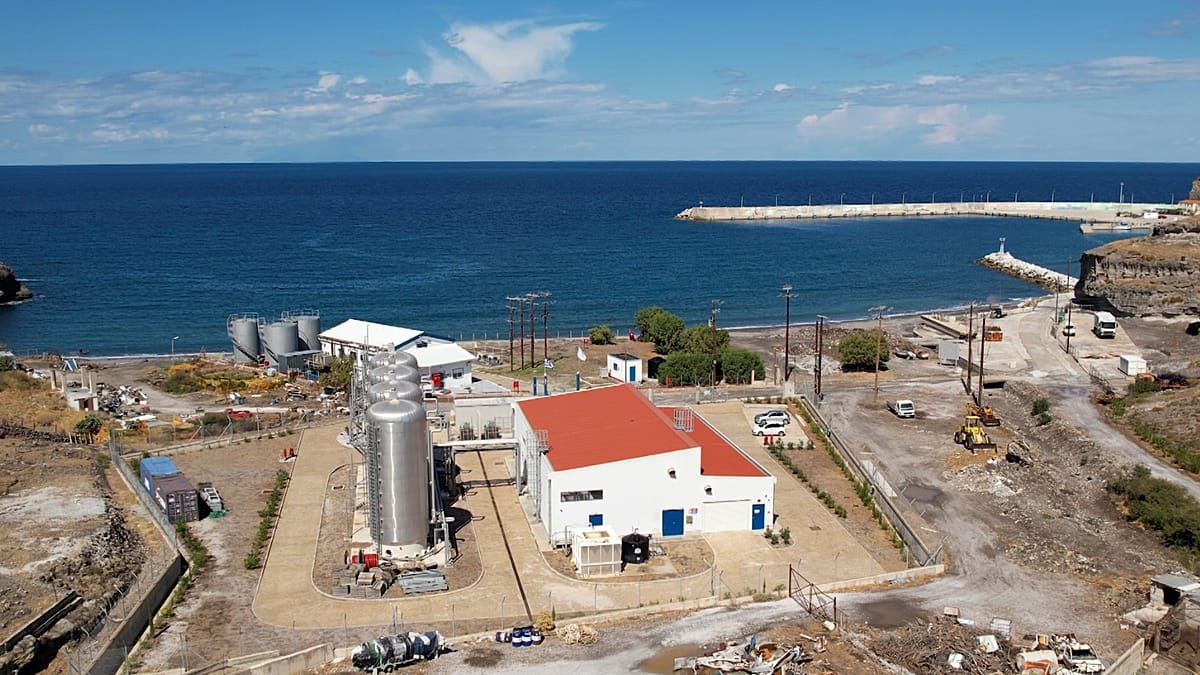
On the small Aegean island of Agios Efstratios, the shift from diesel to renewable energy has brought electricity costs down to levels comparable to the Greek mainland. Dimitrios Kardomateas, chief executive of the Centre for Renewable Energy Sources and Saving (CRES), recalls the island's former dependence on diesel generators: “Before, 100% of electricity was produced from diesel, using diesel engines. In addition to producing CO₂ emissions, the cost was very high, about three or four times the cost on the mainland.” That burden hit both the environment and the islanders' wallets, and the same applied to heating buildings.
The Ai Stratis – Green Island pilot project, launched with EU support, set out to change that. Its carefully calibrated goals were to cover 85% of electricity needs and 75% of heating needs with renewables. In the first ten months of operation, the results exceeded expectations: 91% of electricity and 85% of heating demand came from renewable sources. Kardomateas calls this “a very positive result.”
What happens when the wind doesn't blow?
Agios Efstratios does not yet run entirely on green energy, and that was never the plan. The island's hybrid system combines wind turbines, solar panels, and battery storage, but it still keeps a diesel backup for rare stretches of calm, cloudy weather. “Maybe over the years we will cover 100% of needs at certain points,” Kardomateas explains. “But if there are some days of prolonged absence of wind, combined with cloudiness, the renewable energy sources will be offline. Therefore, in those rare cases, the island will need to have an alternative, using conventional diesel, but the goal is for its use to be less than 10% throughout the year.”
That pragmatic approach—maximising renewables while keeping a small fossil-fuel safety net—is central to the project's replicability. Kardomateas is optimistic that the model can be adapted to other Greek islands and beyond. The European Union has been pushing for faster clean-energy adoption across its member states, and islands like Agios Efstratios offer a testing ground for integrating variable renewables into small, isolated grids.
The cost savings are striking. Before the project, each kilowatt-hour cost three to four times more than on the mainland, a heavy burden for residents and businesses. Now, with renewables covering the bulk of demand, the cost has dropped to near mainland levels. That economic argument, Kardomateas suggests, is just as persuasive as the environmental one.
The success of Agios Efstratios comes at a time when energy security is high on Europe's agenda. The ongoing war in Ukraine has underscored the risks of fossil-fuel dependence, and Brussels has been exploring ways to frame its climate diplomacy around energy security. Meanwhile, some member states are urging the EU to ease carbon rules to protect industry during the energy crisis—a reminder that the transition must balance climate goals with economic realities.
For Greece, the project is part of a broader push to decarbonise its islands, many of which still rely on expensive, polluting diesel. The country has set ambitious targets for renewable capacity, and the experience from Agios Efstratios could inform similar initiatives elsewhere in the Mediterranean and beyond. Kardomateas is confident that the model can be scaled up, though he acknowledges that each island has its own characteristics—wind patterns, grid size, and local acceptance all play a role.
Local support was crucial from the start. Kardomateas notes that leaders needed the backing of the island's population to make the transition work. That meant not only installing new infrastructure but also convincing residents that the change would bring tangible benefits—cheaper electricity, cleaner air, and greater self-sufficiency. The project's success suggests that when communities see those benefits, they are willing to embrace change.
As Europe looks to cut greenhouse-gas emissions and reduce its reliance on imported fossil fuels, small islands like Agios Efstratios offer a glimpse of what is possible. They are not just testbeds for technology but also for the social and economic dynamics that determine whether a transition succeeds. The island's achievement—cutting costs while slashing emissions—is a reminder that the green transition can deliver both environmental and economic dividends.



