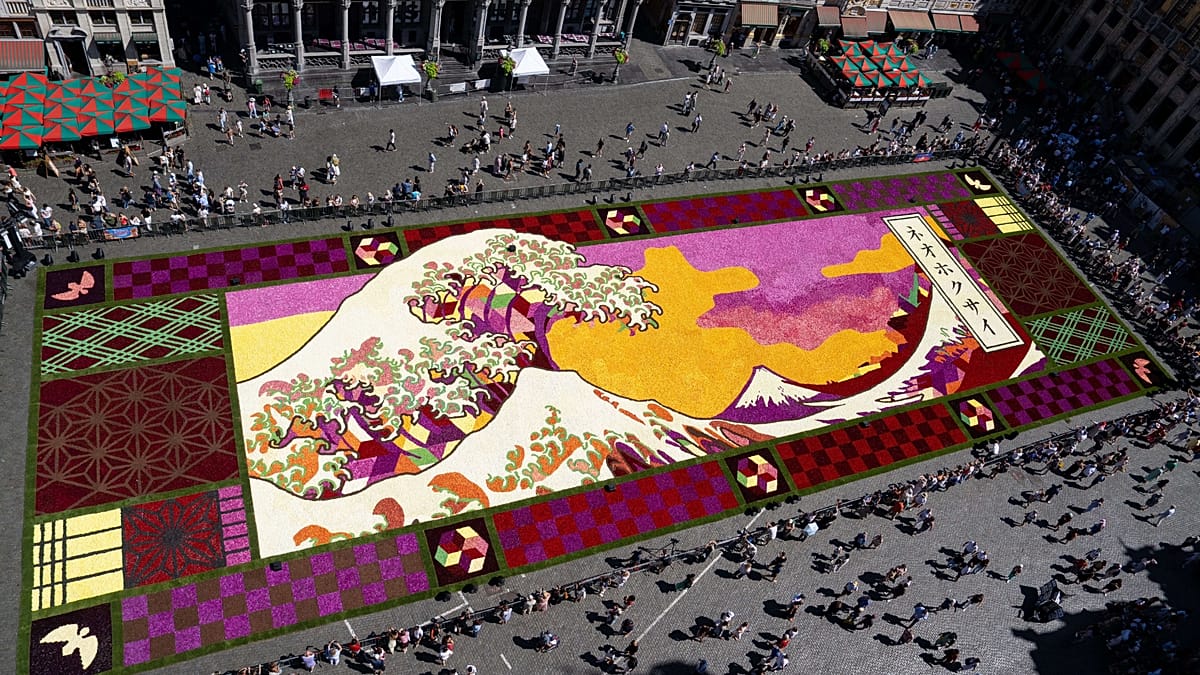
Every two years, Brussels' Grand Place undergoes a remarkable transformation, and this summer is no exception. The UNESCO-listed square has been covered with a sprawling floral mosaic inspired by Katsushika Hokusai's iconic woodblock print, The Great Wave off Kanagawa. The installation, which opened to the public this week, uses roughly 500,000 dahlias arranged across 1,300 square metres of cobblestones, turning the medieval heart of the Belgian capital into a vibrant homage to Japanese art.
A floral tribute to a timeless masterpiece
The design recreates the dramatic curl of the wave, with its frothy white crests rendered in pale and cream dahlias, while the deep blue of the sea is evoked through rich violet and indigo blooms. The composition also nods to Mount Fuji in the background, using subtle gradients of green and yellow. The choice of Hokusai's work is deliberate: the print, created in the early 1830s, is one of the most recognised images in global art history and has long been a symbol of cultural exchange between Japan and Europe.
Organisers say the project required weeks of preparation. The dahlias were grown by Belgian horticulturalists and arranged by a team of volunteers and designers who worked through the night to lay the carpet in time for the opening. The result is a temporary artwork that blends botanical precision with urban spectacle, drawing thousands of visitors to the square each day.
The flower carpet is a biennial tradition in Brussels, first launched in 1971. Over the decades, it has featured designs ranging from Mexican folk art to European baroque patterns. This year's Japanese-inspired theme also coincides with a broader cultural moment: several European museums have recently explored the influence of Japanese aesthetics on Western art, and the Prado's AI video reimagining masterpieces under eclipse light shows how technology is reshaping the way audiences engage with classical works.
Practical details for visitors
The carpet will remain in place for just a few days, as the dahlias are sensitive to heat and foot traffic. Viewing platforms around the Grand Place offer elevated perspectives, allowing visitors to fully appreciate the scale and detail of the design. Local authorities recommend visiting early in the morning or in the evening to avoid the largest crowds.
Brussels is no stranger to large-scale public art, but the flower carpet remains one of its most beloved spectacles. The event also draws attention to the city's broader cultural calendar, which this year includes exhibitions on Japanese woodblock prints at the Royal Museums of Fine Arts and a series of concerts celebrating the 150th anniversary of diplomatic relations between Belgium and Japan.
For those unable to make the trip, the organisers have released a series of high-resolution images and a virtual tour on the city's tourism website. The carpet is also being documented by drone, with footage expected to be shared across social media channels in the coming days.
The choice of Hokusai is particularly resonant in a year when Europe is reflecting on its own cultural ties with Asia. As the EU deepens its engagement with Japan through trade and diplomatic agreements, the flower carpet serves as a colourful reminder of the soft power that art can wield. It also underscores the importance of cultural preservation, a theme that resonates across the continent, from the restoration of historic sites to the debates over Europe's environmental resilience.
While the carpet is ephemeral, its impact is lasting. For the thousands of visitors who will pass through the Grand Place this week, the image of Hokusai's wave rendered in petals will linger long after the dahlias have wilted. It is a testament to the enduring power of art to transcend borders and generations, and a reminder that even in the heart of Europe, the echoes of distant cultures can find a vibrant home.