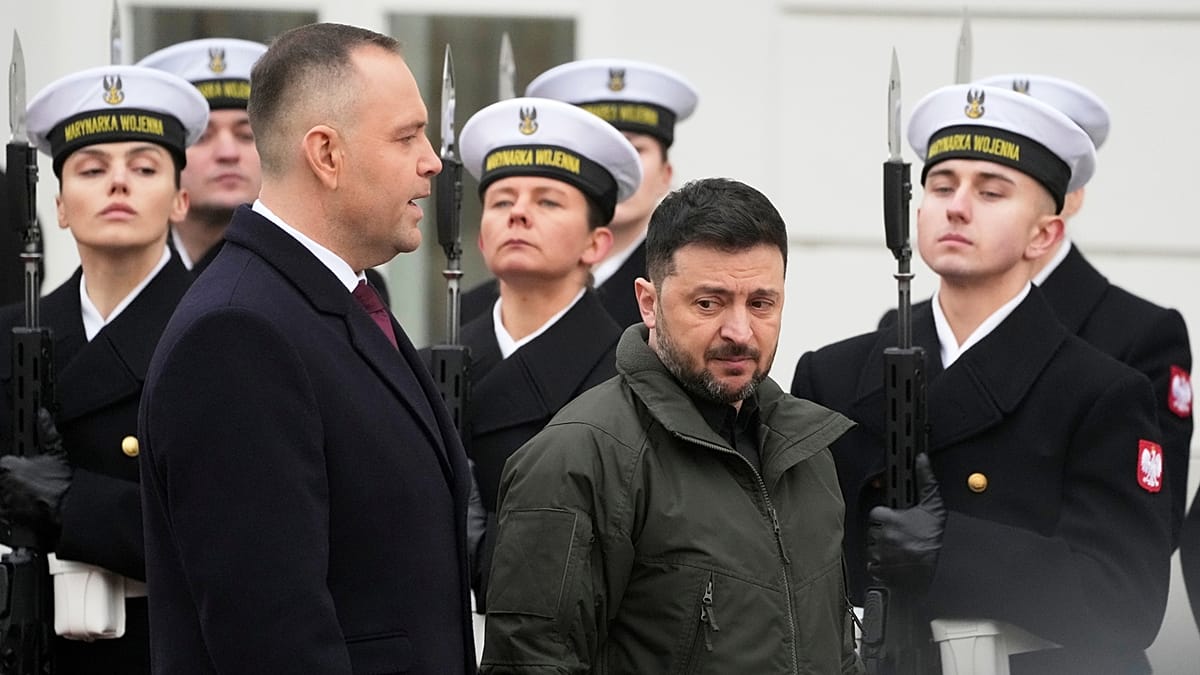
Brussels has issued a sharp rebuke as tensions between Warsaw and Kyiv escalate over historical grievances, warning that the public spat plays directly into the hands of the Kremlin. Paula Pinho, the European Commission's chief spokesperson, told journalists on Tuesday that any dispute between a member state and Ukraine is “not helpful” and that “there is only one happy observer in this type of situation, and that's the aggressor in Ukraine.”
The friction erupted in late May when President Zelenskyy signed a decree naming a military unit after the Ukrainian Insurgent Army (UPA), a decentralized guerrilla movement that fought during World War II. While the UPA is celebrated in Ukraine for resisting Soviet domination and pursuing independence, in Poland it is widely condemned for the massacres of ethnic Poles in Volhynia and Eastern Galicia—events that Warsaw officially recognizes as genocide.
A Symbolic Escalation
Polish President Karol Nawrocki, a nationalist, responded by announcing on Friday that he would strip Zelenskyy of the Order of the White Eagle, Poland's highest civilian honor. Nawrocki called the move a “warning signal” and declared that “there are boundaries that must not be crossed in Polish-Ukrainian relations.” The following day, Zelenskyy posted a photo on social media appearing to show the medal being shipped back to Warsaw, while other Ukrainian figures returned their Polish decorations in solidarity. Zelenskyy stated that “such a symbol requires not only merit, but also respect for the values that form the foundation of our community.”
Polish Prime Minister Donald Tusk, who has frequently clashed with Nawrocki, described the confrontation as a “strategic mistake that will cost both sides.” The bitter exchange comes just days before Poland is set to host the Ukraine Recovery Conference in Gdańsk, a key event for coordinating international support for Ukraine's reconstruction. Zelenskyy, who was originally expected to attend, will now skip the ceremony, with Deputy Prime Minister Yuliia Svyrydenko leading the Ukrainian delegation instead.
The European Commission confirmed that President Ursula von der Leyen will attend the conference as planned and offered to mediate between the two sides. “We stand ready to do all necessary to make sure that this does not stand in the way of a good conference in Gdańsk later this week,” Pinho said, adding that the Commission is “confident that this will be solved.”
The row underscores the delicate balance between historical memory and strategic unity in the face of Russian aggression. As the war in Ukraine grinds on, Brussels is keenly aware that internal divisions among EU member states and their neighbors only serve Moscow's interests. The incident also highlights the broader challenge of reconciling national narratives within the European project—a theme that resonates beyond this bilateral dispute. For context, similar tensions have emerged in other contexts, such as the recent EU's internal power struggle over foreign policy.
While the immediate focus is on the Gdańsk conference, the longer-term implications for EU-Ukraine relations are significant. Poland has been one of Ukraine's staunchest allies since the full-scale invasion began in 2022, providing military, humanitarian, and political support. Any erosion of that solidarity could weaken the broader coalition backing Kyiv. The Commission's intervention is a clear signal that Brussels expects both sides to prioritize the common goal of countering Russian influence over historical grievances.