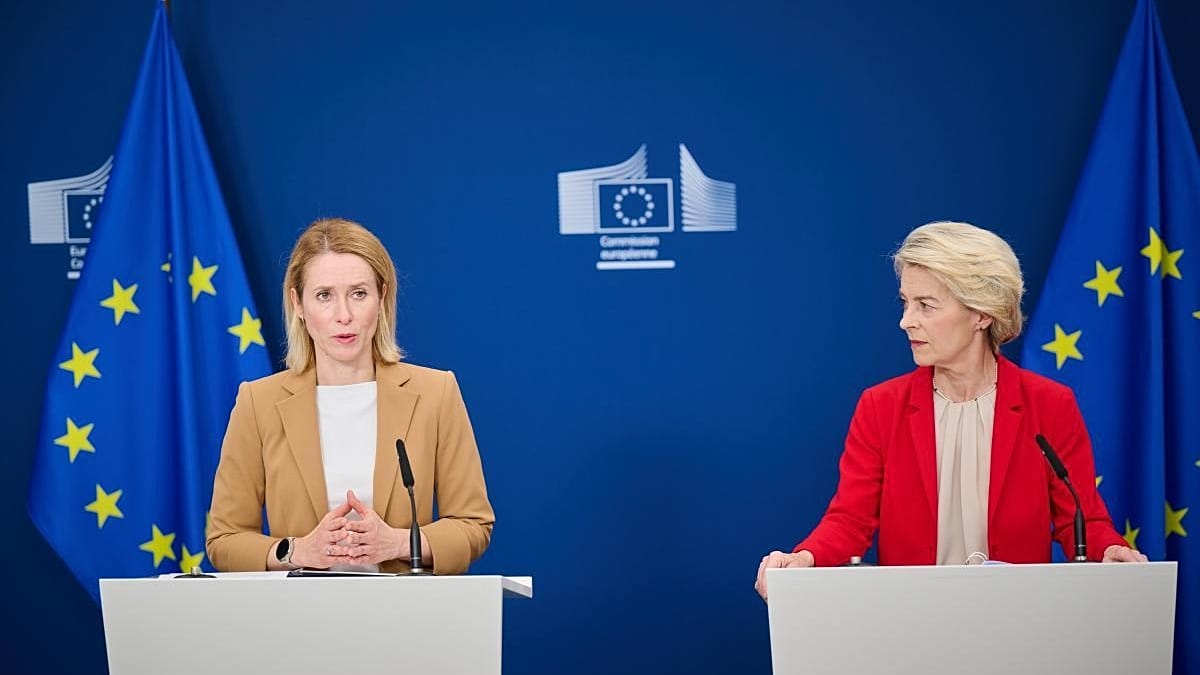
An unannounced visit by European Commissioner Dubravka Šuica to Israel has exposed a deepening institutional struggle within the European Union over foreign policy, with the bloc's relations with Israel serving as the primary battleground. The trip, which caught several EU capitals off guard, comes amid a public spat between Israel's foreign minister Gideon Sa'ar and the EU's top diplomat Kaja Kallas, and underscores a growing rivalry between the European Commission and the European External Action Service (EEAS).
Šuica, the Commissioner for the Mediterranean, travelled to Israel on Monday, a journey that the Commission's spokesperson later described as long-planned but which was not listed on her official webpage. Chief spokesperson Paula Pinho could not explain the lack of communication, merely stating that “they will look into that.” The timing was particularly sensitive: it followed Sa'ar's decision to sever all contact with Kallas after media reports alleged she had compared Israel to apartheid-era South Africa. Kallas's team had questioned the timing of the visit, urging unity, but the trip went ahead regardless.
A Pattern of Independent Action
This is not the first time Šuica has diverged from the EU's chief diplomat. She was the only EU institutional representative to join the Board of Peace, a US-led initiative for Gaza launched by President Donald Trump, which most EU member states boycotted as a rival to the United Nations. EU diplomats, speaking on condition of anonymity, told Euronews that these moves are not personal but part of a broader Commission strategy to assert control over foreign policy. “Šuica has von der Leyen's backing to take these initiatives. That's no secret,” one diplomat said. “The question is what damage that does.” Another added that the trip sends a clear message to Kallas: “that von der Leyen does not need her.”
The Commission's expansion into geopolitics has been systematic. Earlier this month, selective media reports suggested key member states were considering curtailing the EEAS's role, though that was just one option among several, including strengthening the high representative's position. The creation of Šuica's Directorate-General for the Middle East, North Africa and the Gulf (DG MENA) at the start of this Commission's term was explicitly designed to absorb foreign policy competences, effectively competing with the EEAS's traditional turf.
Diverging Policies on Israel
Israel has become the clearest example of this institutional competition. MEP Hildegard Bentele (EPP/Germany), chair of the EU-Israel delegation, welcomed the fact that Kallas is not the sole voice on external relations. “Instead of disturbing rhetoric about Israel from HRVP Kallas, I appreciate and fully support the responsible, practical, constructive and open approach of Commissioner Šuica,” Bentele told Euronews. In contrast, most EU member states, backed by Kallas, have pressed the Commission to impose trade restrictions on Israeli settlements in the occupied Palestinian territories. MEP Lucia Annunziata (S&D/Italy) accused the Commission of “obstructionism on any measures against Israel,” citing lengthy delays on suspending the association agreement. “Things are now slowly moving, probably because of pressure from the member states,” she added.
Last week, EU leaders endorsed a statement calling on the Commission to present options by the next foreign affairs ministers' meeting on 13 July. Commission spokesperson for trade Olof Gill declined to speculate on what those options might entail. The Kallas-Israel spat has further exposed these divisions, with Sa'ar effectively taking a swipe at Kallas during a press point on Monday, prompting several EU diplomats to reproach Šuica for not defending her colleague. Josep Borrell, Kallas's predecessor, who clashed repeatedly with Commission President Ursula von der Leyen over Israel, wrote on X: “What a fine display of 'solidarity and coordination' in the EU.”
Structural Tensions, Not Personal Rivalry
Diplomatic sources stress that these tensions are structural, not personal. The role of the Mediterranean Commissioner appears designed to compete with the EEAS, allowing the Commission to step into foreign policy matters when it deems appropriate. “The Commissioner has a portfolio of her own, and must be able to work on her topics,” a third diplomat acknowledged, noting that these questions were taken away from the EEAS at the start of the mandate. However, critics argue that the overall effect is to undermine the bloc's coherence in foreign policy, a domain where European governments are seldom fully aligned. The Sa'ar call for dialogue highlights the challenge of presenting a unified European stance.
As the EU grapples with crises from the Middle East to Ukraine, the institutional battle over who sets foreign policy risks weakening its global influence. The Commission's push for greater control, exemplified by Šuica's independent initiatives, may offer flexibility but at the cost of coherence. For now, Israel remains the test case for whether the EU can reconcile its internal divisions or whether the rivalry between Brussels and the EEAS will become a permanent feature of European diplomacy.