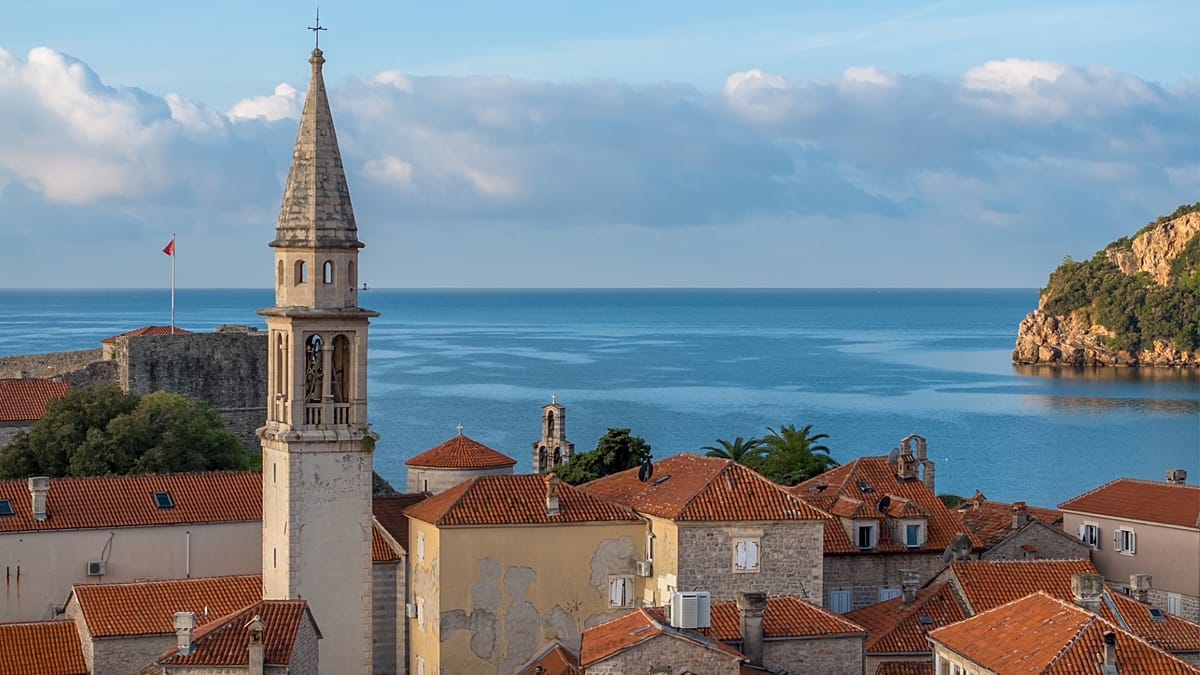
The drive to Budva in high summer is both disconcerting and fascinating. On one side, the Adriatic lies calm and brilliant; on the other, Montenegro's mountains press close to the shoreline. Between them, a road that in July and August struggles under the weight of cars, buses, and holidaymakers heading to one of Europe's fastest-rising coastal destinations.
Budva embodies this transformation. The town pairs a walled medieval core with beaches, hotels, terraces, and a nightlife that keeps going until dawn. In summer, the streets fill with visitors, and after sunset the seafront promenade shifts character entirely: music spills from bars, terraces are packed, and groups of young people roam until the early hours. For a Spanish traveller of a certain generation, the atmosphere may feel oddly familiar—like an endless holiday that never quite ends.
This is the other face of Montenegro, a contrast to the quieter image of its bays, mountains, and small fishing villages. Yet just a few minutes' walk from the bustle lies the Stari Grad, the old town. Behind its walls, a maze of narrow stone streets, small squares, churches, and shops speaks to a history that ranks among the oldest settlements on the Adriatic. Exploring at sunset reveals the duality that explains much of Budva's appeal: a morning on the beach, an afternoon wandering medieval lanes, and an evening in a resort that barely sleeps.
International hotel groups move in
The boom has not gone unnoticed by global hotel chains. Spanish group Iberostar, for instance, has expanded its presence in Montenegro, a country keen to establish itself as an up-and-coming Adriatic destination. The company now runs four properties in the country, two of them in Budva—a significant footprint in a market still small compared with other Mediterranean hotspots but increasingly attractive to international tourism.
One example is the Iberostar Waves Slavija 5*, located 1.5 kilometres from Budva's old town. Its rooftop infinity pool and bar offer sweeping views over the city, the Adriatic, and the mountains that frame the coastline. But Iberostar's presence matters beyond any single hotel. The arrival of a Spanish chain with four properties signals the broader transformation of Montenegro as an emerging European destination. The coast is evolving toward a more international hotel offering, especially around Budva, while trying to preserve what sets it apart: the extraordinary proximity between sea, historic towns, and a mountainous landscape that begins almost where the water ends.
Sveti Stefan: from fishing village to tourist icon
A few kilometres from Budva lies one of Montenegro's most recognisable images. Sveti Stefan is a small historic settlement on an islet linked to the mainland by a narrow isthmus. Its stone houses and reddish roofs, surrounded by the Adriatic, have become a postcard view for the country. What was once a fishing community underwent a profound transformation from the mid-20th century onward, becoming an exclusive tourist enclave and an international symbol. The views from the coast and nearby viewpoints are among the most spectacular on the Adriatic—a near-motionless sea set against a rugged, mountainous shoreline.
Yet driving that coastline also reveals one of the main problems created by Montenegro's rapid tourism growth. In summer, road travel can be unbearably slow. The coastal road carries enormous traffic volumes, and jams are common; journeys that look short on the map can take much longer in July and August. For those flying in, Budva has an advantage: Tivat airport is just a short drive away, offering an easy gateway. But another challenge is the border crossing with Croatia, where travellers by road can wait around two hours in peak season. It is hardly the best welcome for visitors, and it underscores the infrastructure strains that come with success.
Montenegro's EU path, meanwhile, remains a topic of quiet diplomatic friction, as Belgrade's resistance complicates the country's integration hopes. For now, though, the tourism boom continues, drawing Europeans from across the continent—and beyond—to this sliver of Adriatic coast.