The European Union is preparing to unveil a new Arctic strategy that includes plans for a secure submarine cable connecting Greenland directly to Europe, with a longer-term vision to extend the network through Canada to Japan and South Korea. The draft document, seen by Euronews, underscores how digital infrastructure in the High North has become a strategic priority for Brussels.
"The EU is working on a Pan-Arctic Cable concept that will connect Europe to Japan and South Korea via Greenland and Canada. In the coming years, the EU will connect Greenland to the European Union with a sovereign and secure submarine cable," the strategy states. The plan is expected to be formally presented on 20 October.
The initiative reflects a broader shift in thinking among European governments: undersea telecommunications cables are no longer just commercial assets but critical components of national and collective security. With roughly 17 submarine cables crossing the North Atlantic, and US tech giants dominating much of the infrastructure, European officials are increasingly worried about dependence on systems that could be disrupted during a crisis.
Security concerns in the Arctic
The security environment in the Arctic has deteriorated markedly. Russia has expanded its military footprint across the region, and European capitals are on alert for hybrid threats, including interference with satellite navigation and sabotage of undersea infrastructure. These concerns have been amplified by recent incidents, such as the suspected damage to Baltic Sea cables, which have prompted NATO and the EU to step up monitoring.
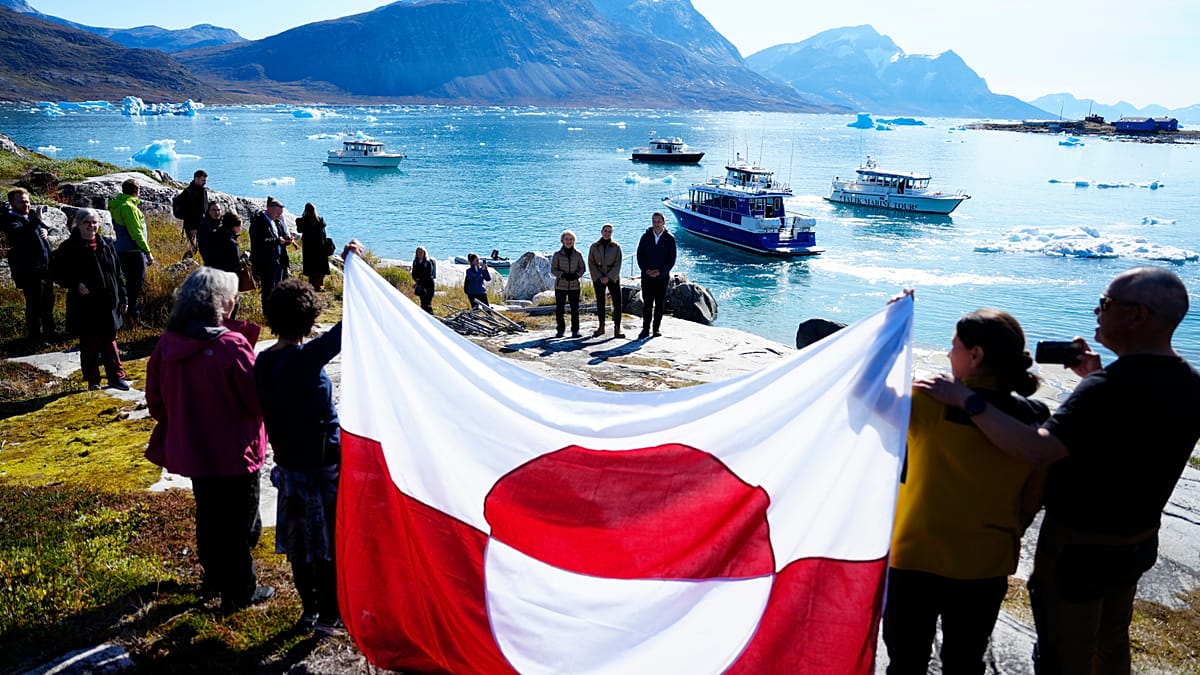
Washington's renewed interest in Greenland has added another layer of geopolitical tension. The autonomous Danish territory sits strategically between Europe and North America, and its role in transatlantic security is growing as competition over Arctic resources, shipping routes, and military access intensifies. For Brussels, a direct digital link with Greenland would not only improve connectivity for remote communities but also give the EU a tangible stake in the region's infrastructure.
"The new submarine cable routes will enhance the access of Arctic communities as well as boost resilience and redundancy in Europe's digital connectivity," the draft strategy reads. "Such connection is a pre-condition for further investments highly relevant for both competitiveness, inclusion, preparedness and defence."
The proposed extension towards Asia through Canada adds a strategic dimension that goes beyond simple connectivity. Rather than treating Greenland as an isolated challenge, the EU is exploring how Arctic infrastructure could form part of a wider network linking European and Asian economies. However, the strategy does not settle key questions about financing, ownership, or construction timelines.
Funding and feasibility
The EU has already earmarked €107 million for connectivity projects involving Greenland, so the cable would build on existing commitments. The European Commission had previously floated the idea of co-financing Far North Fibre, a subsea cable project in the Arctic estimated to cost around $1.15 billion, but it received only about €11 million in EU support.
Any extension towards Japan and South Korea would require coordination with partners outside the EU, and the strategy acknowledges the need for cooperation with Canada and other like-minded nations. The document also proposes the creation of an Arctic Cable Hub for EU countries, Norway, and Iceland, to monitor, protect, and repair submarine cables in the North Atlantic-Arctic. Such a hub would likely require an enhanced icebreaker fleet.
Indeed, the EU's Arctic ambitions extend beyond cables to the vessels needed to operate in increasingly contested waters. At an Arctic Summit in September, the EU's special envoy for the region, former Finnish Prime Minister Jyrki Katainen, warned of a critical shortfall in European icebreaker capabilities. German Chancellor Friedrich Merz echoed that sentiment, saying, "This is not just an issue for Finland, for Norway, for Sweden. This is something for the entire European Union, for the entire European continent."
The strategy therefore vows to establish an EU Industrial Maritime Value Chains Alliance to map icebreaking needs, manufacturing capacity, and technical specifications. It also outlines options for joint procurement and pooling of icebreaker capabilities among member states and partners.
While the vision is ambitious, the practical hurdles remain significant. Technical feasibility, commercial demand, and financing will determine whether the Pan-Arctic Cable becomes a reality. But the strategic direction is clear: Europe is seeking to reduce its vulnerability in the digital domain, and the Arctic is emerging as a frontline in that effort.
For more on how European firms are grappling with a broader range of security threats, see our analysis on widening security threats beyond cyberattacks. The EU's push for Arctic connectivity also echoes concerns raised by a UN adviser about AI data centre security, highlighting the growing importance of resilient digital infrastructure.