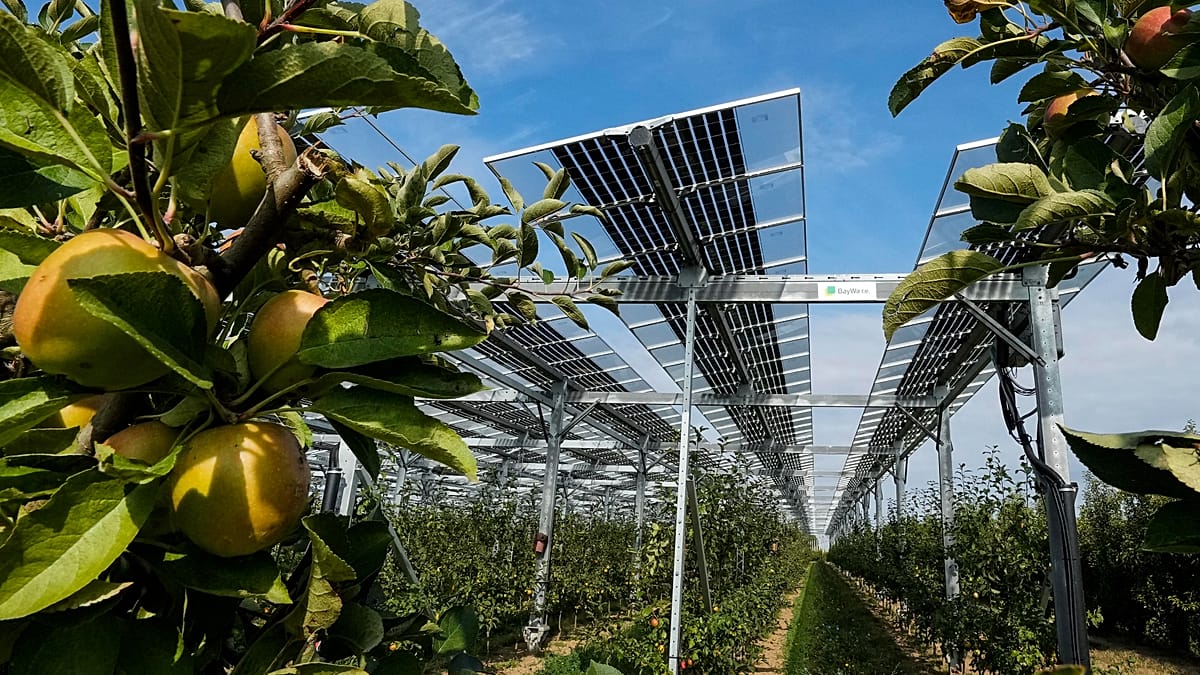
In the sun-scorched fields of Murcia, southeastern Spain, rows of photovoltaic panels now shade bell peppers, wine grapes, and even dragon fruit. This region, long dependent on agriculture and blessed with abundant sunshine, is testing whether food production and solar energy can share the same land rather than fight over it.
Agrivoltaics—also known as agri-PV—involves mounting solar panels above, between, or at the edges of crops. “It’s the integration of food production with renewable energy production,” explains Silvia Tomasi, senior researcher at Eurac Research in Italy. A 2023 study estimated that Europe could theoretically generate 25 times its current electricity demand through agrivoltaics alone.
Yet solar power is not without its own environmental and social costs. It requires more land per unit of electricity than most other energy sources, sparking conflicts in rural areas where arable land is precious. “Agrivoltaics has great potential: both economic benefits and environmental ones,” Tomasi says. “But then it’s always a matter of how the technology is implemented and who really benefits.”
Governments and Big Tech turn to agrivoltaics
The idea of turning southern Europe into a solar powerhouse gained a high-profile endorsement in January, when Elon Musk suggested that sparsely populated areas of Spain and Sicily could theoretically generate enough solar power for the entire continent. Big Tech has already moved in. In southern Italy, Amazon and Apple have signed power purchase agreements (PPAs) with large-scale agrivoltaic projects totaling over 150 megawatts—enough to supply roughly 100,000 Italian households annually.
European institutions are backing the shift with money. The EU-funded AGRISOL project plans to invest €1.9 million in agrivoltaic installations in Italy and Spain, while Italy alone has secured €1.7 billion in state aid for the initiative. “For now, it’s just a minimal contribution,” says Angelo Gentili, national secretary of Legambiente, Italy’s largest environmental organisation. “But if it expands, it will represent a big impulse for decarbonisation goals.”
Managing the impact on crops and land
To prevent agrivoltaics from becoming a backdoor for land speculation, EU and national rules increasingly require that agriculture remains a meaningful part of any solar project. In France, projects must maintain at least 90% of crop production compared to local reference yields. Italy mandates that at least 70% of the area stays dedicated to farming.
Experts argue that not every combination of solar and agriculture should qualify. “More than a definition, what we really need is a classification,” says Pilar Flores, who coordinates an EU-funded agrivoltaics project at the Murcian Institute for Agricultural and Environmental Research and Development (IMIDA). She insists that protecting agriculture should drive all classifications: “The key is to ensure there’s minimal loss of arable land.”
Why use farmland at all when there are empty or abandoned plots? Flores points out that the requirements are similar—relatively flat, near the grid—but unused land may hold ecological value. “It’s not just a simple calculation of how much free land is left,” she says.
How agrivoltaics can benefit farmers
In some cases, agrivoltaics have been shown to improve water-use efficiency, shield crops from extreme weather, and boost overall land productivity. Solar panels can also help farmers adapt to climate change. “Excessive rainfall and heat have heavily damaged agricultural fields, pushing farmers to abandon farmland,” says Gentili. “Agrivoltaics represent a great instrument to avoid land abandonment and profit gaps for farmers.”
The shade cast by panels can reduce evaporation, help soil retain moisture, and offer relief to farmworkers and grazing animals. Panels can also protect crops from hail. Farmers can use the generated electricity to power their own operations, sell surplus to the grid, or rent the space above their fields to energy producers.
But benefits are not guaranteed, Flores warns. “All these opportunities are sometimes discussed as if they always happened, but it depends on the agrivoltaic system used and the specific characteristics of the site.” In Murcia, her team found that water-stressed peppers actually grew better under solar panels than well-watered ones. “You have to analyse each case and each location,” she says.
But who really benefits from agrivoltaics?
Not all farmers are convinced. Fabrizio Garbarino, president of the Italian farmers’ union Associazione Rurale Italiana, argues that agrivoltaics fail to address the root problems facing agriculture. “Agrivoltaics are taking advantage of the farming sector crisis in Italy while we should actually focus on real solutions for preventing farmland abandonment,” he says. “To me, this just sounds like a shortcut.”
He adds that startups representing larger companies, including data centre developers, are aggressively courting farmers for their land. “Even if the energy produced is good, we’re taking away their land to support businesses that require a lot of energy.”
Big Tech firms say agrivoltaic PPAs help them reach net-zero targets. But a PPA does not necessarily mean that electricity from a particular solar farm physically powers a specific company facility, and the exact carbon footprints of AI data centres remain opaque. A 2025 study co-authored by Tomasi, based on expert interviews across four European regions, found that the benefits of agrivoltaics can disproportionately favour large-scale farmers, landowners, and investors over smallholders.
As Europe pushes to expand renewable energy while protecting its farmland, agrivoltaics offer a promising but contested path. The technology could help prevent land abandonment and boost rural incomes, but only if implemented with care and with genuine benefits for the people who work the land. The debate is far from settled, and the stakes are high for both Europe’s energy transition and its agricultural future.



