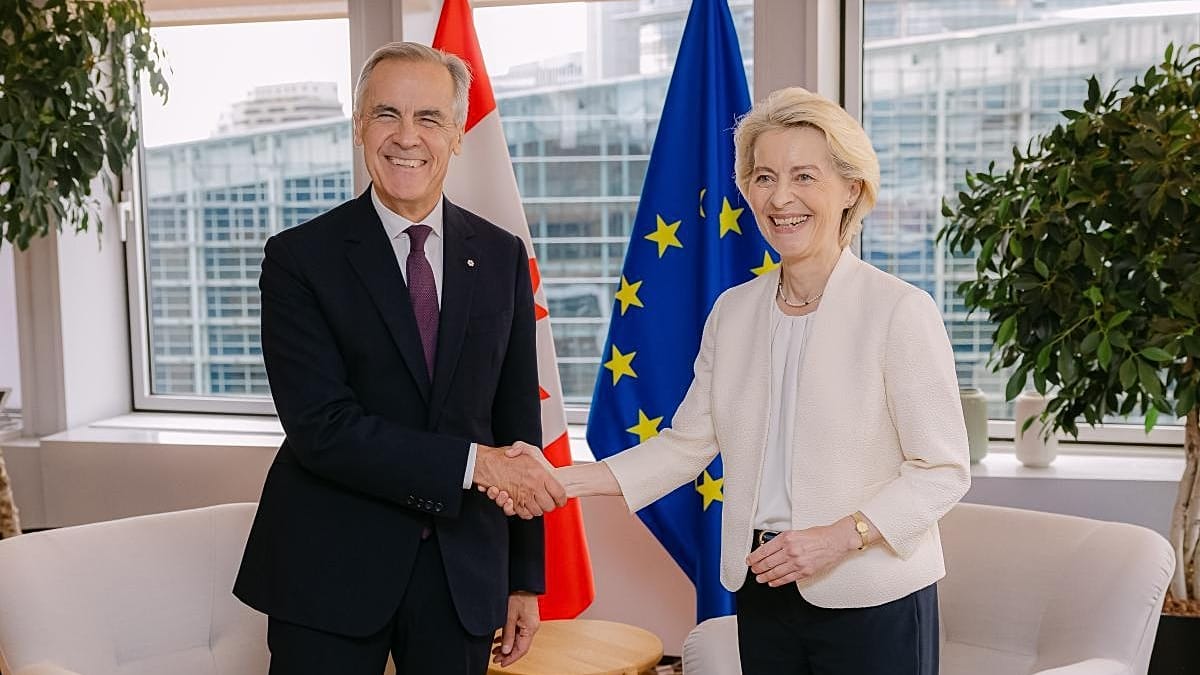
Ottawa and Brussels are exploring a groundbreaking arrangement that would allow Canada to participate in the European Union's Erasmus+ exchange programme, a flagship initiative that has long been celebrated as one of the bloc's most tangible achievements. If realised, Canada would become the first non-European country to join the scheme, which funds study and training placements for students, educators, and organisations across borders.
The talks come as EU-Canada relations reach an unusually high point. Prime Minister Mark Carney has actively sought to deepen ties with Europe in response to the unpredictable trade policies and erratic diplomacy of the second Trump administration. The two sides are also discussing a broader 'associate membership' status for Canada, a novel concept that would stop short of full EU accession—which remains legally impossible for a non-European state.
European Commission President Ursula von der Leyen extended the invitation to Canada on Wednesday, proposing that it become the first 'associate member' of the EU. While the precise contours of that status are still being defined, the immediate focus is on integrating Canada into existing EU programmes, with Erasmus+ at the forefront.
First non-European partner
Currently, Erasmus+ is open to EU member states and six non-EU countries: North Macedonia, Serbia, Iceland, Liechtenstein, Norway, and Türkiye. Canada is already recognised as a partner country, which allows its universities and organisations to participate in certain actions under specific conditions. However, full 'associated' status would grant Canadian students and institutions the same access as their European counterparts, enabling seamless exchanges in both directions.
Javier Moreno Sánchez, a Spanish MEP from the Socialists and Democrats group who chairs the European Parliament's delegation to Canada, confirmed that negotiations are underway. "Canadians want to participate in Erasmus+. It will be expensive for them, but they are ready to do that," he told reporters at a briefing on Tuesday. He described the move as a way to strengthen the relationship with tangible benefits for ordinary people.
The financial implications are significant. Joining Erasmus+ would require Canada to contribute to the programme's budget, a cost that Ottawa appears willing to bear. The potential payoff is substantial: increased student mobility, deeper academic collaboration, and a stronger people-to-people connection between Canada and Europe.
Beyond education, the two sides are also exploring Canadian participation in Horizon Europe, the EU's flagship research and innovation programme. Currently, Canada's involvement is limited to specific strands focused on global challenges and industrial competitiveness. Full association would open the door to broader research collaboration, a prospect that excites scientists and universities on both sides of the Atlantic.
Moreno also suggested extending the mutual recognition of professional qualifications beyond architects—a convention already in place—to include doctors, engineers, and professors. Such a move would ease labour mobility and further integrate Canadian and European professional markets.
The talks are still at an early stage, but there is clear momentum on both sides. The proposal for associate membership, first floated by von der Leyen, has been met with cautious optimism in Brussels and Ottawa alike. For Canada, it represents a strategic hedge against the unpredictability of its southern neighbour. For the EU, it offers an opportunity to project soft power beyond the continent and to build a partnership with a like-minded democracy.
As the negotiations progress, the details of what associate membership entails will become clearer. But the prospect of Canadian students studying in Paris, Berlin, or Warsaw—and European students experiencing Toronto, Montreal, or Vancouver—is a compelling vision of transatlantic cooperation. It is a reminder that, even in turbulent times, the bonds between Europe and its friends can grow stronger.