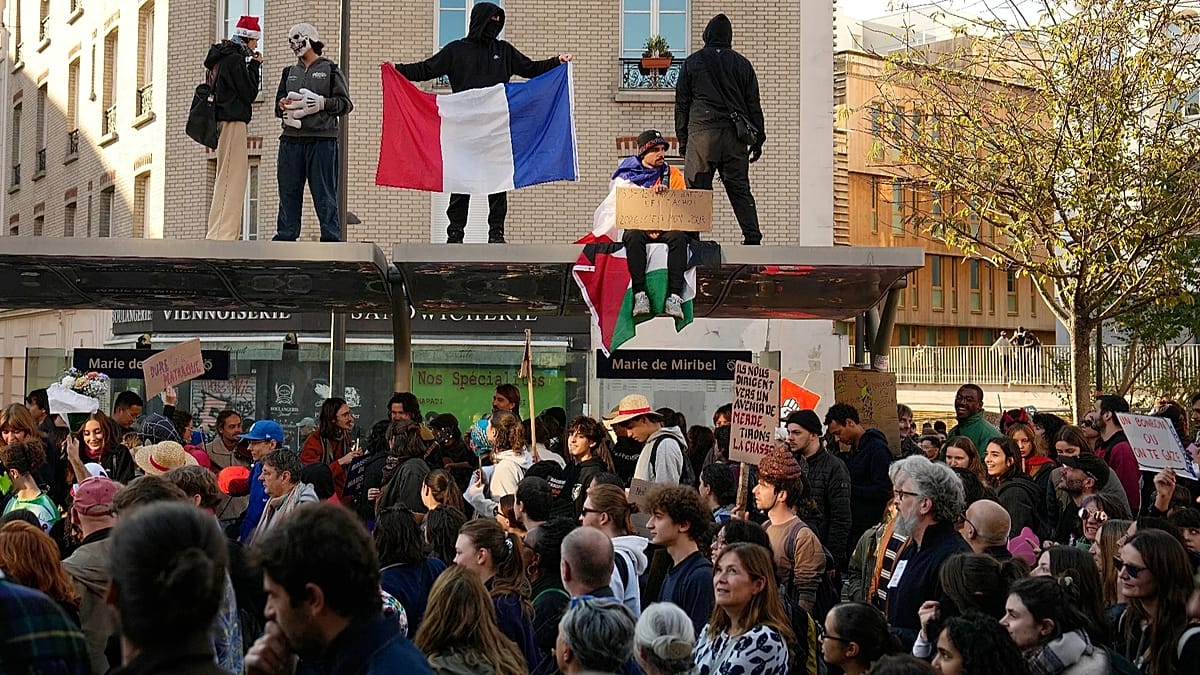
France's rolling wave of social protest entered its third weekend with markedly thinner crowds and a familiar pattern of calm marches followed by scattered confrontations at dispersal. The Interior Ministry put nationwide participation at roughly 320,000, of whom some 70,000 marched in Paris — a clear decline from the 410,000 counted on 24 October and the 550,000 on 17 October. Organisers disputed those figures, insisting they had mobilised 800,000 people on each of the two earlier Saturdays.
Disruption to public transport appears to have kept numbers down. In Lyon, trams and metro services ran at roughly half capacity, while more than 40 metro stations were shut in Paris and tram routes were also affected. The ministry described conditions as "generally calm" and "without any notable incident" through the early afternoon, reporting 27 arrests by 2 p.m. against 217 at the same hour during the previous weekend's mobilisation.
Tear gas in Lyon as marches break up
The mood shifted as processions reached their endpoints. In Lyon's 7th arrondissement, security forces fired tear gas as the demonstration arrived at Place Jean-Macé. Tensions were also reported during dispersal in Paris and Marseille. The ministry issued a blunt warning that the police would show "the greatest firmness towards those responsible for violence and damage".
Authorities had prepared for the possibility that Halloween festivities could serve as a "pretext" for disorder once the marches dissolved. Interior Minister Bruno Retailleau's department coordinated a heavy deployment, with 70,000 officers on the streets over the weekend. Access to Place de la République and Les Halles was barred between 11 p.m. and 6 a.m., and unaccompanied minors faced a 9 p.m. curfew around the Champs-Élysées — though a Paris court had suspended an earlier curfew on minors on Wednesday, calling it a serious and unlawful infringement of freedom of movement.
President Emmanuel Macron said the weekend's marches would be kept out of city centres to protect shops, a nod to the looting and rioting that caught the government off guard on 17 October. Most participants have been peaceful, but a violent fringe routinely targets police with fireworks and projectiles. The response has included tear gas, dispersion grenades and water cannons, tactics that have left demonstrators with serious injuries.
A movement that outgrew its origins
The rallies began last month as a high-school campaign against neglected school buildings, teacher shortages and a university admissions system widely seen as unfair to students from disadvantaged backgrounds. Trade unions and other groups opposed to Macron's agenda have since joined, bringing a patchwork of demands that ranges from wages and pensions to public services. The unrest lands against a difficult economic backdrop, with France's economy stalling as budget negotiations drag on in the Assemblée nationale.
Echoes across the continent
The mobilisation is not confined to France. In Germany, a youth initiative calling itself "Gen Z regelt" — loosely, "Gen Z's got this" — has staged rallies in several cities around education, healthcare, climate protection and the cost of living, and against any reintroduction of military conscription. Organisers said more than 180,000 people had registered online, though only several thousand had marched by Saturday afternoon. Protesters also gathered at Berlin's Brandenburg Gate to demand greater investment in schools and housing.
In the Netherlands, police were out in force around The Hague's downtown shopping district after online calls to demonstrate and fears of rioting and looting. By mid-afternoon there was little sign of protest and no major disturbance; local media reported that officers frisked groups of black-clad youths and checked identities, while many shops had boarded up their windows.
Italian police remained on alert following recent clashes in Milan, Turin and Bologna. In Barcelona, the Catalan Mossos d'Esquadra prepared to activate their highest alert level after an anonymous TikTok network called Blocus urged fresh gatherings; rioting there the previous Saturday led to about 130 arrests, most of them minors. The pattern — decentralised, youth-driven, organised largely online — suggests the current cycle of European protest has yet to run its course.