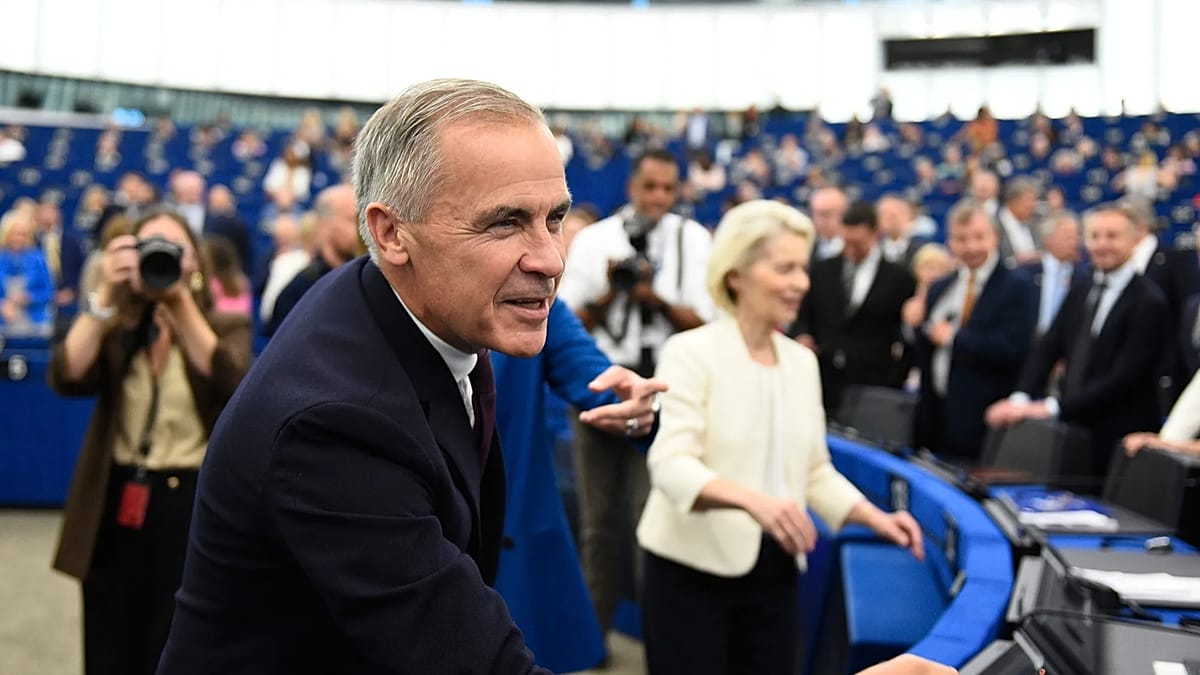
European Commission President Ursula von der Leyen used her annual State of the Union address in Strasbourg to invite Canada to become the first "associate member" of the European Union. The announcement, made on Wednesday, came in the presence of Canadian Prime Minister Mark Carney, who was in the chamber as part of a push to deepen ties with Europe amid escalating trade tensions with the United States.
The status is entirely new, and its precise contours remain undefined. Von der Leyen framed the move as a natural extension of shared values and interests. "We share one ocean, one set of values, one way of seeing the world. And we will now build our shared future as well," she told MEPs.
Canada is not a European state, so full membership is off the table. But Ottawa has been lobbying since late August for a closer institutional relationship with Brussels, and Carney has spoken of building a "unique alliance" with the EU. The invitation marks a significant political gesture, even if the practical implications are still being worked out.
What does associate membership mean?
The EU already has several tiers of cooperation for non-member states. Norway, for instance, is part of the single market and collaborates with the bloc on defence initiatives. Switzerland has access to the single market through a patchwork of bilateral agreements. The United Kingdom, since Brexit, has secured the largest and broadest trade and cooperation deal in the bloc's history, and participates in programmes such as Horizon Europe, the EU's research and innovation framework.
According to sources familiar with the talks, Ottawa is already in discussions with Brussels to join the Erasmus+ exchange programme, Horizon Europe research grants, and mutual recognition of professional qualifications. However, the associate membership status is a blank slate. Key questions remain unanswered, notably whether Canada would have any voting rights in EU institutions. Norway and Switzerland, despite their deep regulatory alignment, have no say in EU law-making.
The idea of associate membership was floated earlier by German Chancellor Friedrich Merz, who proposed it for Ukraine. In a letter to EU leaders, Merz suggested that such a status would give Ukraine access to decision-making bodies like the European Council, the Commission, and the Parliament, but without voting rights or a dedicated portfolio. It would also allow Kyiv to tap into EU-funded programmes on a step-by-step basis.
Canada is hardly in the same situation as Ukraine, a country at war. But von der Leyen's invitation sends a strong signal in a volatile geopolitical climate. "Europe and Canada believe in democracy. That power does not belong to the strongest, the richest, or the loudest – but to all of us," she said. "Democracies have the freedom to choose with whom to work."
The Commission President also proposed a new alliance with Ottawa, covering technology, defence, Arctic cooperation, energy, critical minerals, and artificial intelligence. She referenced the existing EU-Canada trade agreement, CETA, which has been provisionally applied since 2017 but remains unratified in several member states. "We will move from CETA to an Alliance for the Future to create a common prosperity and economic security space," she said.
The announcement has been met with cautious optimism in Brussels, though many details are still to be hammered out. The European Parliament will likely debate the scope of associate membership in the coming months. For now, the invitation is a political statement of intent, one that could reshape the EU's external partnerships in a world where traditional alliances are being tested.
For more on the evolving EU-Canada relationship, see our analysis of what's known and what's not about the new status, and the unresolved fate of CETA. The move also comes as Canada moves to join the EU's €90bn loan package for Ukraine, underscoring the deepening security cooperation.