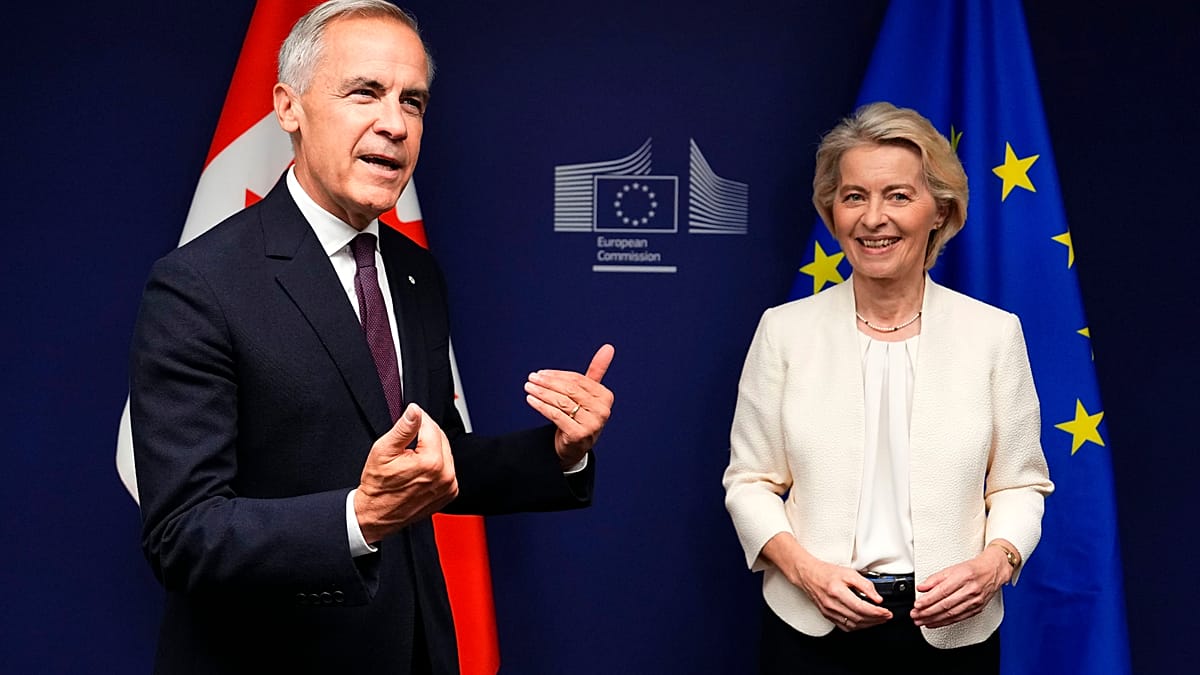
When Canadian Prime Minister Mark Carney received a standing ovation in the European Parliament in Strasbourg, it was more than a diplomatic courtesy. It signalled a realignment that could reshape transatlantic economic relations. With Washington's trade war pushing Ottawa away from its traditional ally, Europe is emerging as a natural partner — and European companies are already reaping the benefits.
European Commission President Ursula von der Leyen has given this momentum a political framework. In her State of the Union address, she proposed an "Alliance for the Future" with Canada, covering defence, energy, technology, critical minerals, and the Arctic. She also floated the idea of making Canada the first "associate member" of the EU — a status that does not yet exist in the bloc's treaties.
Creating such a category would require unanimous agreement among the 27 member states and complex legal negotiations. Notably, ten countries, including France and Italy, have still not ratified the Comprehensive Economic and Trade Agreement (CETA) signed nearly a decade ago. Carney has clarified that Canada is not seeking full membership, but rather a "unique alliance" that goes beyond a conventional free-trade deal. For now, the proposal is more political signal than legal blueprint.
Trade is already moving
Despite the institutional hurdles, commercial ties are deepening. EU-Canada trade in goods and services has grown by over 81% since 2016, reaching €130 billion in 2025. German exports alone totalled €12 billion last year, followed by Italy at €6.3 billion and France at €4.4 billion. Machinery, chemicals, pharmaceuticals, and transport equipment dominate European sales to Canada.
Some sectors have seen remarkable growth. European machinery exports hit a record €9.5 billion, while electrical equipment rose from €2 billion in 2022 to €3.3 billion. Car sales climbed from €2.9 billion to €4.4 billion over the same period. But the most striking surge came in aerospace: powered aircraft sales jumped from €449 million in 2022 to €1.2 billion last year.
Defence: a clear opening
Defence is where the "Canada effect" is most visible. In July, Ottawa selected Germany's TKMS AG & Co. KGaA as the preferred supplier for up to 12 new submarines, a major contract that places a European firm at the heart of Canada's naval modernisation. Sweden's Saab has also gained ground, winning a deal for six GlobalEye surveillance aircraft, beating American rivals Boeing and L3Harris. The GlobalEye is built on Bombardier business jets, and Saab has pledged to carry out much of the work in Canada, combining European sensors with Canadian manufacturing.
Canada's inclusion in the EU's SAFE defence procurement programme in June was another milestone. It grants Canadian firms access to joint European purchasing, making it easier for European defence groups to build cross-Atlantic supply chains.
Aerospace and industrial tech follow
Beyond defence, commercial aerospace is thriving. Air Canada has placed a firm order for eight Airbus A350-1000 aircraft, and the Canadian government has contracted Airbus for four new A330 tankers plus five conversions, part of a C$3.6 billion programme. German industrial giant Siemens is investing C$150 million over five years in a Canadian research centre focused on AI-powered battery manufacturing.
French companies are also making inroads. Keolis, Systra, and SNCF Voyageurs are part of the Cadence consortium selected in 2025 to develop Alto, the planned high-speed railway between Toronto and Quebec City. The Canadian government has allocated about €2.4 billion for the project's development phase.
Critical minerals: the next frontier
Canada's vast reserves of nickel, lithium, copper, and other critical minerals present a strategic opportunity. Europe is eager to reduce its dependence on concentrated and politically risky suppliers, while Canada seeks investment, processing capacity, and new customers outside the US. In March, the European Investment Bank and the Canadian government signed a letter of intent to explore financing for Canadian critical-minerals projects. While it contains no financial commitments yet, it could eventually support European companies in mining technology, processing, recycling, and battery production.
As CETA has already eliminated 99% of tariff lines, the next gains from a deeper partnership would come from government procurement, investment, digital trade, professional mobility, and mutual recognition of standards. Greater access may require Canada to align some of its rules with EU norms, a prospect that remains uncertain. But the direction is clear: Europe and Canada are moving closer, and European companies are well positioned to benefit.