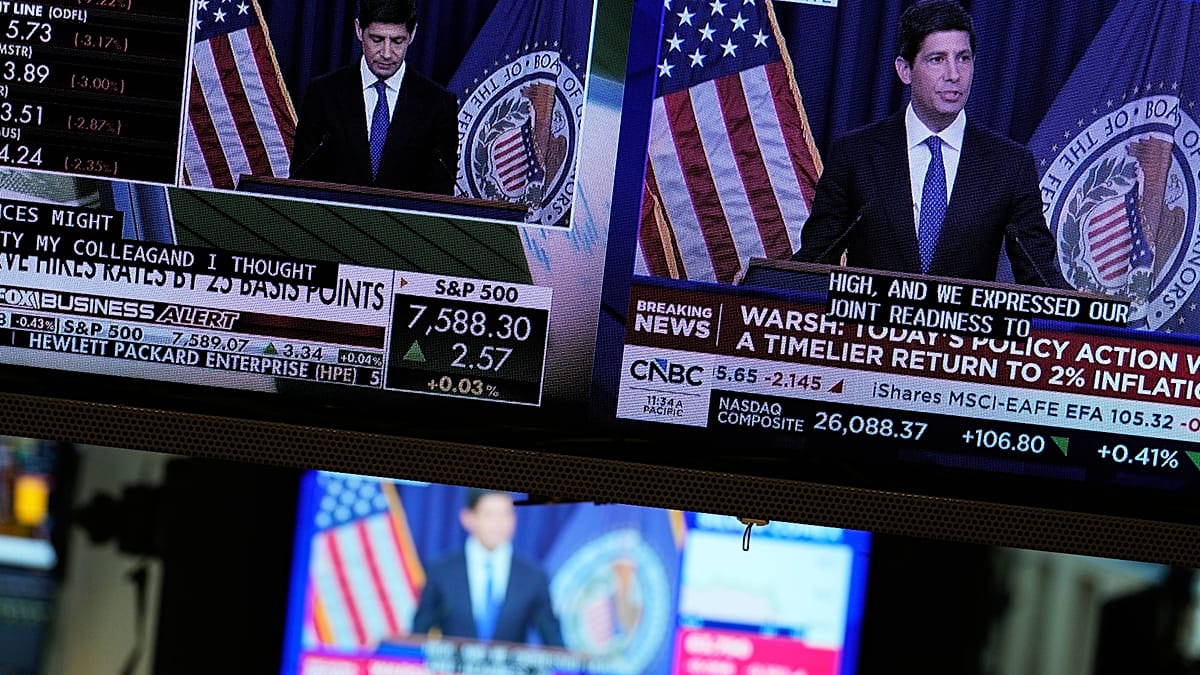
European equity markets opened firmly in positive territory on Thursday, as investors took the Federal Reserve's first interest rate increase in more than three years in their stride. The pan-European Stoxx 600 and the Euro Stoxx 50 both advanced more than 0.6% in early trading, while national benchmarks across the continent posted gains.
France's CAC 40, Germany's DAX 30, Italy's FTSE MIB, Spain's IBEX 35, the Netherlands' AEX and Switzerland's SMI all traded between 0.2% and 0.7% higher than their Wednesday close. London's FTSE 100 led the way, climbing more than 1%.
In Paris, carmakers and industrial stocks drove the index upward, with Renault gaining over 2%, Stellantis rising 1.6% and Schneider Electric adding 1.3%. Technology shares lagged, with Dassault Systèmes falling 2.4%.
The calm in Europe contrasted with a rougher session on Wall Street, where the Dow Jones Industrial Average closed 1.2% lower on Wednesday and the S&P 500 slipped 0.4%, while the Nasdaq was broadly flat. Asian markets were mixed overnight: Tokyo's Nikkei 225 rose 0.2%, Seoul's Kospi gained 0.9%, but Hong Kong's Hang Seng fell 0.7% and the Shanghai Composite dropped 0.4%.
Lorraine Tan, director of equity research for Asia at Morningstar, said the reaction was "pretty much expected since the rate hike was also in line with market expectations." She added that the ongoing conflict in the Middle East is likely to keep upward pressure on inflation.
Dollar strength and bond yields
The more consequential moves were in currencies and fixed income. The US dollar climbed to its highest level in seven weeks against a basket of major currencies, buoyed by a jump in short-dated Treasury yields following the Fed's decision. The euro traded around $1.146, down 0.5% from Wednesday's open.
A stronger dollar makes European exports more competitive in American markets, but it also raises the cost of dollar-denominated commodities, including oil and gas, adding to Europe's energy import bill at a delicate moment.
In bond markets, the two-year Treasury yield—the maturity most sensitive to rate expectations—jumped to around 4.72% from 4.67% before the decision, holding near that level on Thursday. The 10-year yield hovered close to 5%, reflecting both the war-driven energy shock and mounting investor concern about US government debt.
Traders now fully price in another rate hike by December and see about a 50% chance of a move as soon as October. Goldman Sachs has become one of the first major Wall Street banks to forecast consecutive hikes, reversing its earlier view that this month's move would be the only one.
Attention now turns to the Bank of England, which announces its decision later on Thursday and is widely expected to hold rates steady. The Bank of Japan follows on Friday, where a hike is anticipated. These decisions will be closely watched by European investors, as the divergence in monetary policy could further influence currency movements and capital flows across the continent.