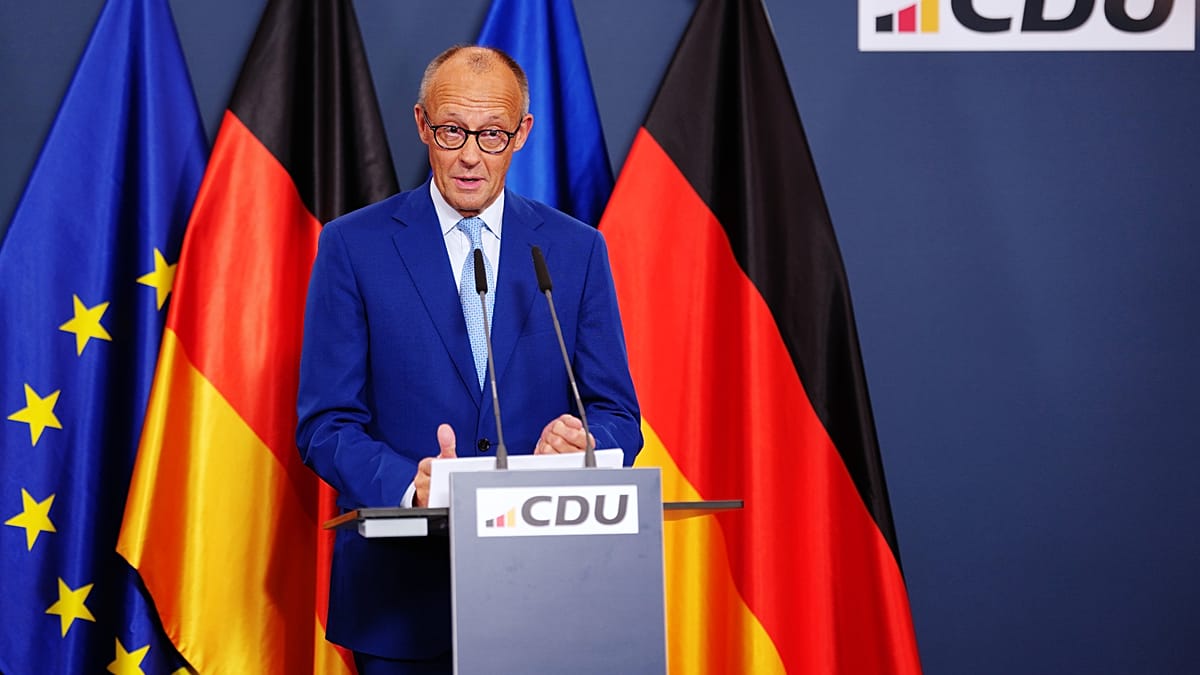
Chancellor Friedrich Merz's centre-right Christian Democratic Union (CDU) faced a bruising day in two German state elections on Sunday, with exit polls pointing to historic losses that could deepen the political crisis in Berlin.
According to projections by public broadcaster ARD, the CDU is set to collapse to just 5.5% in Mecklenburg-Western Pomerania, a largely rural state in the former communist east. That would be the party's worst result in the state since the end of the Second World War. In Berlin, the CDU is projected to finish second with 20%, trailing the Left Party, which leads with 24.5%.
The results come just two weeks after the far-right Alternative for Germany (AfD) narrowly missed an absolute majority in the small eastern state of Saxony-Anhalt, raising the prospect of the country's first far-right regional government since 1945. The AfD has again made significant gains in Sunday's votes, further unsettling the national political landscape.
Merz under pressure
Merz, who took office 16 months ago promising to revive Germany's stagnant economy, has struggled to lift a sullen national mood. His personal approval ratings have plunged, and the AfD's strong showing has intensified calls from within his own party to consider a change at the top. While no senior allies have publicly demanded his resignation, many have warned against opening a divisive internal debate over leadership.
Apparently anticipating a difficult post-election period, Merz cancelled a planned trip to New York next week for the UN General Assembly. Speaking after the exit polls were published, he insisted he intends to remain leader of the CDU and chancellor until the end of his term.
The CDU's poor performance in the east is particularly damaging because it underscores the party's failure to reconnect with voters in regions where economic anxiety and distrust of the political establishment run deep. Mecklenburg-Western Pomerania, with its sparse population and reliance on agriculture and tourism, has become a bellwether for the CDU's broader struggles in the former East Germany.
In Berlin, the CDU's second-place finish behind the Left Party reflects a fragmented urban electorate, where housing costs, migration and public services dominate the agenda. The Left Party's lead, while modest, signals a shift to the left in the capital, even as the AfD gains ground in other parts of the country.
The results also put additional strain on the federal coalition, which has been under strain as voters shift to the AfD, according to warnings from the Social Democrats and other coalition partners. The CDU's losses are likely to embolden critics who argue that the government's response to economic stagnation and social discontent has been inadequate.
Analysts note that the CDU's decline in the east is not new, but the scale of Sunday's losses marks a new low. The party has struggled to articulate a compelling vision for the region, where many voters feel left behind by globalisation and the energy transition. The AfD has capitalised on these sentiments, presenting itself as the only genuine opposition to the established parties.
For Merz, the immediate challenge is to stabilise his leadership and prevent further erosion of support. The coming weeks will be critical, as the CDU prepares for federal elections scheduled for next year. Some within the party are already calling for a strategic rethink, while others fear that any public infighting would only benefit the AfD.
The broader European context adds another layer of concern. Germany's political instability comes at a time when the EU is grappling with stalled budget talks and internal divisions over everything from migration to defence. A weakened German government could hamper efforts to present a united front on key European issues, from support for Ukraine to the green transition.
As the dust settles on Sunday's votes, the CDU faces an uncomfortable reckoning. The party that once dominated German politics is now struggling to hold its ground in its traditional heartlands, while the far right continues to rise. Whether Merz can reverse this trend remains an open question, but the exit polls suggest that time is running out.