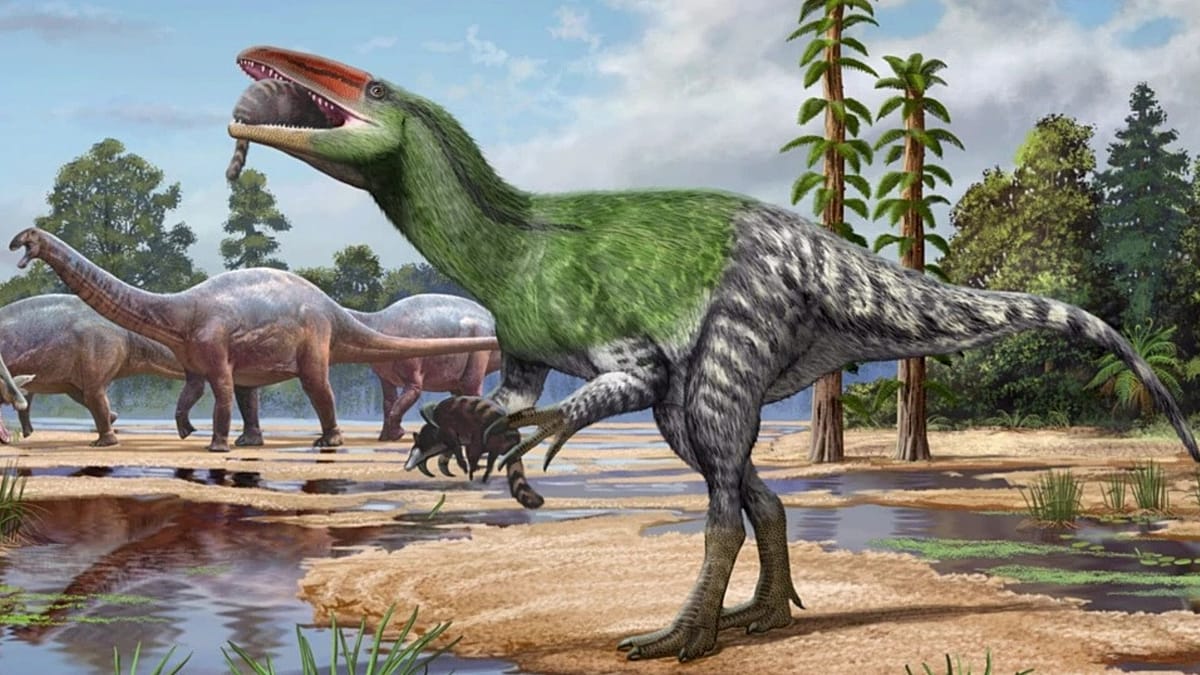
For nearly a hundred years, a fragment of dinosaur skull sat unnoticed in the archives of London's Natural History Museum. Now, researchers have finally given it a name: Invictibellatrix amberina, a previously unknown carnivore that roamed the Early Cretaceous landscape of what is now the Isle of Wight.
The fossil, dating back roughly 120 million years, is the first confirmed evidence of a megaraptoran dinosaur in Europe. These predators, despite their name, were not the small, bird-like creatures often associated with the word 'raptor'. Instead, they were larger hunters, more closely related to tyrannosaurs, with slender skulls, long arms, and formidable curved claws.
A century-old mystery solved
The story begins with Reginald Walter Tooley, an amateur fossil collector who discovered the specimen at the base of a cliff on the island's southwest coast. After Tooley's death in 1924, the Natural History Museum acquired more than a thousand specimens from his collection, including this fragment. For decades, scientists knew it belonged to a dinosaur, but its exact identity remained elusive.
It took modern technology to crack the case. Using CT scanning, researchers at the museum and University College London (UCL) examined the fossil's internal structure and created a detailed 3D model. Their findings, published in the journal Royal Society Open Science, confirm that the skull fragment belongs to a new species.
Professor Paul Barrett, senior author of the study and a researcher at the Natural History Museum, said: "Despite over 200 years of collecting, the Isle of Wight continues to surprise us with new dinosaur species, and finds of carnivorous dinosaurs, such as Invictibellatrix, have been particularly elusive." He added: "Work like this shows the exceptional value of working with historical museum collections where there are still many discoveries to be made."
The discovery underscores the importance of museum archives, a theme that resonates across Europe, where many institutions hold specimens that have yet to be fully studied. Similar efforts have recently led to re-identifying ancient fossils using the same imaging techniques.
A predator of its time
Invictibellatrix amberina is estimated to have measured between three and four metres in length and stood about 1.5 metres tall. It lived during the Early Cretaceous, a period when dinosaurs dominated terrestrial ecosystems. While its exact appearance remains uncertain, researchers suggest it may have had feathers.
Dr Cassius Morrison, a researcher at UCL's Earth Sciences department who led the study, explained the creature's role in its ecosystem. "It was not the apex predator of its time, but for humans this dinosaur would have been more dangerous than a T. rex. We would have been perfectly sized prey, about a third of their body weight. They definitely would have chased us. A T. rex would not have bothered, as we would have been too small," he said.
Morrison compared its ecological niche to that of a modern hyena, preying on small dinosaurs, lizards, and mammals. This places Invictibellatrix as a mid-level carnivore in a food chain that included larger theropods.
The Isle of Wight has long been a hotspot for dinosaur discoveries, with new species emerging regularly. This find adds to the island's rich paleontological heritage and highlights the ongoing value of re-examining historical collections. As Professor Barrett noted, there are still many secrets waiting to be uncovered in museum drawers across Europe.
For now, Invictibellatrix amberina stands as a testament to the patience of science and the enduring mysteries of the natural world.