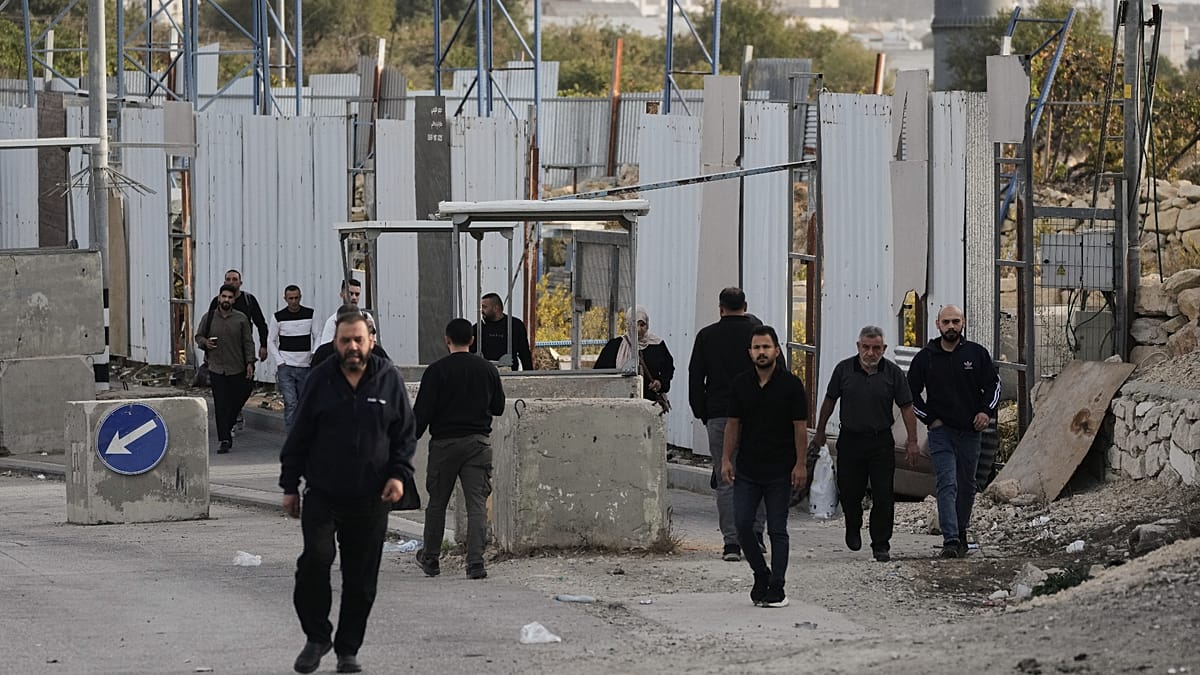
Spain's former foreign minister, Arancha González Laya, has described the mass entry of around 80,000 migrants into the Spanish enclave of Ceuta from Morocco as a "hybrid attack" on an "external border of the European Union". In an interview with Euronews, she said the incident was designed to "use migration as a tool" to "weaken" the EU at a time when migration is a "sensitive social issue" across the continent.
The May 2021 border breach saw thousands of people, including many minors, cross into Ceuta after Moroccan border guards appeared to stand aside. Leaked police reports have since suggested that Moroccan security forces may have facilitated the surge, putting Rabat's role under scrutiny. However, Spain's Prime Minister Pedro Sánchez has publicly defended Morocco, emphasising the importance of the bilateral relationship.
González Laya, who served as foreign minister from 2020 to 2021, stressed that Spain and the EU must maintain "the best relationship possible with their neighbours", as this is "good for the stability of Europe". Her comments come as the EU grapples with how to respond to hybrid threats that exploit migration as a geopolitical lever.
A wake-up call for the EU
The Ceuta crisis has prompted a broader debate about the EU's preparedness for hybrid tactics. As Germany's approach to hybrid threats shows, member states are increasingly focusing on responses that stay below the threshold of conventional war. The use of migration as a weapon is seen as a particularly potent form of hybrid warfare, because it tests the EU's unity and its commitment to open borders.
For Spain, the incident was a stark reminder of its role as the EU's southern border. Ceuta and Melilla, Spain's two North African enclaves, have long been flashpoints for migration. The 2021 surge, however, was unprecedented in scale and coordination, leading to accusations that Morocco was deliberately punishing Spain for hosting the leader of the Polisario Front, Brahim Ghali, in a Spanish hospital.
González Laya's remarks add to a growing chorus of voices calling for the EU to take a firmer stance. Ceuta's local leaders have urged the EU to confront Morocco over the incident, while Spain's top court has opened a criminal probe into the events. The EU has also begun to integrate migration into its broader security strategy, recognising that border pressure can be a deliberate tactic.
Yet González Laya cautions against a purely confrontational approach. "We need to be firm on our borders, but we also need to engage with our neighbours," she said. "The EU's strength lies in its ability to combine security with diplomacy." This balancing act is central to the bloc's response, as it seeks to deter future incidents without alienating key partners in North Africa.
The former minister's comments also resonate beyond the immediate crisis. As migration returns to the EU agenda, the Ceuta episode has reshaped how policymakers view border security. It is no longer just a humanitarian or logistical challenge, but a strategic one that requires a coordinated European response.
For now, the EU is walking a tightrope. On one hand, it must protect its external borders and uphold the rule of law. On the other, it must maintain constructive relations with Morocco, a key partner in counter-terrorism and trade. González Laya's call for a balanced approach reflects the complexity of the situation, and her warning about hybrid attacks is likely to resonate in Brussels and other capitals.
As the EU continues to develop its toolkit against hybrid threats, the Ceuta crisis will remain a case study in how migration can be weaponised. Whether the bloc can turn this challenge into an opportunity for greater resilience remains to be seen, but the former minister's analysis offers a clear framework for understanding what happened and what is at stake.