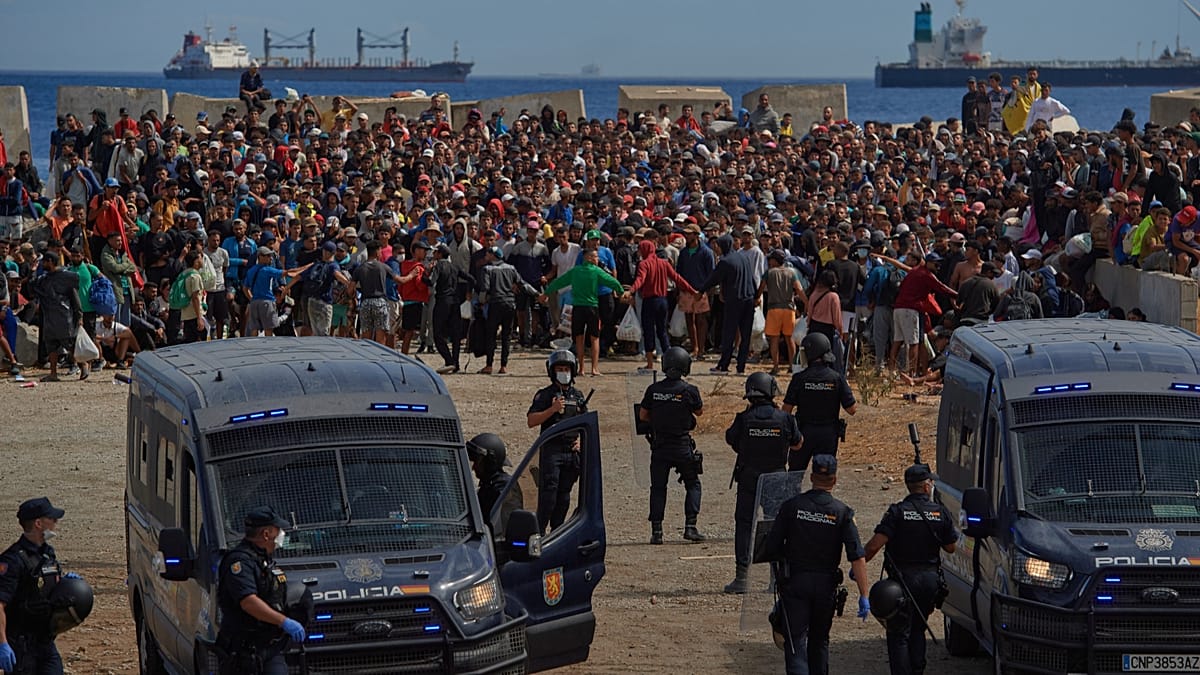
In the Spanish North African enclave of Ceuta, protests over the presence of hundreds of migrants have turned violent, with residents clashing with police and attempting to block humanitarian aid. The unrest comes exactly one month after a chaotic mass crossing from Morocco that brought over 70,000 people into the territory in a matter of days.
On Thursday, demonstrators waving Spanish flags staged a sit-in to prevent Red Cross vehicles from reaching a beach where migrants have been sleeping rough. Chants of “They should leave” and “Out with the Red Cross” were heard before police dispersed the crowd. Later, officers charged protesters who had moved into the area where migrants were staying, with some belongings set on fire during the disturbances, according to images broadcast on Spanish public television.
The clashes follow a night of heightened tension, during which police fired tear gas to separate protesters from migrants camping on the beach. The situation has been further inflamed by an incident in the early hours of Thursday, when a military vehicle carrying four soldiers was attacked by around 70 migrants armed with stones and other objects. A police spokesperson in Ceuta told AFP that the soldiers fled and called for assistance. Twelve Moroccan migrants were detained, and one soldier sustained minor injuries. The motive for the attack remains unclear.
Residents feel abandoned
Kissy Chandiramani, the finance councillor for the autonomous city, told radio station SER that “the tension in the city of Ceuta is very high” because there is “no response” from the government and “we feel abandoned.” However, she also appealed for calm, acknowledging the right to protest but warning that growing hostility would not resolve the crisis.
The Spanish government, led by Prime Minister Pedro Sánchez, has faced mounting criticism from Ceuta’s right-wing leadership and residents, who accuse Madrid of reacting too slowly to the mass arrival. Justice Minister Félix Bolaños appealed for calm in the national parliament, insisting that authorities were working “without rest” to restore normality to the territory.
The government has recently moved to expand shelter capacity and speed up the identification of migrants who can be returned to Morocco. On Thursday, the Interior Ministry announced it would send additional personnel to help with identification, while the cabinet approved €25 million in extra funding for the care of unaccompanied minors, who are entitled to special legal protections. To streamline the response, the government also created a “single command” for Ceuta, led by Territorial Policy Minister Ángel Víctor Torres.
Despite these measures, the crisis has deepened Spain’s political divisions ahead of a general election expected next year. Conservative and far-right opposition parties are calling for the immediate return of all migrants, while the government insists that each individual must be assessed for asylum eligibility or deportation. Thousands of minors require special protection, complicating any swift resolution.
Alberto Núñez Feijóo, leader of the main opposition Popular Party, wrote on X that “people in Ceuta have been putting up with this alone for a month.” He added: “Nothing was done to prevent the invasion...and nothing is being done to stop the public-order crisis that is worsening every day.”
The situation in Ceuta has also drawn attention to the broader challenges of migration management within the European Union. The enclave, just 18 square kilometres, has become a flashpoint for debates over border security and humanitarian obligations. As the standoff drags on, Spain has moved to align its asylum rules with the EU pact, a step that could have implications for how similar crises are handled elsewhere in the bloc.
Meanwhile, the human cost remains evident. Hundreds of migrants continue to live on the streets of Ceuta, with many sleeping on the beach. The Red Cross, which has been providing food and basic supplies, has become a target of local frustration, despite its humanitarian mission. The unrest has also affected journalists, who have faced hostility while covering the events.
As the crisis enters its second month, the Spanish government faces a delicate balancing act: addressing legitimate security and hygiene concerns of residents while upholding the rights of migrants and minors. The coming weeks will test whether Madrid’s new measures can ease tensions or whether Ceuta will remain a symbol of Europe’s unresolved migration dilemmas.