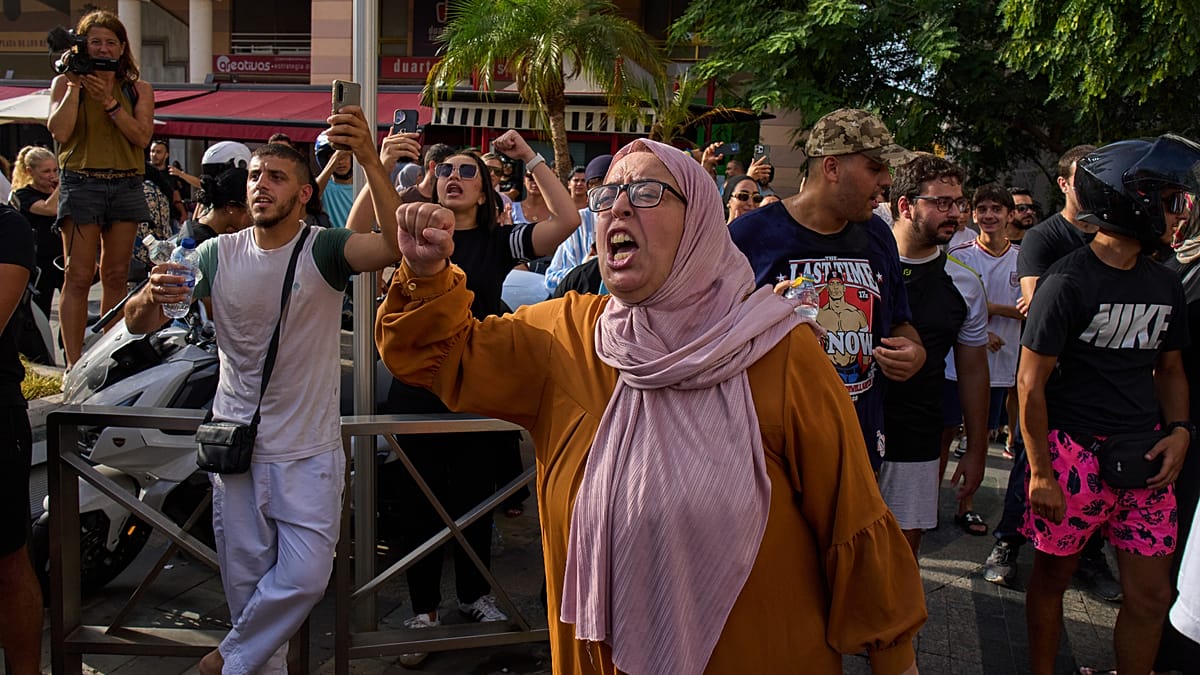
Ceuta has endured a second consecutive night of protests linked to the ongoing migration crisis, with tensions in the Spanish enclave showing no sign of easing. Demonstrations that began on Tuesday against the government's reported plan to house migrants in the Coronel Fiscer barracks continued into Wednesday evening, when crowds erected barricades, police fired rubber bullets, and streets near the port were blocked.
Both nights shared a troubling pattern: journalists covering the unrest became targets of hostility. On Tuesday, a reporter and cameraman from the Spanish channel La Sexta were forced to take cover behind tables at a pavement terrace as a group of residents surrounded them, shouting “Fuera, fuera!” (“Out, out!”). Video footage captured by El Faro de Ceuta showed insults and shoving, including by minors, with police initially failing to intervene.
The same day, a journalist from the public broadcaster RTVE opted to cover the story without the foam cover on their microphone, a move widely interpreted on social media as an attempt to avoid detection. On Wednesday, caution proved insufficient. As the National Police sealed off access to the Government Delegation—where a monitoring committee chaired by Territorial Policy Minister Ángel Víctor Torres met with Ceuta's president Juan Jesús Vivas, Migration Minister Elma Saiz, and other officials by videoconference—demonstrators hurled abuse at an RTVE crew, according to the broadcaster itself.
Press freedom under pressure
The Federation of Spanish Journalists' Associations (FAPE) and the local party Movimiento por la Dignidad y la Ciudadanía (MDyC) have condemned both incidents as part of an escalating pattern of harassment against the press in Ceuta. They note that this follows the expulsion of RTVE and EFE crews from the Moroccan town of Fnideq by Rabat authorities several weeks ago. A fortnight earlier, another journalist was assaulted in Ceuta after being mistaken for a migrant.
MDyC stressed that residents' frustration, however understandable after nearly a month of crisis, must not turn reporters into targets. “They are doing their job, just like the State's law-enforcement agencies,” the party said in a statement.
The protests began at 19:00 on Wednesday, with hundreds of residents, many waving Spanish flags, chanting slogans such as “Ceuta se defiende” and “un caballa nunca se rinde”, demanding faster deportations of irregular migrants who do not qualify for asylum. As night fell, the mood hardened: small barricades were erected, and a group of young people attempted to dismantle huts in the migrant settlement on Trampolín beach, where police blocked access and fired rubber bullets to deter them.
The main march, heading toward the Government Delegation, dispersed in Plaza de África without reaching the Otero flour factory as planned, according to RTVE. However, one group continued and blocked Avenida Teniente General Muslera near the port by dragging containers into the carriageway, as reported by Radio Television Ceuta.
Residents voiced their distress. “We can't go out, the children can't get to school, we can't go out feeling safe,” one local said. Others complained that public services are overwhelmed: “Our police, our ambulances, our cleaning services, can't cope,” said the president of the San Daniel neighbourhood association. Since Wednesday, municipal workers have held a minute's silence, joined by Vivas himself.
The backdrop to the unrest is the mass entry of nearly 80,000 migrants on 30 and 31 July, according to Interior Minister Fernando Grande-Marlaska, most of whom have already been returned. The focus now is on minors: the National Police has identified around 1,500 minors who entered irregularly, a figure revised down from an initial 2,168 after duplicate records were removed. This revision was confirmed by Spanish authorities.
Pre-dawn ambush on soldiers
Amid the escalating tensions, a serious incident occurred in the early hours. Four soldiers were injured in an ambush by a group of 30 to 40 people who had arrived in Ceuta during the mass entries, in the Benzú area. At around 5:30 a.m., as the soldiers headed to an observation post, the group emerged from different directions and rushed toward their vehicle, which was not armoured. The attackers hurled large stones, forcing the soldiers to abandon the vehicle and flee on foot toward Calamocarro, still under a hail of projectiles. The soldiers managed to find cover and call the 112 emergency number.
The emergency call triggered a joint operation by the National Police and the Civil Guard. The arrival of the first police vehicle prompted the attackers to flee toward Benzú. Security forces pursued and arrested 12 individuals, all Moroccan nationals, apparently aged between 35 and 40.
The incident underscores the volatile security situation in Ceuta, which has become a flashpoint in Europe's broader migration debate. As the EU pushes for return hubs and stricter border measures, the human and political costs on the ground remain high. The Spanish government faces mounting pressure to address both the immediate crisis and the underlying tensions that have made the enclave a symbol of Europe's migration challenges.