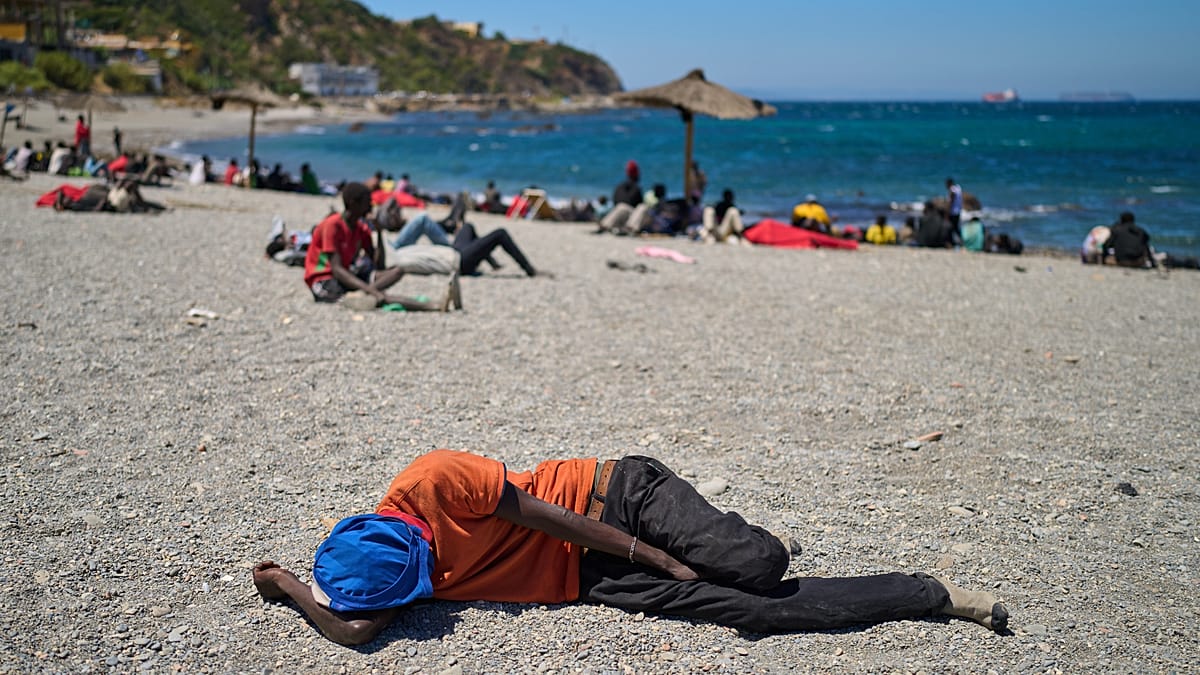
Hundreds of residents of Ceuta took to the streets on Sunday, calling for an “immediate, decisive and proportionate” response to the migration crisis that has gripped the Spanish enclave on Morocco's northern coast. Organized by the city's four religious communities—Christian, Muslim, Jewish, and Hindu—the rally in Constitution Square aimed to send a message of unity and coexistence while demanding concrete solutions.
Chants of “Ceuta is not for sale. Ceuta is Spain” and “Sánchez, resign” echoed through the square, reflecting deep frustration with the central government in Madrid, which many protesters accused of abandoning the territory. Some demonstrators later marched toward the Government Delegation building, where tensions briefly flared when far-right activist Vito Quiles appeared, with some in the crowd accusing him of seeking to divide the city.
Minors at the heart of the crisis
The protest came as Ceuta's regional president, Juan Jesús Vivas, met with Spain's Minister for Youth and Children, Sira Rego, to discuss the situation of unaccompanied migrant minors. The government has identified 1,342 minors, though many more have yet to be registered. Vivas insisted that the only solution is their return to Morocco via the Tarajal border crossing, describing the situation as “absolutely unsustainable” and calling for more resources and security personnel.
Rego, however, emphasized the protection of minors, stating that each case must be examined individually. “Many of the unaccompanied migrant boys and girls do not have families, so in these cases the autonomous communities must act as their guardians and guarantee their rights,” she said. The minister also pledged “full support, financial, technical and human, for Ceuta,” with a technical team already deployed to assist with reception and coordination.
The next flashpoint will be the Sectoral Commission on Children and Adolescents, scheduled for 13 August, which will address the transfer of minors from Ceuta to other regions. Vox, the far-right party, has announced that its regional vice presidents in Castile and León, Extremadura, and Aragon will boycott the meeting, reiterating its opposition to the distribution with the slogan “children with their families”.
Political fallout and Schengen dispute
The crisis has also intensified political confrontation over Spain's decision to temporarily reinstate border controls for travellers arriving from Italy, after Rome refused to lift its own checks on passengers from Spain. This tit-for-tat escalation has drawn sharp criticism from regional leaders, including Isabel Díaz Ayuso, president of the Madrid region, who said, “We let more than 70,000 people enter illegally through Ceuta alone and we ban Italians from entering, a brother country that invests in and contributes to Spain.”
Alberto Nadal, deputy secretary for Economy and Sustainable Development of the conservative People's Party (PP), accused Prime Minister Pedro Sánchez's government of having “isolated Spain in the European Union” with its migration policy and demanded explanations in Parliament. Extremadura's president, María Guardiola, also voiced her discontent, stating, “Extremadura rejects this drift. This is not about setting territories against each other, or seeking fractures to mask problems. This is about facing the situation with humanity, seriousness and a firm voice.”
The dispute with Italy has become a major point of friction, with Rome denouncing Spain's measures as “unacceptable”. The border checks on Italian arrivals are seen by many as a direct response to Italy's refusal to lift its own restrictions, a move that has raised questions about the future of the Schengen area. Spain has given Italy an ultimatum to end its checks, but so far there is no sign of a breakthrough.
Meanwhile, the Spanish Civil Guard has warned of a possible mass crossing attempt on 15 August, adding to the sense of urgency. The warning comes amid reports of sexual assaults on migrant girls, which have further inflamed public opinion. Ceuta's president, Juan Jesús Vivas, has called on the people of Ceuta to remain united, stressing that the rally was not about any political party but about making clear that “Ceuta will not give in, that Ceuta will move forward.”
Despite his criticism of the central government, Vivas said he would maintain “institutional loyalty” and a “sense of state”, but he also noted that after the 2021 border crisis and the current one, the government “has stumbled twice on the same stone.” The situation remains fluid, with the upcoming Sectoral Commission and the potential for further crossings keeping tensions high.