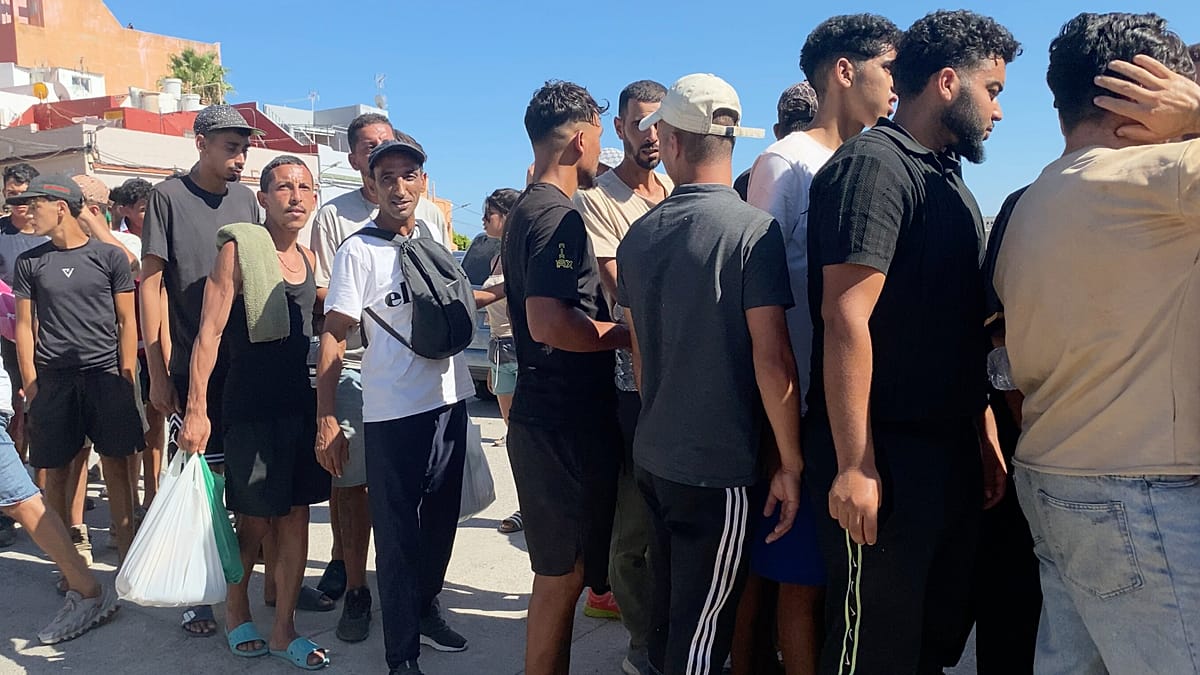
Two days after at least 72,000 people crossed illegally from Morocco into the Spanish autonomous city of Ceuta, the streets remain a cauldron of anger, fear, and compassion. Our reporter Julián López Gómez arrived to find a city in shock, where residents and migrants alike are trying to make sense of an unprecedented event.
A city that feels betrayed
Within hours of his arrival, a protest was called against the Spanish government. Despite the Interior Ministry's insistence that most migrants had already returned to Morocco, the mood was defiant. Chants of "Ceuta is not for sale," "Pedro Sánchez, resign!" and "Ceuta, united, will never be defeated!" echoed through the streets. One woman, who had not slept for two nights and had locked herself inside with her granddaughters, told our reporter: "This cannot be, Spain cannot have such a useless intelligence service that it has no idea what is going on in Ceuta."
Another protester, waving a Spanish flag, demanded a military response: "This is a military city. The 3,000 soldiers we have should have been deployed to defend it." A third added: "No one came out to say absolutely anything. At least to say what we are going to do. A plan. Nothing."
The anger is palpable, but so is fear. The migrants who remain—an undetermined number, including at least 1,000 minors according to the Government Delegation—are overwhelmingly young men, roaming beaches, streets, and wasteland. Their presence has heightened a sense of vulnerability among residents, even those who describe themselves as moderate.
"You feel afraid because everything gets out of control, you feel that the security forces cannot keep up," a man told our reporter while playing with his dog. "For the safety of the people who live over there in Morocco and of those of us who live here, since a border has to be in place, it needs to be a solid one."
A humanitarian crisis unfolds
Amid the anger, there is also a human tragedy. Spanish authorities say at least 75 people drowned while trying to swim around the border's floating barrier, and there are fears the toll could be higher. The migrants who remain have no means of subsistence. The NGO Luna Blanca has assisted at least 4,000 people since the crisis began. On the afternoon our reporter was filming, 2,000 food portions were handed out in barely two hours.
Halima Ahmed Iacobi, the NGO's coordinator, defended the aid against accusations that it might act as a pull factor. "We are human first and foremost. We cannot allow people to die of hunger. So, where does humanity come in? What do we care about the pull factor?" she said, as she distributed milk, bread, and biscuits.
She also pointed to the real driver of the surge: "Do you know what the pull factor is? The pull factor is the rumours that spread on social media saying that when a migrant arrives in Spain a red carpet is rolled out, they are given 1,500 or 1,800 euros in benefits, every social benefit imaginable is opened up to them, with soup kitchens for their children. The only thing they still need to tell them is that they are given a car and a holiday flat as well. That is the pull factor."
Our reporter spoke to migrants who expressed desperation. One young man, wandering aimlessly in 33°C heat, said: "There is no money in Morocco. That is why we came to Spain. But here we have been treated very badly." Another, heading toward the port, said: "My father, my whole family are poor. Now we are here and we try to get by. We sleep on the street. We are here, life is very hard, but…" When asked if he would try to stay, he replied: "For now, here. I don't know how long I can hold out here."
The visible deployment of security forces has done little to ease the anxiety. Our reporter captured an operation involving a group of migrants on one of the city's central beaches, and later watched as others were taken off buses and escorted back to the border crossing point.
Ceuta's path back to normality remains uncertain. The city is caught between a government in Madrid that insists the crisis is under control and a population that feels abandoned. The European Union has voiced support for Spain, but the deeper questions about border management and migration policy remain unresolved. As protests expose a rift in Spain's border policy, the enclave's residents are left to wonder whether their city will ever feel safe again.