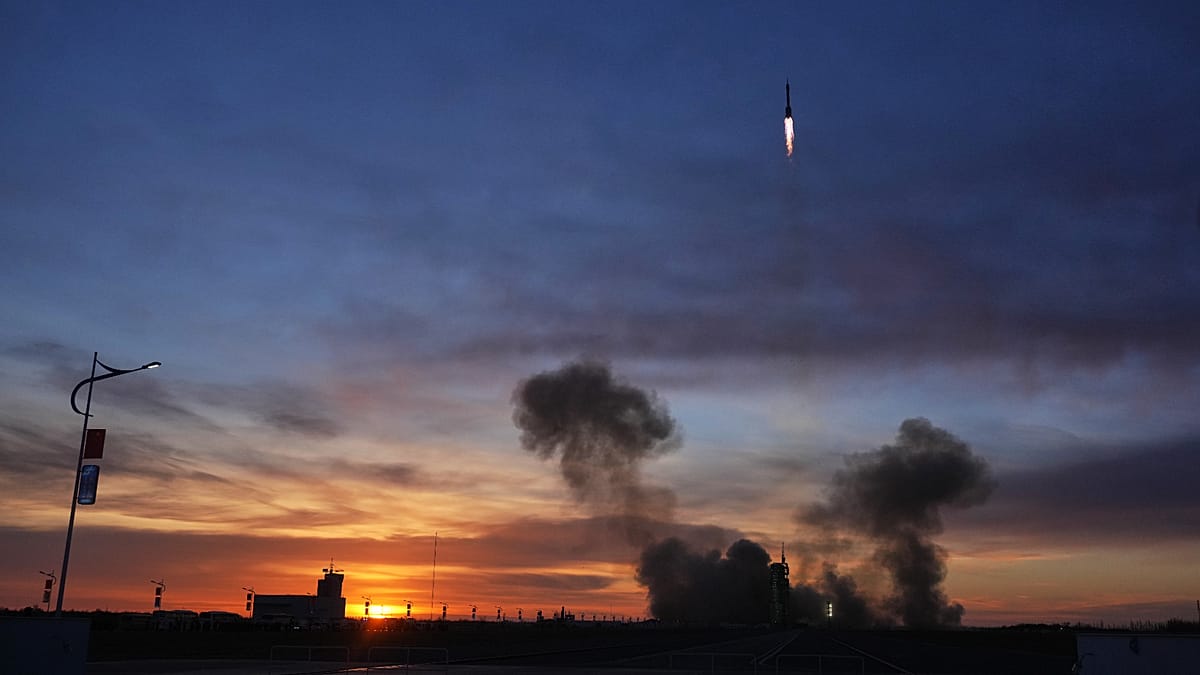
A Long March 2-F rocket lifted off from the Jiuquan Satellite Launch Centre in northwestern China at 8:18 am local time on Wednesday, carrying the Shenzhou-24 spacecraft and three astronauts toward the Tiangong space station. Among the crew is a Pakistani astronaut, marking the first time a non-Chinese national has flown on a Chinese crewed mission.
Footage from state broadcaster CCTV showed the rocket climbing into a clear sky amid billowing flames and smoke, with onlookers at the launch site watching from a distance. Inside the space station, astronauts already on board followed the ascent on a screen, awaiting the arrival of their new colleagues.
The mission underscores China's expanding ambitions in human spaceflight and its willingness to bring allied nations into its orbital programme. For Pakistan, the flight is a point of national pride and a tangible result of the two countries' long-standing strategic partnership. The inclusion of a Pakistani crew member also signals Beijing's intent to position Tiangong as an alternative to the International Space Station, which has traditionally been led by the United States and Russia.
European implications of a new space axis
For Europe, the launch carries strategic significance that extends beyond the spectacle of a rocket firing. As the European Space Agency (ESA) and its member states reassess their own access to space, China's ability to offer crewed flights to partner nations presents both a challenge and a potential opportunity. European countries with strong commercial or diplomatic ties to Beijing, such as Hungary and Serbia, may be tempted to explore similar arrangements, while others remain wary of deepening dependence on Chinese infrastructure.
The mission also comes at a time when the European Union is tightening its stance on China in other domains. The European Commission recently unveiled its 22nd sanctions package aimed at Russia's war economy, a move that indirectly affects Beijing's calculations, as China has been a key economic partner for Moscow. Meanwhile, concerns about cyber espionage persist, with China-linked hackers suspected in a month-long breach of EU institutions, adding a layer of mistrust to any potential collaboration in space.
Yet the Shenzhou-24 flight is not merely a geopolitical statement. It is a technical achievement that demonstrates China's growing proficiency in sustained orbital operations. Tiangong, which has been continuously crewed since 2021, is now a permanent outpost in low Earth orbit, and Beijing has announced plans to expand it further and to conduct crewed lunar missions by the end of the decade.
The Pakistani astronaut's participation is the result of an agreement signed between the two countries in 2022, under which Pakistan would send a crew member to Tiangong. The selection process involved rigorous training in China, and the astronaut was integrated into the crew as a fully fledged mission specialist. This model of cooperation could serve as a template for other nations seeking access to space without relying on Western partners.
For European observers, the launch raises questions about the future of international space governance. The ISS is slated for decommissioning in the early 2030s, and while ESA is developing its own capabilities, including the Ariane 6 rocket and the Orion service module, a gap in crewed flight capability is likely. Some European governments may see Tiangong as a pragmatic option for scientific research and astronaut training, even as they navigate the broader political tensions with Beijing.
The mission also highlights the growing competition in space between China and the United States, a rivalry that Europe is caught in the middle of. Washington has sought to exclude China from international space projects, citing security concerns, while Beijing has countered by building its own partnerships, particularly among developing nations. Pakistan's inclusion is a clear signal that China is willing to share its space infrastructure with allies, much as the US and Russia did during the Cold War.
As the Shenzhou-24 crew settles into their six-month stay aboard Tiangong, they will conduct a series of experiments in life sciences, materials science, and space medicine, some of which will be carried out in collaboration with Pakistani researchers. The results could have implications for long-duration spaceflight, a field where European scientists have also been active, particularly through their work on the ISS.
For now, the launch is a moment of celebration for China and Pakistan, but its ripples will be felt in Brussels, Paris, and Berlin, where policymakers must decide how to respond to a world in which space is no longer the preserve of a few Western powers. The choice is not simply between engagement and isolation, but between shaping the rules of a new era or watching others write them.