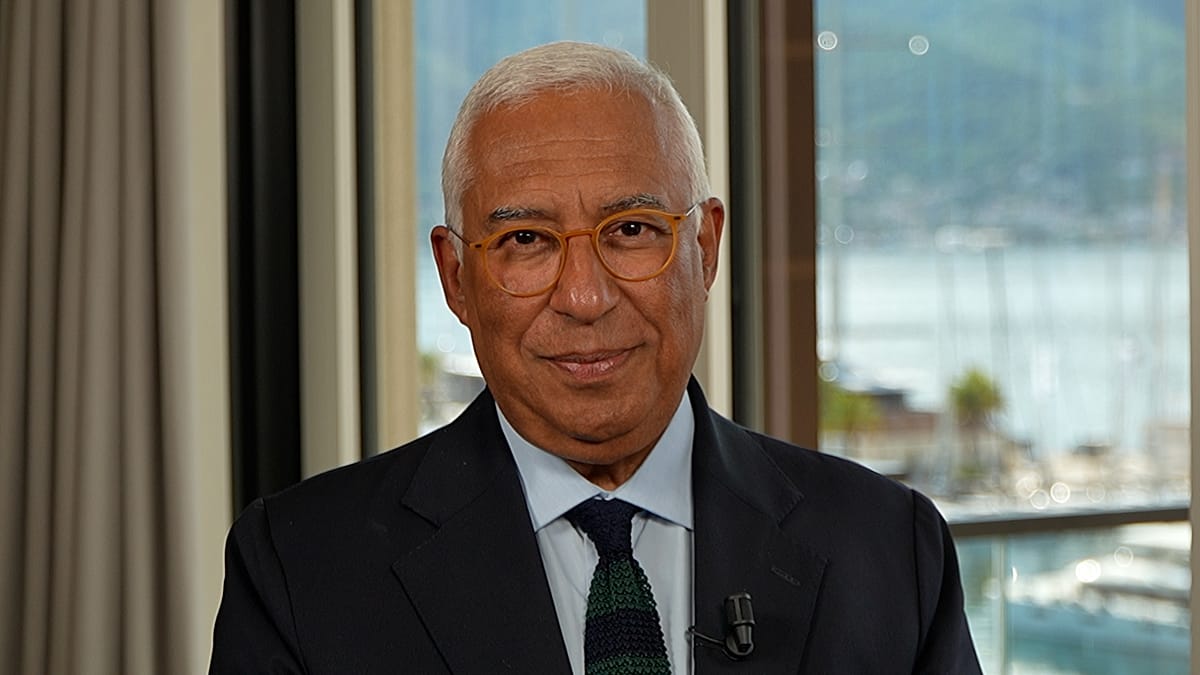
European Council President António Costa has thrown his weight behind a simplification of the European Union's enlargement procedures, arguing that the bloc must move faster to demonstrate its commitment to integrating the Western Balkans. Speaking exclusively to Euronews from Tivat, Montenegro, where EU and Western Balkan leaders are gathering for a summit on Friday, Costa outlined potential changes to what he described as an overly burdensome process that has left some candidate countries in limbo for nearly two decades.
“We currently need to vote more than 40 times to deliver in all the process,” Costa said, adding that the EU could “reduce the moments when we take decisions to streamline” the process. Under current rules, EU membership requires unanimous approval from all member states at several stages, giving individual governments the power to veto progress. This has historically derailed bids, such as North Macedonia’s, which faced repeated vetoes from Greece and Bulgaria over bilateral disputes. Former Hungarian Prime Minister Viktor Orbán also routinely used veto powers to block Ukraine’s advancement.
Costa proposed a targeted change: “I personally believe that we don't need unanimity to open chapters and clusters. We just need unanimity to close chapters and clusters.” He was referring to the 33 so-called “chapters” of the accession process, grouped into six thematic “clusters,” which candidates must complete before joining the Union. He also suggested that “bilateral issues” that could stall a country’s bid should be addressed between the countries involved, with institutional support, but not to the detriment of the candidate.
New Momentum for Enlargement
Costa’s remarks follow a significant breakthrough in Ukraine’s accession talks, after Hungarian Prime Minister Péter Magyar lifted a two-year veto on Kyiv’s negotiations following a deal on the rights of the Hungarian minority in Ukraine. Costa hailed the “new attitude of Hungary in the European Union” as “positive.”
The Council president also floated the idea of using more “transitional periods” for candidate countries to make the process more efficient. For instance, the EU already phases in new members into aspects of its Common Agricultural Policy (CAP). “We learned from the previous enlargement process that we always adopted transitional clauses on policies like agriculture and freedom of movement,” Costa said. “And now, because we are talking about a very challenging enlargement, perhaps we also need transitional clauses on institutional matters.” While he did not specify how new members could be phased into EU institutions, a recent proposal by German Chancellor Friedrich Merz suggested withholding full voting rights from Kyiv as part of an “associate EU membership” before full membership.
In a joint op-ed published in February, Albanian Prime Minister Edi Rama and Serbian President Aleksandar Vučić called for accelerated integration without a veto right, effectively proposing EU membership without full powers in exchange for a seat at the table. Both Serbia and Albania are candidate countries.
Costa will be joined by European Commission President Ursula von der Leyen, 22 EU leaders including France’s Emmanuel Macron and Germany’s Friedrich Merz, as well as all six Western Balkan leaders in Tivat for talks later on Friday. The Western Balkan leaders represent the five official candidates—Albania, Bosnia and Herzegovina, Montenegro, North Macedonia, and Serbia—as well as Kosovo, currently considered a “potential candidate.”
The choice of venue is symbolic: Montenegro is widely seen as the frontrunner among candidate countries and is tipped to become the 28th EU member state as early as next year, a prospect Costa described as “not impossible.” It would mark a breakthrough in the EU’s enlargement drive, which stalled until Russia’s 2022 invasion of Ukraine injected new geopolitical urgency. Montenegro is often viewed as politically and symbolically important but manageable given its relatively small size.
Ahead of the summit, Paris and Berlin co-authored a non-paper calling for “new momentum” in enlargement by simplifying rules and offering “additional incentives” for candidate countries to integrate gradually. “We aim at a new, process-oriented approach which cuts overformalized hurdles for intermediate steps and simplifies the current methodology,” the Franco-German non-paper states. According to diplomatic sources, the pitch is designed with the Western Balkans and Moldova in mind, with no references to Ukraine.
Kyiv has been urging Brussels to fast-track its application, framing EU membership as a crucial post-war security guarantee in the absence of NATO membership. The bloc is in talks on strengthening its mutual defence clause, Article 42.7, which could provide Ukraine with a security shield against future aggression. Officials in Brussels have been exploring alternative integration plans for Ukraine, branded under names like membership-in-reverse, associate membership, and membership-lite, though none have gained broad support. Costa nonetheless expressed optimism about Ukraine’s negotiations.