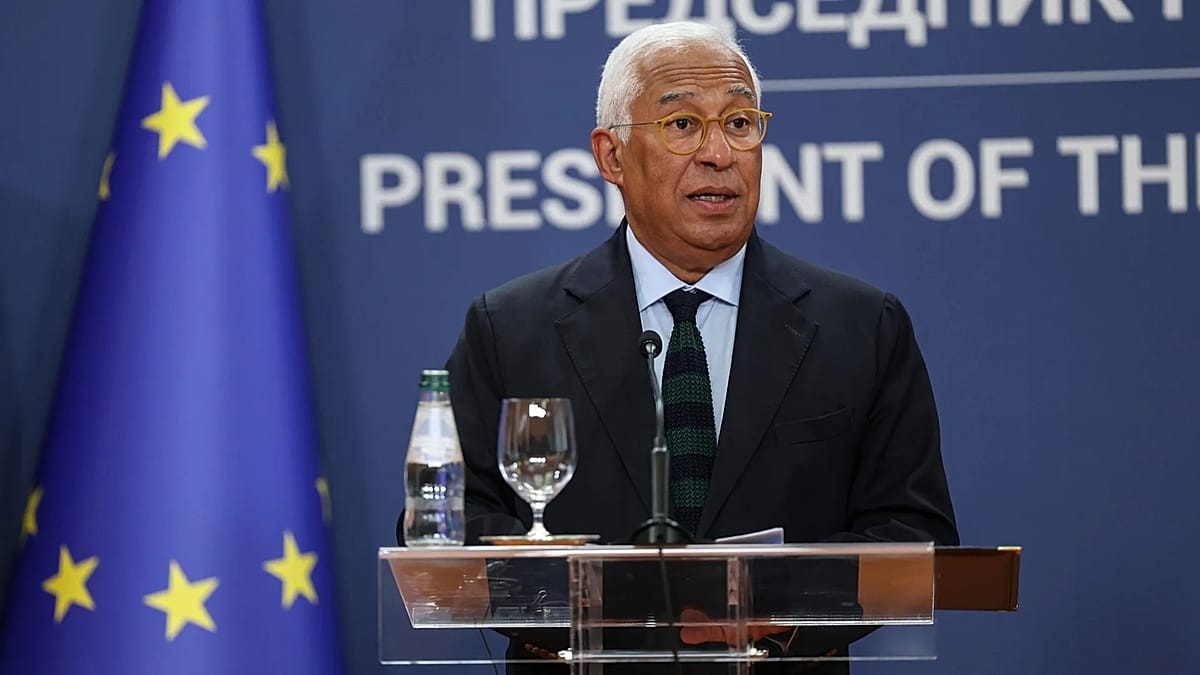
European Council President António Costa has defended his surprise decision to open a diplomatic channel with the Kremlin, a move that dominated Thursday’s summit of EU leaders in Brussels and exposed sharp divisions among member states over how to engage with Russia.
Costa, a Portuguese politician who has made maintaining unity among the 27 a cornerstone of his presidency, instructed his chief of cabinet, Pedro Lourtie, to hold several phone calls with a top aide to Russian President Vladimir Putin. Although Costa’s office did not confirm the identity of the Russian official, it is understood to be Yuri Ushakov, a veteran diplomat and foreign policy adviser.
“The President explained that he had asked his office to open a diplomatic channel with Russia. The aim was to be ready, when the right moment comes, to defend the EU’s interests,” an EU official told reporters. “What we are talking about are brief contacts, with no exchange on substance and no negotiations — simply diplomats carrying out diplomatic work.”
Mixed Reactions from Member States
The initiative has drawn a mixed response. Leaders of Belgium, Slovenia, and Austria publicly welcomed the move, while Slovakia and Bulgaria are also seen as supportive. Slovenian Prime Minister Janez Janša said, “Any steps that can lead to a cessation of hostilities and negotiations should be welcomed.”
However, Poland, the Baltic states, and the Nordic countries expressed concern, according to several diplomats. Critics argue that the timing is premature and that any engagement with Moscow should be handled through the E3 format — Germany, France, and the United Kingdom — which has been exploring its own channel to the Kremlin.
The episode underscores the deep divisions among EU members when dealing with Russia. Dutch Prime Minister Rob Jetten summed up the cautious stance: “Both Ukraine and Europe have always been very clear that ultimately you will need negotiations to reach a lasting peace deal. But as long as the Russians are not willing to do that, we must help Ukraine to get the upper hand on the battlefield.”
Costa’s team insisted that the move was encouraged by Ukraine itself. Ukrainian President Volodymyr Zelenskyy had previously called on Europeans to take a bigger role in the peace process, including by talking to Russia. “It is important for it to have a strong voice and presence in this process, and it is worth determining who will represent Europe specifically,” Zelenskyy said last month after speaking with Costa.
Summit conclusions endorsed by the 27 leaders on Thursday stated, for the first time, that the EU was ready to “step up its engagement” in negotiations. Yet the diplomatic communication occurred days before those conclusions were sealed, raising questions about whether Costa had a mandate or acted with the backing of only a few member states. Multiple officials from several countries told Euronews they were not consulted and learned of the contacts through media reports.
Some leaders suggested that Costa could be appointed as a special envoy for direct talks with Russia, a role that has been floated in recent weeks. “A number of leaders indicated that Costa would be the natural representative of the bloc’s interests,” an EU official said, hinting at potential support for such a move.
The controversy comes as the EU continues to grapple with its approach to Russia amid the ongoing war in Ukraine. Recent events, such as the Russian drone barrage hitting Kyiv and Mykolaiv and the deadly drone strike on a home in Zaporizhzhia, underscore the persistent violence that makes any diplomatic opening fraught with difficulty.
Costa’s decision to open a channel without broad consultation has tested the unity he has championed. Whether this initiative will lead to tangible progress or further discord remains to be seen, but it has already highlighted the fundamental disagreements among EU capitals on how to navigate the path to peace.