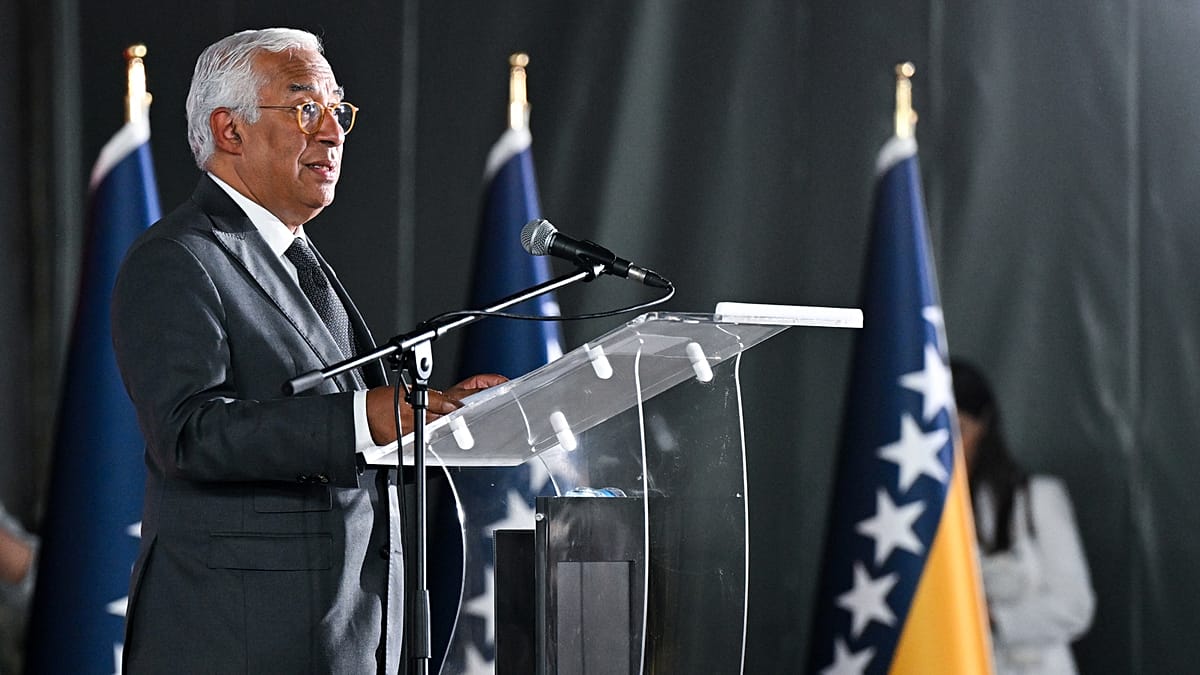
European Council President António Costa begins a one-week tour of the Western Balkans this morning in Sarajevo, Bosnia and Herzegovina, before traveling through six countries and concluding with the EU-Western Balkan Summit in Tivat, Montenegro on Friday. The trip signals a renewed push from Brussels to reinvigorate the enlargement process, which has stalled for nearly two decades.
Officials close to Costa describe the tour as a demonstration of the “priority and importance” he attaches to the region, framing accession as a “necessity for Europe and investment in the security and stability of the continent.” All six Western Balkan countries except Kosovo are official EU candidates; Pristina is recognized as a “potential” candidate. Montenegro is considered the frontrunner, with some analysts predicting it could join the bloc by the end of this year.
The summit’s setting in Tivat, Montenegro, is particularly symbolic. It will be attended by most EU leaders and all six Western Balkan heads of state. For countries that have waited up to two decades in the EU’s waiting room, Montenegro’s imminent accession could be a landmark moment for the region’s European aspirations.
As one senior EU official put it: “There is an opportunity and momentum, and we believe both the EU and the region should seize it.” Former European Commission Vice-President Věra Jourová echoed this sentiment on Europe Today, stating: “I see that we need them to join more than they need Europe. This is obvious, that we need to have courage to grow. We are under big pressure from outside.”
Ukraine’s Shadow Looms Over Enlargement Debate
While this week’s focus is on the Western Balkans, the broader enlargement debate is increasingly shaped by events further east. Ukrainian President Volodymyr Zelenskyy continues to push for a fast-track membership process as a key post-war security guarantee. Brussels officials are being forced to rethink how enlargement works, though no consensus has emerged.
German Chancellor Friedrich Merz recently proposed an “associate” EU member status for Ukraine, allowing it to participate in EU talks without voting rights. The idea was swiftly dismissed by diplomats and sharply criticized by Kyiv. Despite Brussels publicly insisting that the established, merits-based accession process remains intact, officials privately acknowledge that any bending of the rules for Ukraine would inevitably apply to all candidate countries, including the Western Balkans.
Meanwhile, Romania is still reeling from a Russian drone strike that hit a civilian building in Galati last Thursday. President Nicușor Dan published photographic evidence over the weekend, identifying the drone as a Russian Geran-2 and holding Moscow “solely responsible.” Former NATO Deputy Secretary General and Romanian Foreign Minister Mircea Geoană told Europe Today that the “shock” is “still here with us,” calling for better prioritization in procuring drone and anti-drone technology to protect Romanian and European skies.
In a separate development, US Defense Secretary Pete Hegseth criticized European NATO allies during a speech in Singapore, contrasting them with Asian partners. “When our interests align, we act together with focused resolve,” Hegseth said. “When our interests diverge, we adjust pragmatically without the drama or the moralising. I think Western Europe might take note.” The remarks came after President Donald Trump’s visit to China and were notably more restrained than Hegseth’s previous speech, which described Beijing as an “imminent threat” to Taiwan.
Israel’s seizure of a strategic Crusader-era castle in Lebanon—its deepest incursion in 26 years—has prompted a fierce rebuke from France, which called for an urgent UN Security Council meeting. The EU’s foreign policy chief Kaja Kallas is also meeting Pakistan’s Deputy Prime Minister and Foreign Minister Mohammad Ishaq Dar in Islamabad, as Pakistan mediates between Iran and the US.
In France, authorities detained 457 people after violent celebrations of Paris Saint-Germain’s Champions League title win. President Emmanuel Macron condemned the scenes as “unacceptable” when he received the team in Paris on Sunday. The arrests followed thousands of fans pouring onto streets across the country after PSG beat Arsenal on penalties in Budapest.



