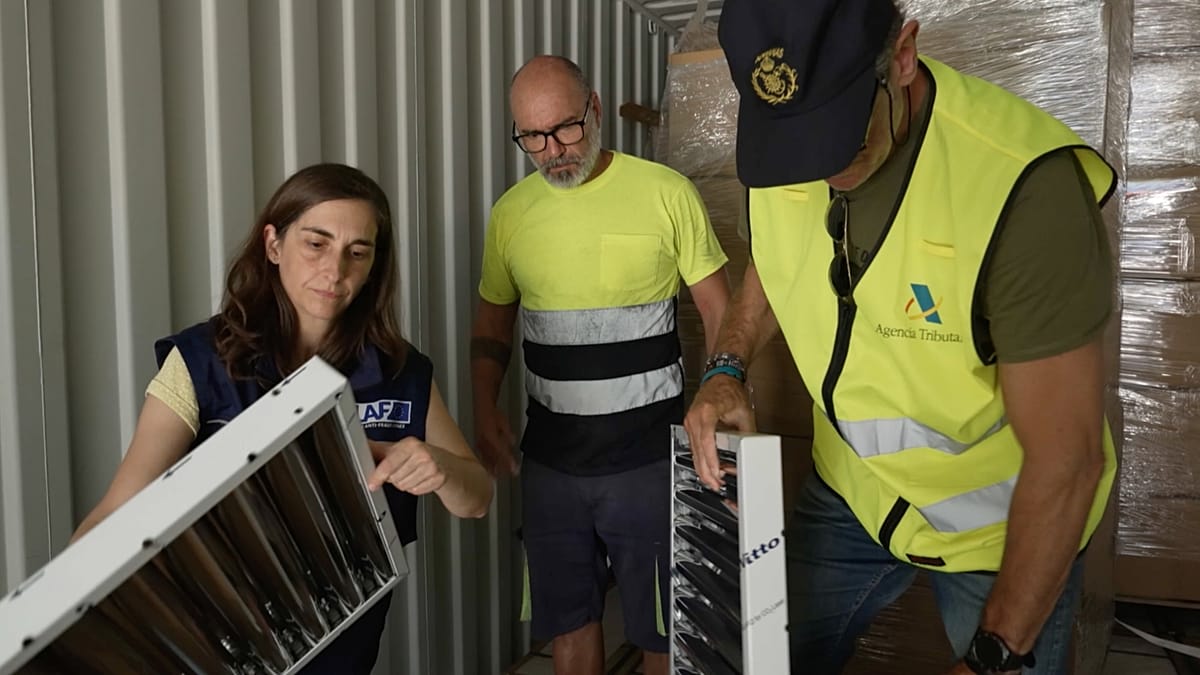
At the port of Alicante on Spain's Mediterranean coast, officers from the European Anti-Fraud Office (OLAF) and Spanish Customs work in tandem, sifting through shipping containers in search of counterfeit products tucked among legitimate cargo. Their work is part of a wider European effort to stem a tide of fake goods that, according to recent estimates, now accounts for nearly 5% of all imports into the European Union.
The scale of the problem is staggering: businesses across the bloc lose an estimated €83 billion each year to counterfeit trade. But the damage goes far beyond lost revenue. Investigators warn that the profits from these illicit sales often flow into organized crime networks, and that consumers are unknowingly financing them every time they buy a suspiciously cheap pair of trainers or a replacement phone battery online.
From luxury fakes to dangerous counterfeits
Counterfeiting is no longer confined to luxury handbags and designer watches. The modern illicit trade is a sophisticated global business model, according to experts, and it has expanded into sectors where the risks to public safety are far more serious. Fake car parts, for instance, can fail at critical moments, while counterfeit electronics may overheat or catch fire. Even more alarming is the proliferation of fake pharmaceuticals and food products, which can contain harmful substances or incorrect dosages.
"This is not just about intellectual property theft," said a senior OLAF official involved in the Alicante operations. "It is about protecting European consumers from products that can kill." The official, who spoke on condition of anonymity, noted that the COVID-19 pandemic accelerated the trend, with criminals quickly shifting to counterfeit masks, tests, and even vaccines.
The port of Alicante is a key entry point for goods arriving from Asia, and it has become a testing ground for new detection techniques. Customs officers use a combination of risk profiling, x-ray scanners, and physical inspections to identify suspicious shipments. But the sheer volume of containers—millions pass through European ports each year—means that only a fraction can be thoroughly checked.
A global network with local roots
The counterfeit trade is not a faceless operation. It is run by organized crime groups that operate across borders, often using the same logistics networks as legitimate businesses. They exploit free trade zones, e-commerce platforms, and even social media to reach consumers directly. In many cases, the production sites are located outside the EU, but the distribution networks are deeply embedded within member states.
Recent seizures have revealed the breadth of the problem. In a single operation last year, authorities in Germany, Italy, and the Netherlands confiscated over 500,000 counterfeit items, ranging from automotive brake pads to children's toys. The goods were destined for markets in Berlin, Milan, and Rotterdam, among others.
The economic impact is felt most acutely by small and medium-sized enterprises (SMEs), which often lack the resources to fight counterfeiters in court. According to the EU Intellectual Property Office (EUIPO), SMEs account for the majority of companies affected by counterfeiting, and many are forced to cut jobs or reduce investment in innovation as a result.
Consumer awareness and the role of e-commerce
One of the most troubling aspects of the modern counterfeit trade is the ease with which consumers can inadvertently purchase fake goods. Online marketplaces, in particular, have become a haven for counterfeiters, who can set up shop with minimal oversight. A recent survey by the EUIPO found that one in three Europeans has unknowingly bought a counterfeit product online.
"Consumers are often drawn in by low prices, but they rarely consider the consequences," said a spokesperson for the European Commission's Directorate-General for Taxation and Customs Union. "Every euro spent on a fake product is a euro that goes into the pockets of criminals."
The Commission has been pushing for stricter regulations on e-commerce platforms, including mandatory checks on sellers and faster removal of listings that infringe intellectual property rights. However, progress has been slow, as platforms argue that they are not responsible for the goods sold by third-party sellers.
In the meantime, customs authorities are stepping up their efforts. The European Union's new Customs Reform Package, proposed in 2023, aims to create a more centralized and data-driven approach to customs controls, with the goal of better identifying high-risk shipments before they reach European shores.
But experts say that more needs to be done. "We need a coordinated response that involves not just customs and police, but also the private sector and consumers," said the OLAF official. "This is a fight that cannot be won by one country alone."
As the sun sets over the port of Alicante, the containers keep coming. Each one holds the potential for either legitimate trade or hidden danger. The officers on the ground know that their work is a constant battle, but they also know that every seizure makes a difference—for the businesses that lose revenue, for the consumers who might have been harmed, and for the rule of law in Europe.