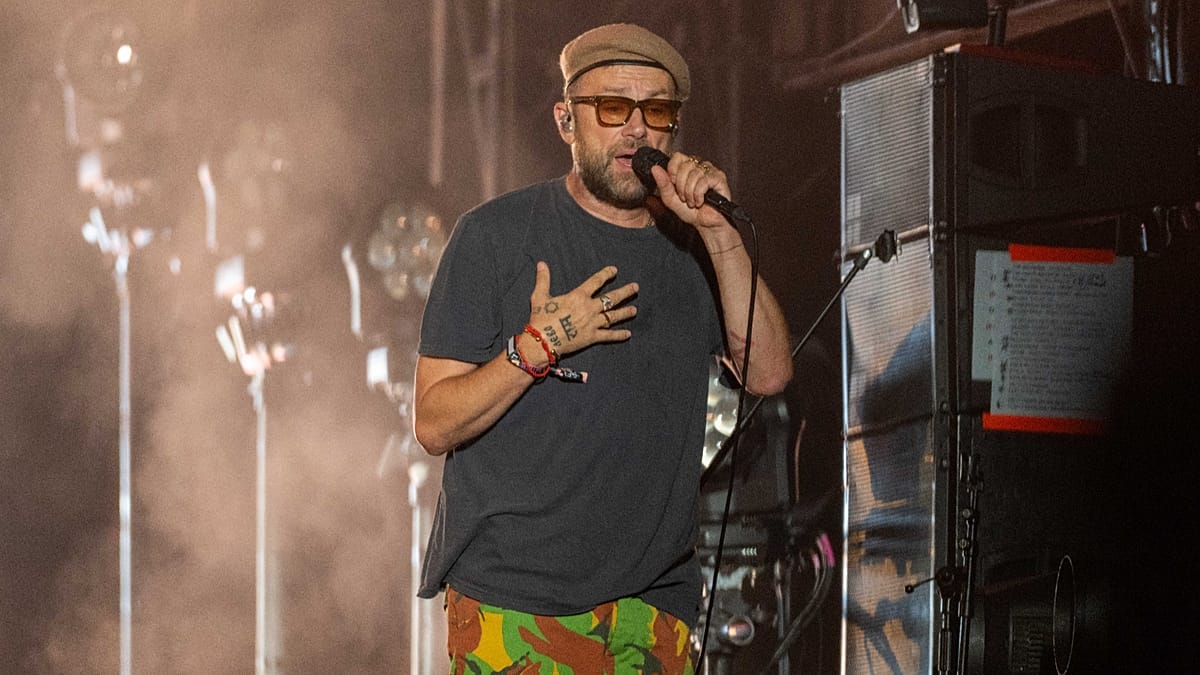
Gorillaz opened their 2026 North American tour in Orlando this weekend, and frontman Damon Albarn used the moment to make a political statement that has reignited debate across the music industry. Taking a Palestinian flag from a member of the audience at the Kia Center, Albarn held it above his head and told the crowd: “Don’t forget this. Ever. Stand your position. Don’t ever be neutral.”
Albarn is far from the first European artist to speak out on the war in Gaza. Acts such as Massive Attack, Kneecap, Fontaines D.C., and Patti Smith have all expressed solidarity with Palestinians in recent months. But his intervention lands at a particularly sensitive moment, following the controversy that erupted around Ed Sheeran’s tour and the dismissal of rapper Macklemore.
A widening rift over neutrality
The row began when Macklemore, during a support slot on Sheeran’s US tour, delivered a speech in which he declared “Free Palestine” and criticised Israel’s military campaign. Robert Kraft, owner of the Gillette Stadium where the concert took place, called the remarks “deeply offensive and hurtful to the Jewish community”, and Macklemore was removed from the line-up. In his speech, Macklemore had explicitly sought to pre-empt accusations of antisemitism: “To all of my Jewish brothers and sisters: criticism of Israel, criticism of apartheid, being against genocide in no way is a criticism of you. My message is for peace; love for all human beings to be treated with dignity, respect, and equality.”
Sheeran, who returned to the stage this weekend without his supporting acts or backing band—all of whom quit in solidarity with Macklemore—admitted to having made “mistakes” and said the episode had made him question whether he wanted “to be an artist at all”. He told the audience: “I don’t want to disappoint fans, and I’ve never wanted to be an activist musician, but this has put me in the middle of an important and passionate argument about freedom of speech and the most complex political issue on the planet. The last week of my life has been one of the worst weeks… Tonight has been honestly the best show of my life. In this situation you really find out who your friends are… People I’ve known for years are backing away.”
His comments drew further criticism online, with many accusing Sheeran of centring his own discomfort rather than the devastating loss of life in Gaza. Massive Attack responded sharply, stating that “neutrality in the face of the slaughter of more than 20,000 children can never be neutrality”. Former Pink Floyd frontman Roger Waters was blunter, calling Sheeran a “little prick”.
Albarn’s long-standing stance
For Albarn, the Orlando moment is part of a longer pattern of outspokenness on Palestinian rights. In an interview with Channel 4 News last year, he said: “I think it’s about not denying the legitimacy of Palestine, not denying the historical presence of Palestinians and recognising the genocide that is taking place there. It’s impossible to watch. It just feels so horrendously helpless and we cannot deny the Palestinians their existence, which is what’s going on at the moment. It’s just wrong. Palestinians belong there and you can’t just kick them out. It’s not acceptable.”
The war began with the Hamas attack on Israel on 7 October 2023. Since then, the Gaza health ministry has reported more than 73,000 deaths from Israeli bombardment. Amnesty International, Human Rights Watch, and the United Nations have all described Israel’s actions as “genocide”. A UN independent commission report published in June found that “Israeli authorities and security forces have deliberately targeted Palestinian children, resulting in genocide and atrocity crimes in the Gaza Strip and war crimes in the West Bank.”
The debate over artistic neutrality is not confined to the United States. Across Europe, musicians and cultural figures have faced pressure over their positions on the conflict, and the question of where to draw the line between personal expression and institutional expectations remains unresolved. As Albarn’s words echo through arenas and social media, they serve as a reminder that for many artists, silence is no longer an option.