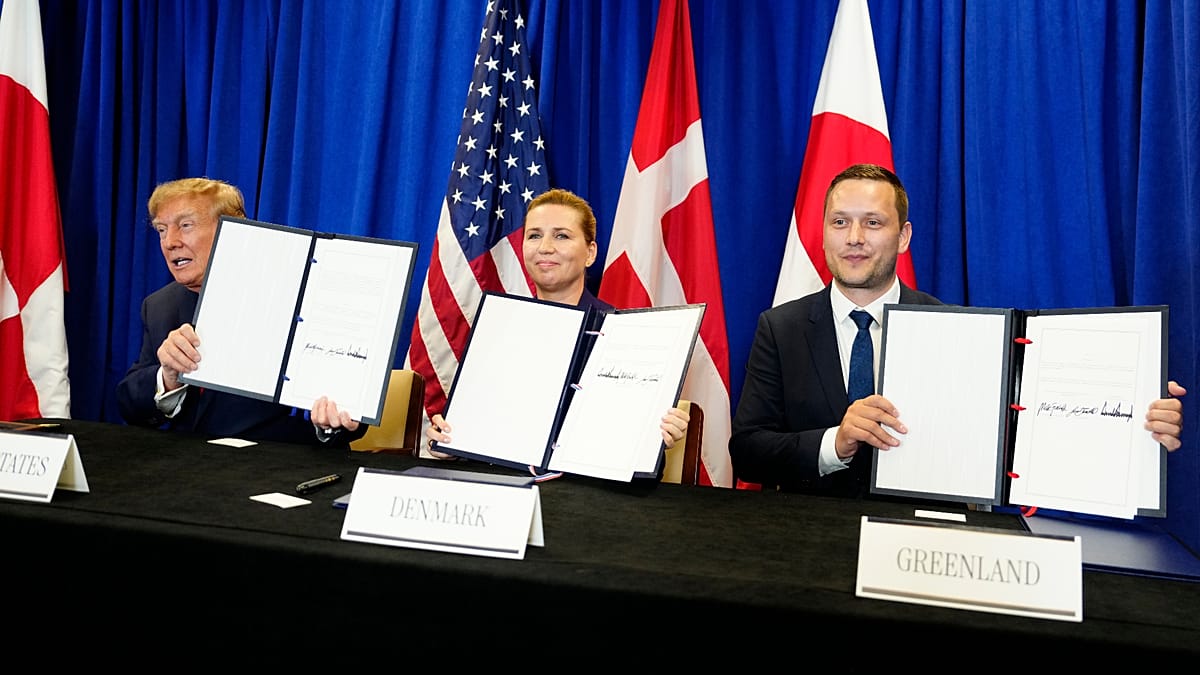
A viral clip from the signing ceremony for the US-Greenland security deal has sparked claims that Denmark deliberately played Stephen Sondheim's "Send in the Clowns" to embarrass US Secretary of State Marco Rubio. The video, shared widely on X, Bluesky, Facebook and Instagram, shows Rubio in the room as the song's lyrics — "Where are the clowns? Send in the clowns. Don't bother, they're here" — are heard. One post on X amassed over 1.3 million views, and an Instagram account went further, alleging that "Denmark just humiliated Marco Rubio at the United Nations!"
But the premise is false. The Danish Ministry of Foreign Affairs told Euronews' fact-checking team that Copenhagen was not involved in selecting the music played before the ceremony on 22 September at UN headquarters in New York. The US Mission to the United Nations did not respond to a request for comment, but there is no evidence that Danish officials or media had any say in the playlist.
The song, written by Sondheim for the 1973 musical A Little Night Music and performed by Judy Collins, was indeed one of the tracks played in the moments before President Donald Trump entered the room to sign the agreement with Danish Prime Minister Mette Frederiksen and Greenland's Prime Minister Jens-Frederik Nielsen. A replay on UN TV confirms the timing, but the choice appears to have been made by the event organisers, not the Danish delegation.
What the deal actually involves
The agreement, reached after ten months of negotiations, ends a diplomatic standoff that began when Trump repeatedly demanded control of Greenland and refused to rule out military force. Under the terms, the US will modernise and enlarge its Pituffik Space Base and establish new defence areas at Narsarsuaq and Mestersvig. The deal also grants US forces "free access to and movement between" these areas, including territorial waters, by land, air and sea, and allows US aircraft to fly over and land anywhere on the island.
At the height of the Cold War, the US operated 17 military facilities and hosted more than 10,000 troops on Greenland. Today, only Pituffik remains, serving as the Department of Defense's northernmost installation, used for missile warning, missile defence and space surveillance, according to the US Space Force.
Frederiksen said the pact "strengthens our common security in the Arctic and the North Atlantic Area," while Nielsen called it "to the benefit of us all." NATO Secretary General Mark Rutte welcomed the deal on X, writing that it enhances the collective security of NATO members.
The episode highlights the lingering sensitivities around the agreement, which has divided opinion in Copenhagen. Some politicians have questioned whether Denmark conceded too much, while others see it as a pragmatic step. For a deeper look at the domestic debate, see our analysis of Copenhagen's split on the pact.
The broader context is Greenland's strategic importance, not just for the US but for Europe. The island sits on vital Arctic shipping routes and holds vast mineral resources. Denmark's minister for Greenland has said those resources are open to all investors, a stance that could reshape the region's economic future.
For Washington, the deal secures a foothold in the Arctic at a time of heightened great-power competition. Our piece on what Washington actually gained breaks down the strategic calculus.
As for the music, the claim is a textbook example of how a misleading narrative can spread faster than the facts. The Danish foreign ministry's denial is clear, but the clip continues to circulate, often stripped of context. In an era of deepfakes and viral misinformation, it's worth remembering that a song played at a ceremony is not necessarily a diplomatic statement.