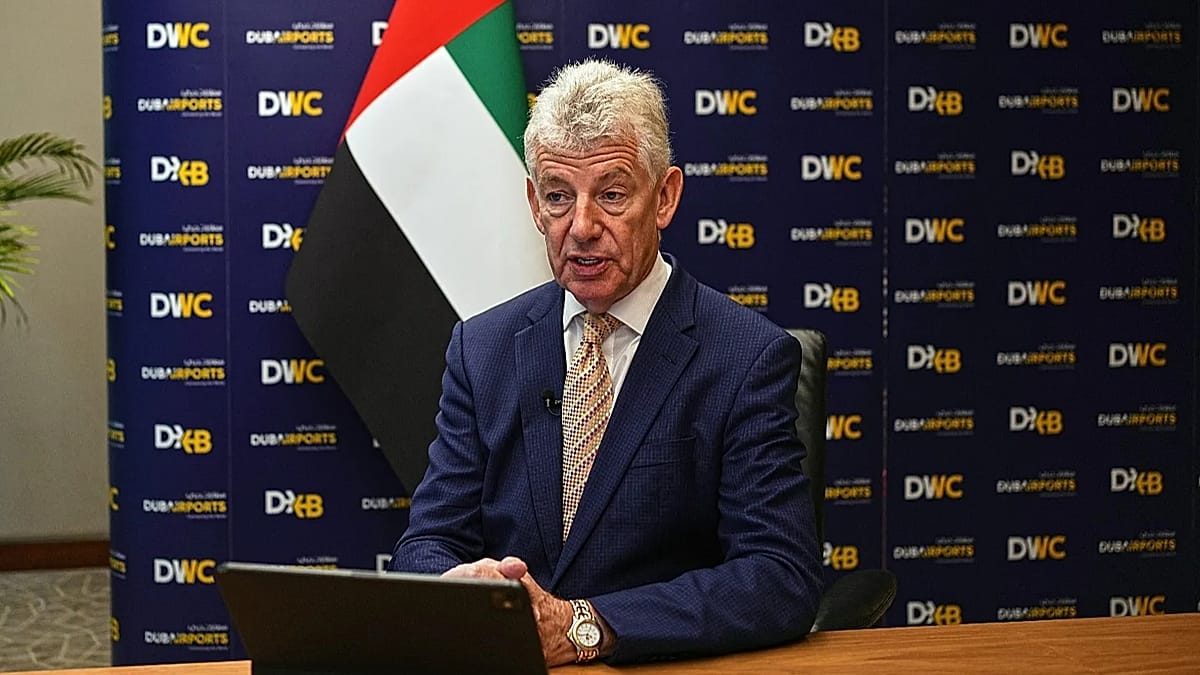
Speaking at the WTTC Global Summit in Malta, Paul Griffiths, CEO of Dubai Airports, outlined a future in which smaller, longer-range aircraft open up direct connections between secondary European cities and Dubai, fundamentally altering how Europeans travel.
“Aircraft technology is changing all the time, and with smaller aircraft able to fly longer distances we'll have all of those secondary cities in Europe directly connected to Dubai,” Griffiths said. He cited Exeter, Valencia, Lyon, Marseille, and Baden-Baden as examples of cities that could soon offer direct flights to the Gulf hub, allowing passengers to “fly from Exeter to Dubai and then on to the world.”
The comments came as Dubai Airports pushes ahead with its plan to transform Al Maktoum International Airport (DWC) into the world’s largest airport, a project announced in 2024. Once complete, DWC will feature 400 terminal gates and five runways, with capacity for 260 million passengers annually. The expansion is slated for completion by 2032.
Griffiths argued that the next decade presents “a fantastic opportunity for regional airports to expand their operations.” He noted that narrow-body jets are now capable of crossing the Atlantic to smaller destinations, where a wide-body aircraft would be commercially unsustainable. “All they have to do is get their surface transport access sorted out,” he added, “and that will be a good place to invest and it will be great for regional economies.”
This vision aligns with broader trends in European aviation, where travel growth is expected to outpace global averages. However, expansion brings environmental challenges. Griffiths emphasised that sustainable aviation fuel (SAF) is “probably the only way” for the industry to eliminate carbon emissions. He pointed to Singapore’s green fuel tax as a model, urging governments to mandate SAF blending and the private sector to invest in production.
“My message is please balance the community impact by mitigating it through taking environmental control seriously, but setting a target and a framework to allow the expansion of the infrastructure to facilitate this increase in income from travel and tourism,” he said.
The future of airport experience
Griffiths also discussed the passenger experience at the new DWC, where he envisions a seamless, technology-driven process that minimises friction. He predicted that passports could become obsolete within five years, a development that would align with UK airports’ plans to scrap passport checks at e-gates by 2027 and the EU’s digital identity wallet initiative.
“I can't comment on the technology that you see, because hopefully if you don't see any technology, then we will have done our job incredibly well,” Griffiths said. “The idea is to make all of the process and the entire customer experience all about human contact.”
Facial recognition will be central, eliminating the need to show a passport or boarding pass, while AI will screen baggage. Griffiths criticised current security procedures, saying that “airport security – and particularly in some airports which I won't name and shame – is probably the most intrusive process that any human being could go through outside of a hospital operating theatre.”
For European travellers, the prospect of direct flights from regional airports to Dubai and beyond could reshape holiday planning and business travel. But as Griffiths’ remarks make clear, the benefits will depend on investments in both infrastructure and sustainability.