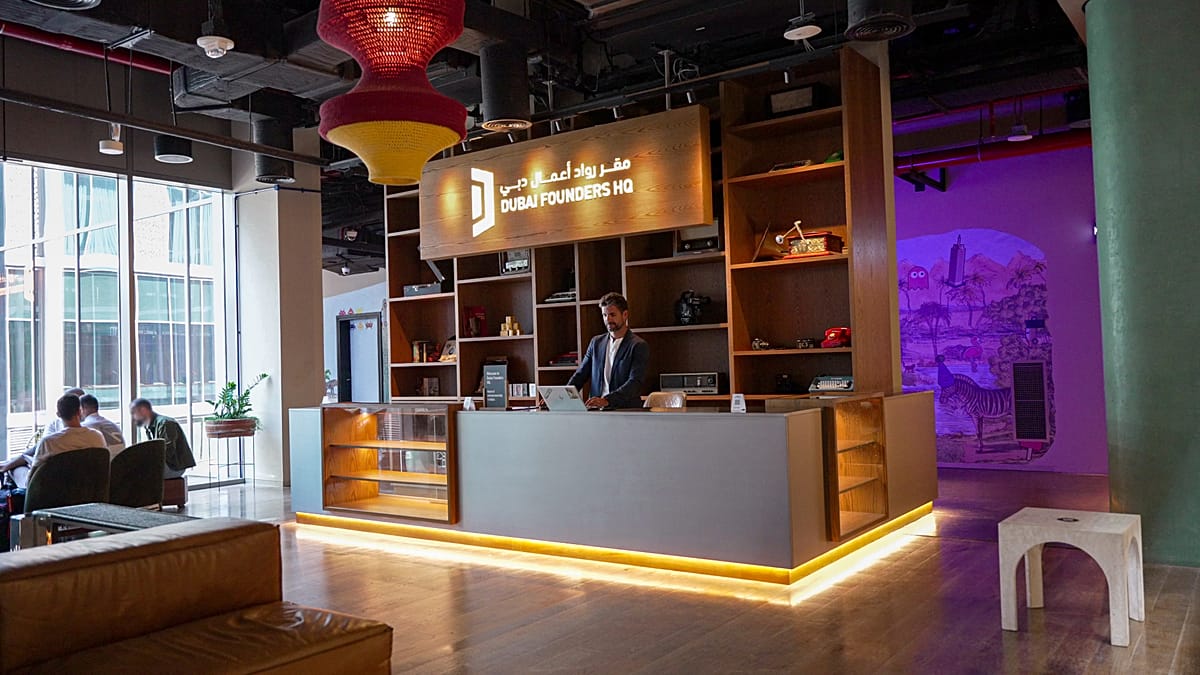
Inside the 25Hours Hotel near the Dubai World Trade Centre, a different kind of energy pulses through the lobby. Alongside tourists and business travellers, entrepreneurs from across the globe occupy co-working desks, meet investors in conference rooms, and attend workshops designed to turn ideas into scalable ventures. This is Dubai Founders HQ, the emirate's flagship startup platform that blends physical space with digital tools to create what it calls a 'phygital' ecosystem.
Launched by Crown Prince H.H. Sheikh Hamdan bin Mohammed bin Rashid Al Maktoum and developed by the Dubai Department of Economy and Tourism and the Dubai Chamber of Digital Economy, the platform aims to solve a familiar problem for founders entering a new market: support exists, but it is fragmented. Investors, accelerators, licensing pathways, and mentorship are scattered, and connecting them takes time that most entrepreneurs lack. Dubai Founders HQ positions itself as the guide—a single entry point that maps the terrain.
A Phygital Approach to Startup Growth
The platform's digital layer includes a curated learning library, an ecosystem directory, and business set-up tools that walk founders through each step. On the ground, it facilitates direct connections with investors, corporate leaders, and ecosystem partners. More than 25 public and private sector partners—including venture capital firms, corporates, and government entities—have already joined, creating a network that spans sectors and stages.
For European founders eyeing expansion into the Middle East, this model offers a structured alternative to navigating Dubai's fast-moving business environment alone. The platform's programmes, delivered with global players like Antler, Endeavor, and Plug and Play, provide mentorship, capital pathways, and corporate access. The first Plug and Play accelerator cohort, over 100 days, brought together 23 startups and five corporate partners—including du Business, DHL, Talabat, Emirates Flight Catering, and Visa—generating 36 proof-of-concept opportunities. Fifteen entered advanced contracting or due diligence, and five signed agreements were completed by the programme's end, compressing partnerships that typically take over a year into three months.
H.E. Hadi Badri, CEO of the Dubai Economic Development Corporation, said: 'Dubai Founders HQ reflects our commitment to building a founder-first ecosystem—one designed not only to support individual businesses, but to strengthen the conditions that allow entrepreneurship to thrive at scale.'
The initiative sits under Dubai's D33 economic agenda, a ten-year framework targeting the creation of 30 unicorns—startups valued at over $1 billion—and significant SME growth by 2033. If met, these goals would reshape the employment landscape for tens of thousands of people across the city, creating ripple effects in banking, logistics, office space, and technology services.
For European observers, the model raises questions about how cities like Berlin, London, Paris, and Stockholm compete for global talent. While Europe boasts deep tech ecosystems and strong public support, Dubai's speed of execution and government-backed integration may appeal to founders seeking a frictionless path from launch to scale. The platform's emphasis on attracting international founders—including those from Europe—could shift some entrepreneurial flows eastward.
Saeed Al Gergawi, Vice President of the Dubai Chamber of Digital Economy, noted that the platform embodies Dubai's approach to entrepreneurship. The Entrepreneur Academy, recently launched, targets those curious about starting a business, offering a head start through structured learning.
As Dubai Founders HQ expands, its success will depend on whether it can sustain the momentum of its early programmes and continue attracting the right mix of founders, investors, and corporate partners. For now, it offers a compelling blueprint for how a city can systematically lower barriers for entrepreneurs—a lesson that European hubs may want to study.