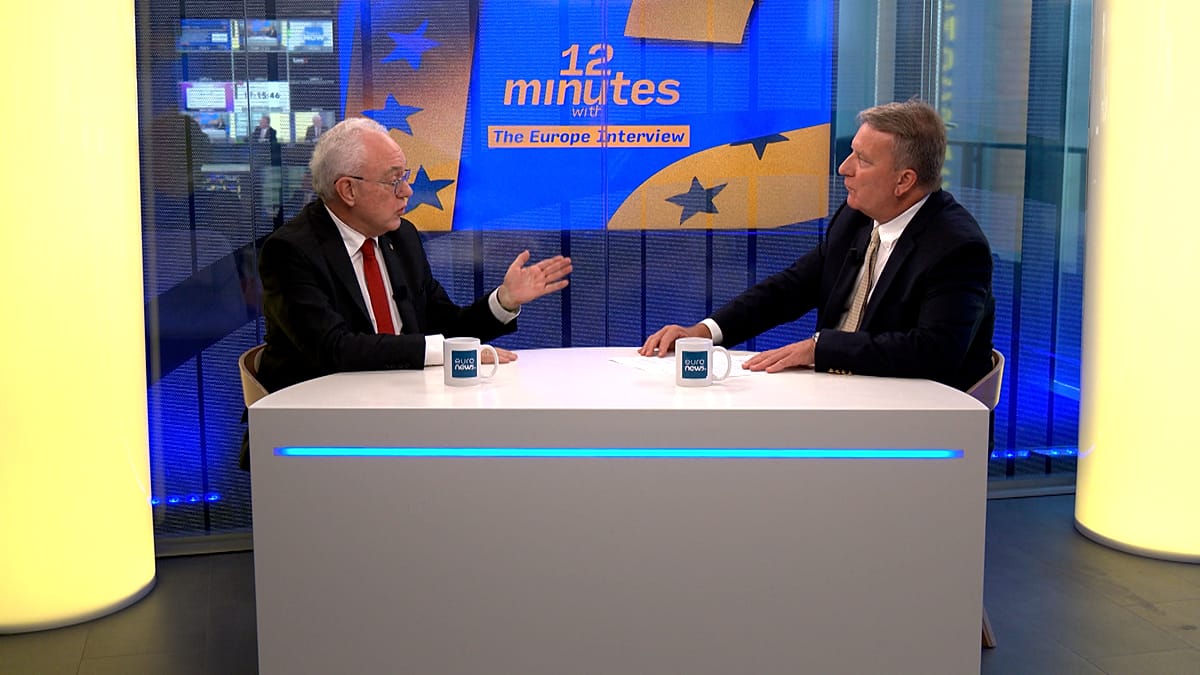
Uruguay's Foreign Minister Mario Lubetkin has delivered a blunt message to Brussels: ratify the long-stalled EU-Mercosur trade agreement or watch China tighten its grip on South America. In an exclusive interview with Euronews during a visit to the Belgian capital, Lubetkin, whose country now holds the rotating presidency of Mercosur, described the deal as a historic opportunity that Europe cannot afford to squander.
“The four Mercosur countries ratified the agreement in just two months,” Lubetkin said. “That has never happened before. Governments from the political right and the left all agreed because we see this as strategically important—not only for us, but for Europe as well.”
The agreement, politically concluded after more than two decades of negotiations, entered its implementation phase for Mercosur on 1 May. In Europe, however, the ratification process remains mired in political contention. In January 2026, the European Parliament voted to request an opinion from the Court of Justice of the European Union (CJEU) on whether the legal structure of the agreement and its provisional application are compatible with EU treaties. As a result, Parliament has not yet given its consent, and the procedure is effectively on hold pending the Court's opinion, which could take more than a year.
Lubetkin acknowledged the uncertainty but expressed confidence that the European Parliament will eventually approve the deal. “I don't know whether it will be in 2027 or 2028,” he said. “That is Europe's decision. From our side, the process is finished.”
Montevideo's Strategic Push
Rather than waiting for Brussels, Uruguay intends to press ahead. As Mercosur president, Montevideo plans to organise the first EU-Mercosur trade forum in December and is working with European Trade Commissioner officials to deepen commercial cooperation even before the ratification process is completed. “Our citizens cannot wait,” Lubetkin said. “They need concrete answers now.”
The minister argued that the agreement has become even more strategically significant than it was five years ago, as global trade becomes increasingly shaped by geopolitical competition. “Europe needs to think about which regions it can work with that share complementary strengths,” he said. “This is a win-win agreement.”
According to Lubetkin, Europeans should expect increased investment flows, stronger economic growth, and new jobs as businesses on both sides of the Atlantic expand their operations. The agreement, he added, is not simply about South American exports entering European markets. “There is plenty of investment capacity in our region as well. This goes in both directions.”
Yet Lubetkin also delivered a clear warning: Mercosur will not wait indefinitely. “If Europe rejects this agreement, the consequences will be much greater for Europe than for us,” he said. Asked whether China would be the obvious alternative partner, Lubetkin replied without hesitation: “Obviously.”
China has been Uruguay's largest trading partner for the past 14 years, while Europe remains the country's biggest source of investment and the United States dominates in services. Rather than choosing sides, Lubetkin insisted Uruguay intends to deepen relations with all major powers simultaneously. “We are not working with China against the United States,” he said. “We work with China, with the United States and with the European Union.”
During Uruguay's six-month Mercosur presidency, the bloc also hopes to conclude trade negotiations with Canada, the United Arab Emirates, and India, while expanding ties with ASEAN countries and Africa. “No one will wait,” Lubetkin warned.
Lubetkin dismissed suggestions that Uruguay risks becoming caught between Washington and Beijing despite growing pressure from the administration of U.S. President Donald Trump to curb Chinese influence across Latin America. “Our policy is positive, not against anyone,” he said. “We want to deepen business relations with all our partners.”
That balancing act reflects Uruguay's broader foreign policy under its centre-left government, which took office in March 2025. Despite an increasingly conservative political landscape across Latin America, Lubetkin rejected the notion that Uruguay is becoming isolated. He pointed to the recent visit of Chilean President Gabriel Boric as evidence that ideological differences are giving way to practical cooperation. “Whether governments are on the right or the left, countries need each other,” Lubetkin said. “The world is changing, and cooperation is becoming more important than political labels.”
For Uruguay, Europe remains the preferred strategic partner. But Lubetkin's message in Brussels was unmistakable: the window of opportunity will not remain open forever. As the EU grapples with internal divisions and external pressures, the stakes extend beyond trade. The outcome of this ratification will shape not only economic ties but also the geopolitical balance in a region where China is already a dominant force. For more on how Europe is navigating global competition, see our analysis of strains on the euro area and the pressure on NATO allies.