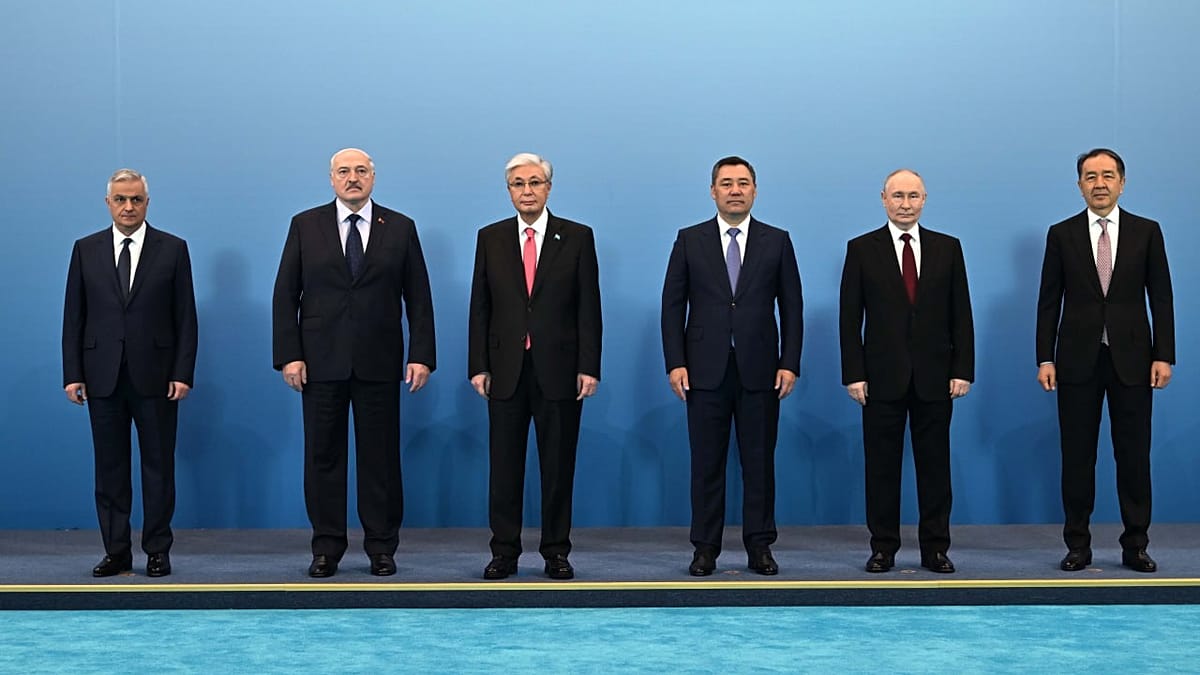
Leaders of the Eurasian Economic Union (EAEU) gathered in Astana for a two-day summit marking the bloc's 12th year, with trade turnover among its five members surpassing €80 billion in 2024. Kazakhstan's President Kassym-Jomart Tokayev projected a further 6% increase this year, potentially exceeding €85 billion, as the bloc deepens its focus on digitalisation and artificial intelligence.
The EAEU, comprising Russia, Belarus, Kazakhstan, Kyrgyzstan, and Armenia, operates as a single integrated market and free trade zone spanning over 20 million square kilometres. Last year, intra-bloc trade more than doubled, while turnover with third countries rose by 72%. Around 90% of settlements are now conducted in national currencies, reflecting a shift away from dollar-denominated transactions.
Digitalisation and AI at the Forefront
Tokayev announced that Kazakhstan, during its EAEU chairmanship, has proposed using AI to implement the bloc's so-called four freedoms—goods, services, capital, and labour. Member states are exploring common principles for responsible AI use, shared computing capacity, and joint model development. Russia's President Vladimir Putin proposed a high-level AI gathering next year to coordinate domestic AI models and connect IT and energy infrastructure.
On the ground, pilot projects are already underway. In Kazakhstan, government agencies and startups have developed AI-powered digital assistants to help citizens navigate legal and regulatory systems. Deputy Minister of Artificial Intelligence and Digital Development Dmitry Mun said these tools aim to simplify legislation, reduce bureaucracy, and make regulatory systems more accessible for businesses and individuals.
Trade Corridors and Logistics Modernisation
Around 85% of goods travelling from China to Europe pass through the Middle Corridor, according to officials. AI is being deployed alongside the Digital Transport Corridor along the Trans-Caspian International Transport Route, with expectations of boosting non-commodity exports by roughly 30% over the next two years. Kazakhstan's Minister of Trade and Integration Arman Shakkaliyev outlined plans to leverage the Middle Corridor and the North–South Corridor to build a fully integrated logistics ecosystem, positioning Kazakhstan as a regional hub. The goal is to handle cargo volumes of around 10 million tonnes by 2030, with railway modernisation and new infrastructure already underway.
China remains the bloc's key external partner, accounting for about one-third of its external trade. The EAEU already has agreements with Serbia, Vietnam, the UAE, Mongolia, and Indonesia, and is exploring further partnerships.
Putin's Visit and Bilateral Deals
The summit followed a state visit by Putin to Kazakhstan, where the two countries signed seven pillars of bilateral cooperation and a broader package covering energy, transport, finance, education, and industrial development. Russia is Kazakhstan's largest investor, with nearly €25 billion already invested, and is building Kazakhstan's first nuclear power plant, valued at around €14 billion. Putin said the plant would meet about 20% of Kazakhstan's electricity demand, with financing conditions aligned with international practice. The project also supports Russian industrial capacity through equipment orders and long-term maintenance contracts, while strengthening cooperation in uranium and nuclear technology.
The EAEU's push for deeper integration comes amid broader geopolitical shifts, including EU shifts toward a harder line on China and ongoing debates over trade balances. The bloc's focus on digital markets and AI mirrors similar efforts in the European Union, though the EAEU's smaller membership and distinct political dynamics present unique challenges.
Tokayev projected GDP growth across EAEU countries at around 2.5% for 2026–2027, underscoring cautious optimism despite global economic uncertainties. The bloc's ability to sustain its record trade turnover will depend on successful implementation of digital tools and infrastructure projects, as well as navigating external pressures from sanctions and shifting trade patterns.