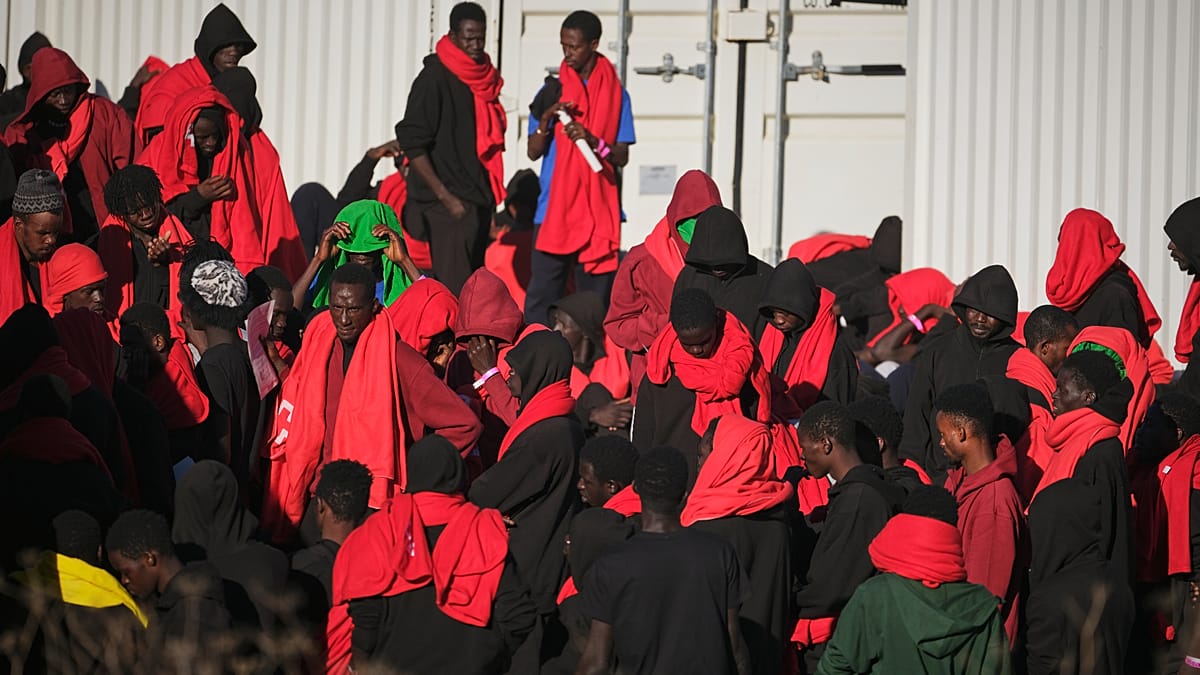
Migration pressure on El Hierro, the smallest of Spain's Canary Islands, intensified again on Sunday as nearly 300 people arrived aboard five traditional wooden boats, known as cayucos, from West Africa. Spanish authorities also located a sixth vessel in nearby waters, underscoring the relentless pace of arrivals on this Atlantic route.
Spain's Maritime Rescue Service and the Civil Guard coordinated the operations, bringing the migrants to the port of La Restinga. According to Spanish public broadcaster RTVE, the five boats carried 74, 82, 22, 35, and 79 people respectively, including around 20 minors. The Civil Guard patrol boat Río Tajo and the rescue vessel Diphda were involved in the response.
With these latest arrivals, roughly 900 migrants are now being housed in facilities on El Hierro, an island of barely 12,000 residents. The reception centre, designed for 500 people, has been overwhelmed for days, and authorities plan to transfer some migrants to other islands in the archipelago between Monday and Tuesday.
A historic November for the Canary route
The surge follows several days of mass arrivals that have stretched local resources to breaking point. Between Saturday and Sunday alone, more than 2,500 migrants reached the Canary Islands – the highest number of rescues recorded in a single day in the three-decade history of this migration route.
So far this November, over 100 cayucos have landed on El Hierro, carrying more than 10,000 people. The island's Temporary Foreigners Reception Centre (CATE) has been operating far beyond its intended capacity, with humanitarian organisations warning that resources are exhausted.
In response, the Spanish government announced an immediate €5 million aid package last Tuesday to reinforce healthcare and address the socio-economic impact on El Hierro. This adds to €15.18 million previously allocated for reception facilities, coastal assistance, and transfers.
Fernando Clavijo, president of the Canary Islands regional government, has criticised the lack of forward planning by Madrid, arguing that the crisis was foreseeable and that preventive measures were insufficient. Humanitarian groups echo this frustration, calling for long-term strategies that tackle the root causes of migration rather than merely reacting to emergencies.
The situation on El Hierro is part of a broader pattern across the Atlantic route, which has seen a sharp increase in departures from West African coasts. Recent tragedies, such as the capsizing of a boat off Senegal with dozens missing, highlight the dangers migrants face. Meanwhile, EU border agency Frontex has been conducting patrols elsewhere, such as off Crete, as Libya migrant crossings surge, illustrating the continent-wide challenge.
Local authorities on El Hierro are bracing for further arrivals, with weather conditions expected to remain favourable for boat departures. The island's mayor has pleaded for more support from the central government and the European Union, stressing that the current situation is unsustainable for a community of this size.
As the Canary Islands become the primary gateway for irregular migration into Spain, the debate over burden-sharing within the EU has intensified. Some member states have resisted mandatory relocation schemes, leaving frontline regions like the Canaries to bear the brunt. The European Commission has pledged additional funding, but critics argue that without a coherent asylum policy, the pressure will only grow.
For now, the immediate priority is to provide shelter, medical care, and legal assistance to the new arrivals, many of whom are exhausted and dehydrated after days at sea. Volunteers and NGOs are working alongside official services, but they warn that the system is at its limit. The coming weeks will test whether Spain and the EU can respond effectively to what has become a recurring autumn phenomenon.