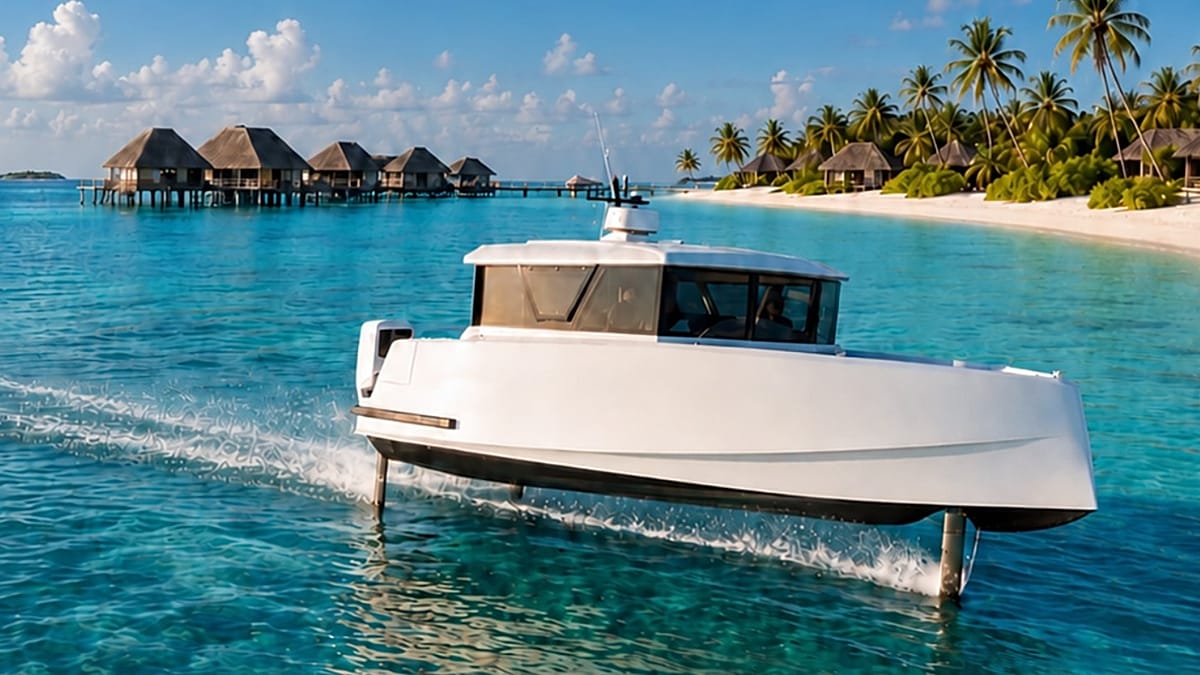
The Maldives is set to overhaul its island-hopping transport network with a fleet of up to 100 electric hydrofoil boats, promising quieter, faster, and more sustainable transfers for tourists and locals alike. The project, backed by a $100 million (€87 million) partnership between US maritime tech firm Navier and Dubai-based JIH Global Investment, aims to replace the archipelago's fragmented speedboat and ferry system with a unified, software-driven network.
Known as the Navier Network, the initiative will connect airports, resorts, private villas, and inhabited islands. The rollout begins later this year with five Navier N30 vessels, with plans to expand by up to 95 additional boats over the following three years.
Hydrofoil Technology for Smoother Travel
Unlike conventional speedboats, the N30 uses hydrofoil technology: underwater wings lift the hull above the water as the boat gains speed, reducing drag and allowing it to glide with minimal noise, vibration, and wake. Passengers will travel in air-conditioned cabins with lounge-style seating and onboard Starlink internet. The electric range reaches 75 nautical miles, extendable to 150 nautical miles in hybrid mode.
“The Maldives is one of the most important maritime transportation markets in the world,” said Sampriti Bhattacharyya, founder and CEO of Navier. “Nearly every guest, every worker, every resort, and every island depends on boats or seaplanes. That makes the Maldives the perfect place to prove that maritime transportation can be cleaner, quieter, standardised, software-driven, and dramatically better for the guest experience. We are not just deploying boats. We are building the first sustainable luxury transportation network on water.”
Mohamed Ali Janah, Chairman of JIH Global Investment, added: “The Maldives has always been at the frontier of luxury tourism, but as an island nation on the frontlines of climate change, we also have an opportunity to help define what the future of waterborne transportation looks like. With Navier, we see the potential to build not only a cleaner, more seamless network connecting airports, resorts, villas, and islands, but a scalable blueprint for sustainable maritime transportation, extending beyond the Maldives to island nations and coastal cities around the world.”
Tourism and Emissions Impact
The Maldives welcomed over 2.2 million visitors in 2025, with nearly all relying on boats or seaplanes to reach their accommodation. Around 3,000 fuel-powered vessels currently operate across the nation, making marine transport a major contributor to the country's carbon footprint. The new electric fleet is intended to help the Maldives meet its goal of reaching net zero emissions by 2030.
While the project is centred in the Indian Ocean, its implications extend to European readers. The technology and business model could be replicated in coastal regions across Europe, from the Greek islands to the Norwegian fjords, where similar transport challenges exist. European companies and policymakers watching the Maldives experiment may find lessons for decarbonising maritime transport closer to home. For instance, the EU's push to cut emissions from shipping, as seen in recent Brussels proposals on electricity tax cuts and grid overhaul, aligns with the kind of innovation Navier is deploying.
The partnership also highlights a growing trend of luxury tourism embracing sustainability—a shift that European travel operators, particularly in the Mediterranean and Baltic regions, are increasingly adopting. As the Maldives demonstrates, electric hydrofoils can offer a premium experience while reducing environmental impact, a balance that many European destinations are striving to achieve.