Disquiet inside the European People's Party over Aleksandar Vučić's Serbian Progressive Party (SNS) has hardened into an open demand for consequences, after senior Serbian officials attended the funeral of convicted war criminal Ratko Mladić with state honours. At the EPP's political assembly in Toulouse on Tuesday, senior figures concluded that the episode "cannot be ignored" as the party weighs the SNS's future within Europe's largest centre-right family.
Mladić, the Bosnian Serb commander convicted of genocide and crimes against humanity for his role in the 1995 Srebrenica massacre, died in late August at 84 in a UN detention facility in The Hague. The presence of high-ranking Serbian officials at his burial, and the honours attached to it, drew swift condemnation from the heads of EU institutions and has now become a focal point of the EPP's year-long scrutiny of its Serbian member.
A funeral that sharpened an existing review
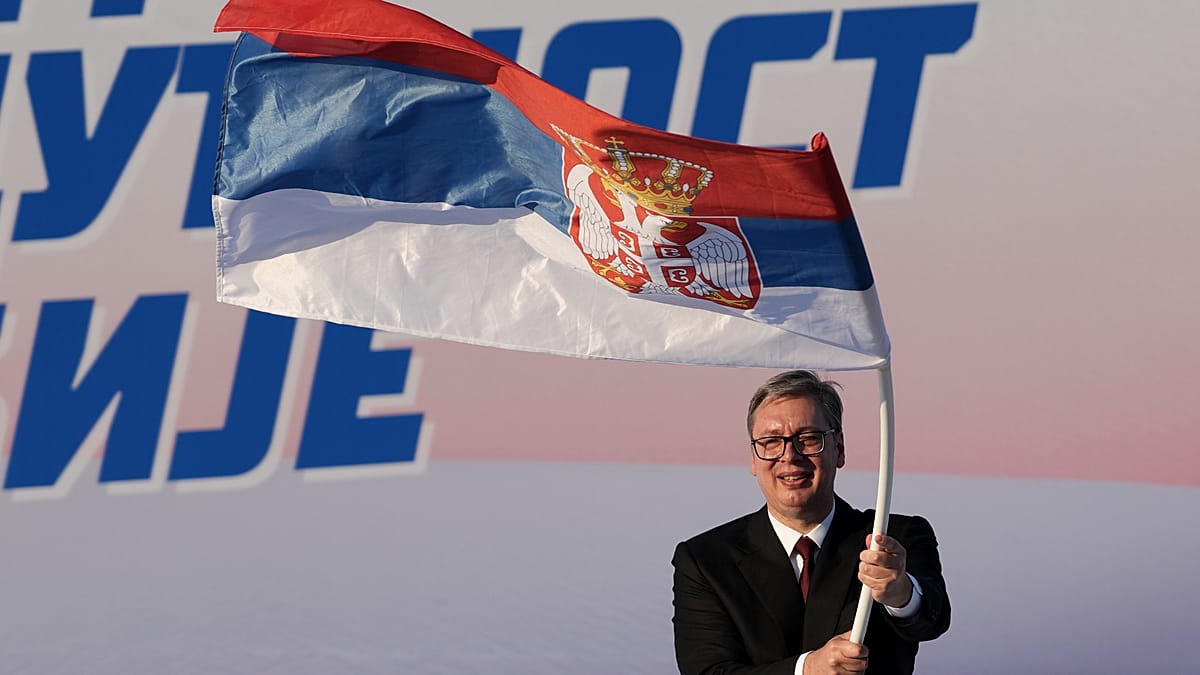
The EPP opened its examination of the SNS a year ago, following the Serbian government's crackdown on protests against corruption. That process is expected to conclude by the end of this year, though officials say no decision will be taken before Serbia's parliamentary election on 25 October. Vučić, who stepped down as president last Sunday, is standing as the SNS's candidate for prime minister — a contest that will shape how Brussels reads Belgrade's direction regardless of what the EPP decides.
Lukas Mandl, a senior EPP MEP, was blunt about the party's incompatibility with its Serbian counterpart. "There is not an inch of Vučić's policies that would fit into the EPP universe. EPP is for the people, not for autocrats," he told Euronews. Mandl argued for expulsion, citing what he called the "terrible misbehaviour around the funeral of one of the last European war criminals of the 20th century."
Vučić led the SNS from 2012 until 2023, when he handed the formal presidency to Miloš Vučević, but he remains widely regarded as the party's de facto chief. That continuity is central to the argument of those who want the SNS out: they contend that the party's direction has not changed with its letterhead.
Weber holds back as the machinery grinds
EPP leader Manfred Weber has also criticised the Serbian government's role in the Mladić funeral, but has so far declined to propose stripping the SNS of its membership. Under EPP rules, a suspension or exclusion must be proposed either by the Presidency or by seven member parties drawn from at least five countries, and is ultimately decided by the Political Assembly. The scrutiny process itself carries no fixed timetable and no predetermined outcome — a structure that gives the leadership room to delay, and reformers room to keep pressing.
The timing is delicate. Serbia's vote on 25 October will be read across the continent as a signal of whether Belgrade remains on a European trajectory or drifts further toward a model of governance that sits uneasily with EPP values. For now, the party's internal debate is a test of how far the EPP is willing to police its own membership at a moment when the wider continent is already contending with pressure on EU defence priorities and shifting alliances.
The Mladić affair has also revived uncomfortable questions about memory and accountability in the Western Balkans, where the legacy of the 1990s wars still shapes politics from Belgrade to Sarajevo and Pristina. Honouring a man convicted by the International Criminal Tribunal for the former Yugoslavia is not a private act of mourning in this context; it is a statement about which version of history a state chooses to endorse.
What happens next
No formal move is expected before Serbians cast their ballots. After that, the EPP's Political Assembly could take up a proposal that has been building for months. Whether it does will depend on how forcefully Weber and the Presidency read the mood in Toulouse — and on whether the SNS's conduct between now and the end of the year gives its defenders anything to work with.
For the EPP, the stakes extend beyond Serbia. Expelling a governing party would be a rare and pointed act, signalling that membership carries obligations that outlast electoral convenience. Suspending it would be a softer rebuke, but still a mark against a party that has long presented itself as a natural home for the Serbian centre-right. Either way, the decision will be watched closely in Belgrade, in Brussels and in the capitals of the Western Balkans, where the line between European integration and illiberal drift is being drawn in real time.