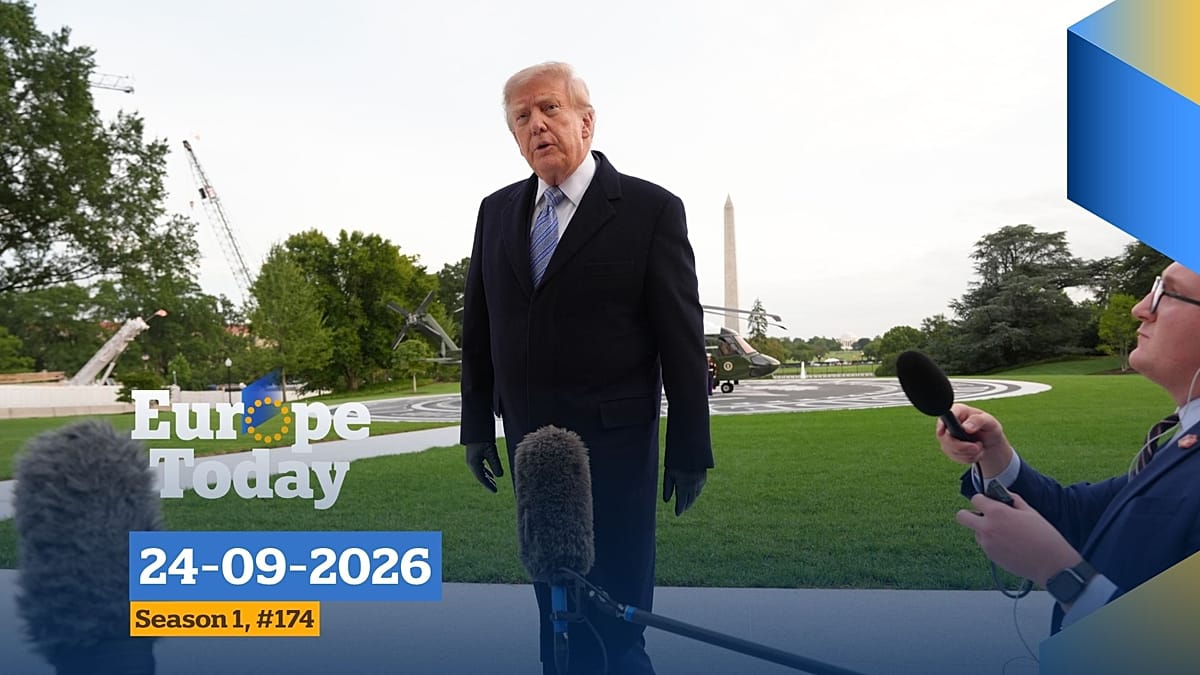
In the latest edition of Europe Today, the focus turns to transatlantic friction over international justice, Europe's defence ambitions, and the economic fallout from the Middle East conflict. The show, broadcast across the continent, brings together policymakers, analysts, and experts to unpack the stories shaping Europe's place in the world.
Trump's assault on the International Criminal Court
US President Donald Trump has renewed his attack on the International Criminal Court (ICC), calling on every nation to withdraw from the Hague-based tribunal. Washington is also preparing a package of sanctions aimed at crippling the court and its judges, a move that has alarmed European governments, many of which are staunch supporters of the ICC.
Chloé Ridel, a French socialist MEP who sits on the European Parliament's Justice Committee, joined the show to discuss the implications. She argued that Trump's pressure threatens the very foundation of international accountability. "The ICC is not perfect, but it is the only permanent court capable of prosecuting war crimes, crimes against humanity, and genocide," Ridel said. "If European states cave to this bullying, we are effectively endorsing impunity for the worst atrocities."
The US has never been a party to the Rome Statute, the treaty that established the ICC, and has long criticised the court for what it sees as politically motivated prosecutions. However, the current push is seen as particularly aggressive, with sanctions targeting not only court officials but also their families and any entities that assist them. European diplomats are reportedly working on a coordinated response, though divisions remain over how far to go in confronting Washington.
Ridel also drew parallels with other recent US actions that have unsettled European allies, such as Trump's trade truce with China, which was negotiated without European input. "Europe cannot rely on the US to defend the rules-based order when it is actively undermining it," she warned.
EU defence chief: Europe must step up
In an exclusive interview, European Commissioner for Defence and Space, Andrius Kubilius, outlined his vision for a more robust European defence posture. Kubilius, a former Lithuanian prime minister, stressed that the war in Ukraine has fundamentally changed the security landscape. "For decades, Europe outsourced its security to the United States," he said. "That era is over. We must invest in our own capabilities, from air defence to cyber and space."
Kubilius pointed to the growing role of private technology firms in defence, noting that several EU member states are now engaging with Palantir, the American data analytics company. While Palantir's platforms are used for intelligence and military logistics, concerns about ethics and data privacy persist. "We need to be careful," Kubilius acknowledged. "But we also cannot ignore the technological edge that such tools provide. The key is to ensure robust oversight and compliance with European values."
The commissioner also addressed the need for a unified European defence market, criticising the fragmentation that currently sees member states buying from non-European suppliers. "If we want strategic autonomy, we need to produce more of our own equipment," he said. "That means investing in European defence industries and reducing our dependence on third countries."
His remarks come as the EU grapples with the fallout from Trump's prediction of a swift end to the Ukraine war, which has exposed splits among member states over sanctions on Russian oligarchs. Kubilius declined to comment on internal disagreements but insisted that "the EU's support for Ukraine is unwavering."
Fuel prices squeeze European consumers
The show also turned to the economic impact of the Middle East war, which has disrupted global oil supplies and sent refining costs soaring. European consumers are feeling the pinch at the pump, with petrol and diesel prices rising across the continent. Osama Rizvi, Global Market & Product Strategist at Primary Vision, analysed the situation. "The conflict has added a risk premium to oil prices, but the bigger issue is refining capacity," Rizvi explained. "Europe relies heavily on imported refined products, and when those supply chains are disrupted, prices spike."
Rizvi noted that the situation is particularly acute in France, where fuel prices have ignited political tensions ahead of the presidential vote. "This is not just an economic issue; it's a political one," he said. "Governments across Europe are under pressure to provide relief, but they have limited fiscal space."
The European Commission has proposed measures to ease the burden, including temporary tax cuts and subsidies for low-income households. However, critics argue that such measures are short-term fixes that do not address the underlying structural problems in Europe's energy market.
UN declaration on climate-displaced states
Finally, the show examined a landmark UN declaration aimed at ensuring that countries whose territories become uninhabitable due to rising sea levels do not lose their statehood or their place in the international system. Kamal Amakrane, Managing Director of the UN's Rising Nations Initiative, explained the significance. "This is about protecting the rights of millions of people who may have to leave their homes," Amakrane said. "Statehood is not just a legal status; it is a lifeline for these nations."
The declaration, which was adopted at the UN General Assembly, has been welcomed by Pacific island nations and other vulnerable states. European countries, many of which are major emitters, have a particular responsibility to support these efforts, Amakrane argued. "Europe has the technology and the resources to help, but it also has a moral obligation," he said.
As the show concluded, the message was clear: Europe faces a complex web of challenges, from external pressures on its institutions to internal economic strains and the existential threat of climate change. How the EU responds will define its role in the world for decades to come.