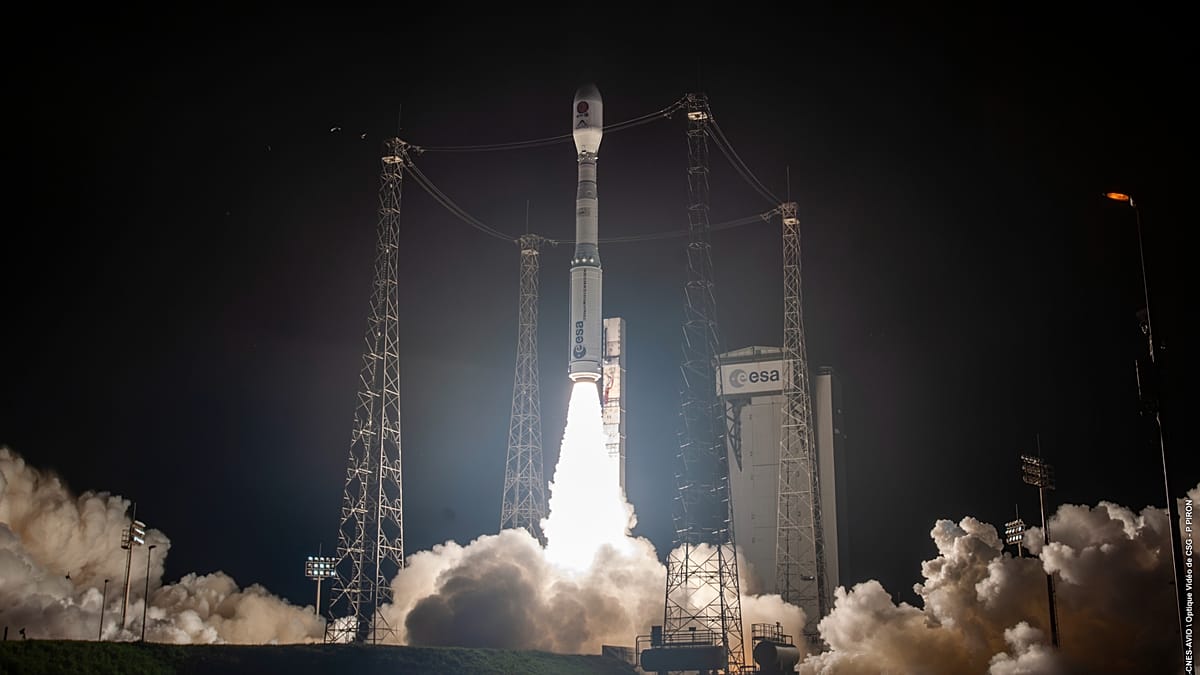
A European–Chinese mission designed to X-ray Earth’s magnetic atmosphere has successfully reached orbit. The Solar Wind Magnetosphere Ionosphere Link Explorer (SMILE), a collaboration between the European Space Agency (ESA) and the Chinese Academy of Sciences (CAS), lifted off on Tuesday from Europe’s spaceport in Kourou, French Guiana.
The 3-metre-tall spacecraft, equipped with advanced trackers and antennas, will monitor the magnetosphere — the planet’s invisible shield that deflects charged particles streaming from the Sun, known as the solar wind. Without this protective bubble, ESA notes, life on Earth would be impossible.
Mapping the Invisible Frontier
SMILE’s primary goal is to observe how, where, and when the solar wind interacts with Earth’s magnetic field. The mission will capture soft X-ray and ultraviolet emissions, offering unprecedented views of the dynamic boundary between our planet and space weather. This data is critical for understanding gaps in our knowledge of the solar system and for safeguarding both satellites and astronauts in future missions.
“If it weren’t for the magnetosphere, life could not survive on planet Earth,” ESA stated in a mission overview. The agency emphasised that SMILE will help predict space weather events that can disrupt power grids, communications, and navigation systems across Europe and beyond.
The spacecraft will operate in a highly elliptical orbit, reaching altitudes of up to 121,000 kilometres above the North Pole — roughly one-third of the distance to the Moon. During each 45-hour orbit, it will collect continuous observations, providing scientists with a wealth of data on the magnetosphere’s response to solar activity.
This joint effort underscores a rare area of cooperation between Europe and China amid rising geopolitical tensions. While trade disputes and diplomatic frictions have strained relations — as seen in the EU weighing tariffs and supplier rules — scientific partnerships like SMILE continue to bridge divides. The mission also complements other European space initiatives, such as the Finnish ICEYE satellites, which lead Earth observation with radar precision.
For European space agencies and industries, SMILE represents a strategic investment in fundamental research with practical payoffs. Understanding the magnetosphere is essential for protecting the continent’s growing fleet of satellites, which underpin everything from weather forecasting to financial transactions. As ESA pushes forward with its ambitions in lunar exploration and deep-space travel, insights from SMILE will inform the design of future spacecraft and habitats.
The mission also highlights the importance of international collaboration in space science. By combining European expertise in X-ray imaging with Chinese capabilities in satellite platforms, SMILE sets a precedent for joint projects that transcend political boundaries. As the spacecraft begins its mapping campaign, researchers in Paris, Beijing, and elsewhere will analyse the data to refine models of space weather and its effects on Earth.
With its first images expected in the coming months, SMILE is poised to deliver a clearer picture of the magnetic shield that makes life on our planet possible — and to help ensure that the technology Europeans rely on remains safe from the Sun’s fury.