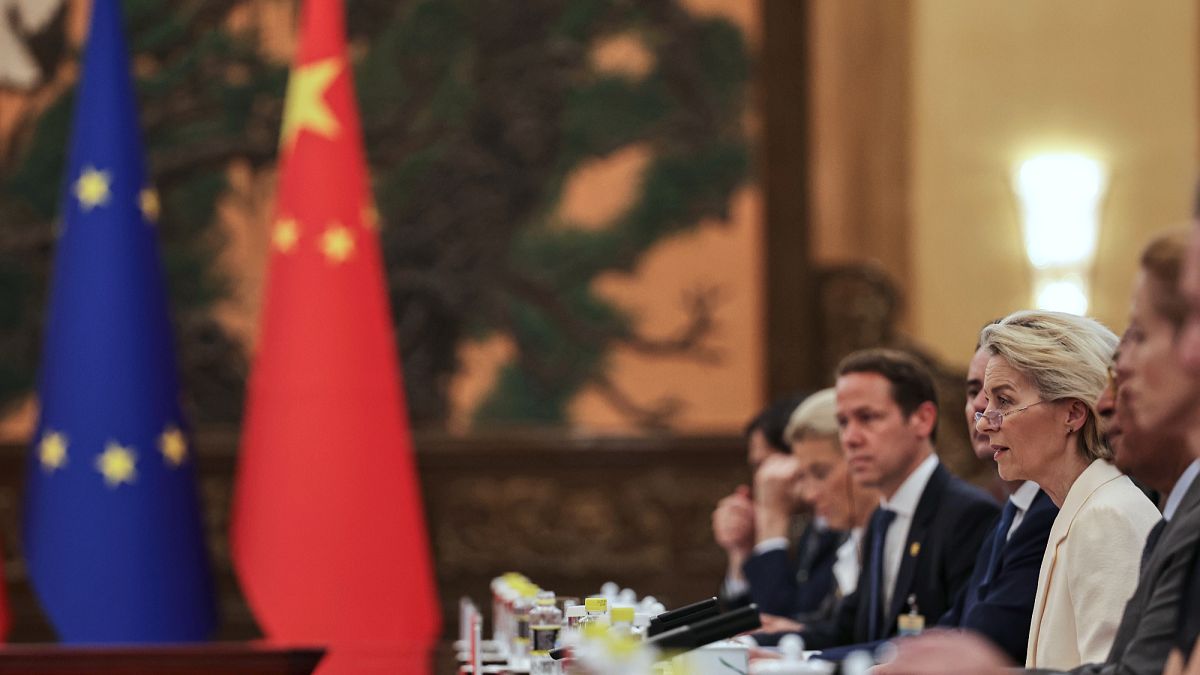
As Chinese-made goods continue to flood the European single market, threatening jobs in key industries, the European Commission is accelerating efforts to shield the bloc from Beijing's excess production capacity. The urgency is underscored by fresh data from Chinese customs: in the first four months of 2026, China's trade surplus with the EU-27 reached $113 billion, a $22 billion increase over the same period in 2025. The EU's overall trade deficit with China had already ballooned to €359.9 billion last year.
Beijing has also ramped up retaliatory threats in recent weeks, pushing back against several EU laws that limit Chinese companies' access to the single market. On Friday, China banned its firms from engaging with the Commission over EU foreign subsidy investigations. Against this backdrop, EU Commissioners are set to debate the bloc's options on 29 May. Here are the main tools under consideration.
1. Reducing Reliance on Chinese Components
According to a report in the Financial Times, the Commission is drafting a plan that would force EU companies to source critical components from at least three different suppliers. The proposal would set thresholds of around 30% to 40% for purchases from any single supplier, with the remainder coming from at least three suppliers, not all based in the same country. This move follows China's 2025 restrictions on exports of rare earths and chips, materials vital to Europe's green tech, automotive, and defence sectors.
2. Targeting Strategic Sectors with Tariffs
In its economic security strategy published last December, the Commission pledged to introduce new tools by September 2026 to protect EU industry from unfair trade practices and overcapacities. “We will fight tooth and nail for every European job, for every European company, for every open sector, if we see they are treated unfairly,” Trade Commissioner Maroš Šefčovič told Euronews. EU countries and the European Parliament have already agreed to impose new quotas and double tariffs on global steel imports, a sector dominated by Chinese overcapacity. Now the chemical industry is in the spotlight: Chinese chemical imports have surged 81% over five years. However, the EU chemical sector also relies heavily on exports, including to China—its fourth-largest export market—making any targeted measure a delicate balancing act. “As an export-oriented industry, the European chemical industry generates over 30% of its sales abroad. That creates a risk of retaliation from third countries,” said Philipp Sauer, trade expert at Cefic, the European chemical industry lobby group.
3. Anti-Dumping and Anti-Subsidy Duties
The Commission can impose duties on Chinese imports when prices fall below those on the domestic market, or investigate firms for receiving unfair subsidies. Yet these investigations can take up to 18 months, and DG Trade, with only around 140 officials, is already overwhelmed. Sauer noted that between one-third and half of all ongoing investigations relate to the chemical sector.
4. The Anti-Coercion Instrument
Dubbed the EU's “trade bazooka,” this last-resort tool allows the bloc to hit back with measures such as restricting access to licences or public procurement if a third country exerts economic pressure. Its activation requires a qualified majority of member states—a condition that is far from guaranteed. Germany opposed EU tariffs on Chinese electric vehicles in 2024, and Spanish Prime Minister Pedro Sánchez, who has visited China four times in three years, favours closer ties with Beijing to secure major Chinese investment.
5. Unifying Member States
Brussels also faces the risk that its decoupling strategy may encounter significant resistance from national governments. EU member states remain divided over how to approach China, a fragmentation that Beijing can exploit by playing capitals against each other. These differences are already visible in the information and communications technology (ICT) sector. The EU has proposed a mechanism to phase out high-risk suppliers such as Huawei and ZTE from strategic industries, starting with telecommunications, as part of a revamp of the EU Cybersecurity Act. Spain and Germany, where Chinese equipment is deeply embedded in digital infrastructure, are pushing back. European telecom operators have asked for financial compensation to replace Chinese gear, following the US “rip and replace” model, but neither the EU nor national governments have shown willingness to fund such a costly transition. The full decoupling from China, in short, carries high political and economic costs for Europe.
As the Commission prepares its May debate, the bloc's ability to forge a unified stance will be critical. The outcome will shape not only trade relations with Beijing but also the broader transatlantic trade dynamics and Europe's position in a world of rising great-power competition.