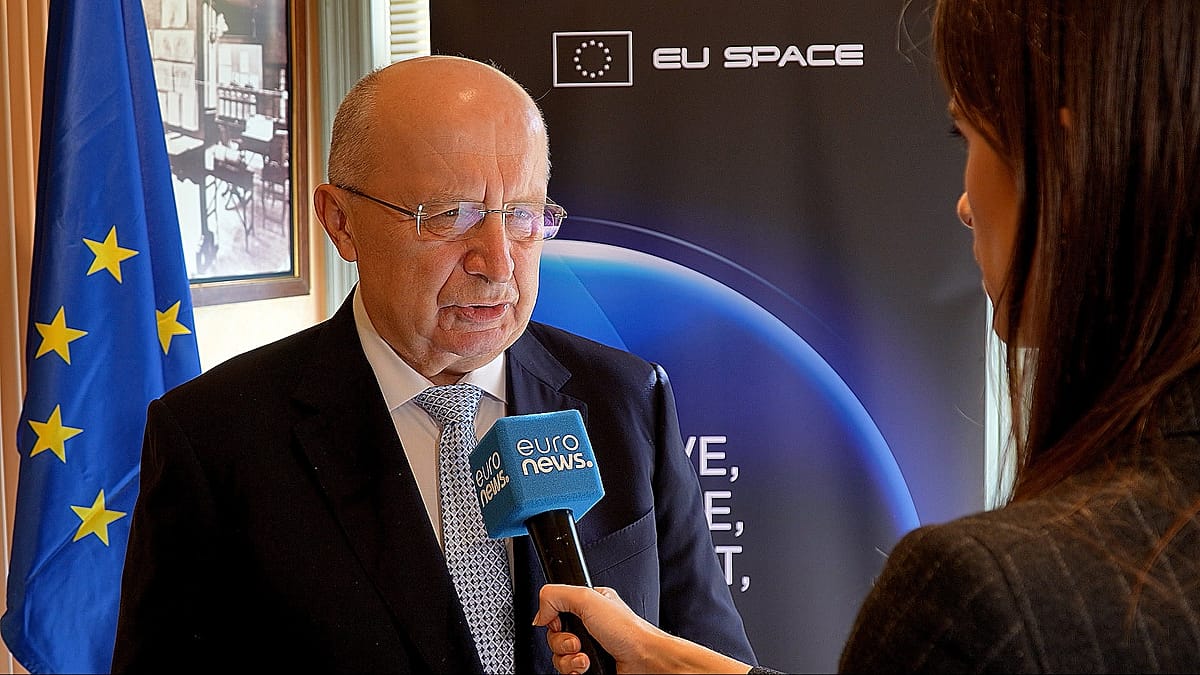
As the presidents of Lithuania and Poland met with the CEO of Palantir Technologies on the sidelines of the United Nations General Assembly in New York, the European Union's defence commissioner has voiced support for the controversial data analytics firm, calling it "a great company" and stressing that artificial intelligence is becoming indispensable for modern military strategy.
Andrius Kubilius, the European Commissioner for Defence and Space, made the remarks in an interview with Euronews' Europe Today programme on the margins of the second EU Access to Space Summit in Brussels on Wednesday. He argued that AI-driven tools for intelligence gathering and data management are "very crucial for modern warfare doctrines," and that Europe must develop its own capabilities in this field.
Palantir, founded in 2003 and known for its work with intelligence agencies and militaries, has drawn sharp criticism from human rights organisations and several European governments over its involvement in military operations, mass surveillance, and immigration enforcement. Despite that, Polish President Karol Nawrocki and Lithuanian President Gitanas Nausėda met with Palantir's CEO Alex Karp this week in New York, with both leaders touting deeper cooperation on defence and NATO-related operations.
Asked whether such partnerships are wise for Europe's eastern flank, Kubilius said he was not privy to the details of the discussions between the leaders and Karp. But he added that AI is becoming "the new normal" in defence planning, and that Europe should not lag behind. "Developments with AI for intelligence, for managing the data, are very crucial," he said, while stressing the need for European strategic autonomy in this area.
Greenland agreement: a step back from annexationist rhetoric
In a separate development, Kubilius welcomed the trilateral agreement signed on Tuesday between Denmark, Greenland, and the United States, which he said resolves the "totally unacceptable" language that had come from Washington regarding the Arctic island. The deal, finalised after ten months of negotiations in New York, gives the US "permanent control" over Greenland, according to President Donald Trump, and includes plans for the US to reopen two additional military bases.
Kubilius said the Danish government is pleased with the outcome, particularly because it removes the kind of rhetoric that Europeans found alarming. "The language was that, you know, we remember very well, that Greenland should belong to United States and so on and so because of security reasons. So now those issues are resolved," he said. Trump had previously said "we need Greenland" and that the US would "do something there whether they like it or not," without ruling out the use of force.
Sanctions reform: less member-state influence
Kubilius also weighed in on the recent controversy over the EU's sanctions policy, following France's successful lobbying to remove an individual from the latest sanctions package against Russia. Latvia and other Baltic states, including Lithuania, strongly opposed the de-listing, which has exposed deep divisions among member states over how sanctions are adopted.
Latvian Prime Minister Andris Kulbergs has voiced concern about the precedent set by the episode. Kubilius argued that the incident shows the need for reform. "Sanctions policy in Europe should be strengthened and made more effective," he said. "There should be less of individual member states' influence to influence on sanction lists as it happens, and that is why I am very much in favour of what German government is proposing."
Berlin has been pushing for faster and more efficient decision-making in the EU's common foreign and security policy, particularly when it comes to sanctions. Kubilius's comments align with that push, which aims to reduce the ability of single member states to block or alter sanctions packages.
The debate over Palantir's role in European defence comes at a time when NATO's eastern flank is under heightened scrutiny. As Palantir courts Baltic leaders, questions about the ethics and strategic implications of AI in warfare are likely to intensify. Meanwhile, the EU is also grappling with broader defence and technology challenges, as highlighted in recent Europe Today debates.
Kubilius's endorsement of Palantir may signal a pragmatic shift in Brussels, where the need for advanced technology is increasingly seen as outweighing reputational concerns. However, critics argue that partnerships with companies like Palantir could undermine European values and privacy standards. The coming months will show whether the EU can balance its security needs with its commitment to fundamental rights.