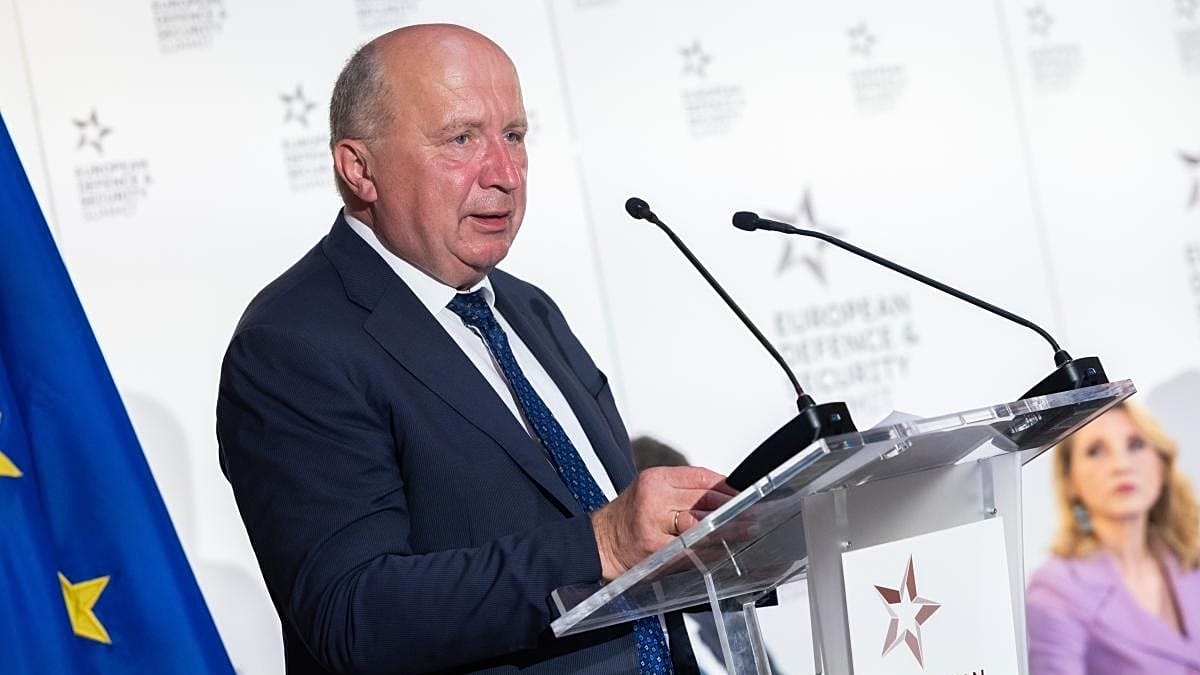
European Commissioner for Defence Andrius Kubilius has warned that Europe should brace for further attacks on its soil as Russian President Vladimir Putin grows increasingly desperate amid setbacks on the frontlines in Ukraine. Speaking at the European Defence and Security Summit in Brussels on Tuesday, Kubilius said provocations are intensifying against the Baltics and the eastern flank, and the killing of a Russian dissident in Poland last week may be only the beginning.
“Unfortunately, there may be more such attacks — and even worse ones. Not only in Ukraine, but also in Europe,” Kubilius said, referring to the death of Semyon Skrepetsky, a 44-year-old artist who had been living in Poland. Skrepetsky, whose legal name was Robert Kuzovkov, was shot multiple times on 8 June in a town near the Belarusian border. Polish authorities have arrested a suspect carrying a Georgian passport and are investigating possible links to Moscow.
Skrepetsky was known for provocative paintings that caricatured Russia’s political elite, including a piece depicting Putin cradled in the arms of Soviet dictator Joseph Stalin. Kubilius suggested the artist was targeted “because of his paintings about Putin.” Polish Prime Minister Donald Tusk described the incident as a potential case of “state-sponsored terrorism” on European soil, the first of its kind.
Production Gaps and the Urgency of Integration
Kubilius used the killing as a stark warning: if the 27 EU member states fail to take Russian threats seriously and do not ramp up defence production, more shocks are inevitable. “Russia is still outproducing us and is able to use millions of drones,” he said. “Putin is still a danger to European security. Putin is still willing and able to test Article 5. The question is: are we willing and able to defend ourselves and deter aggression?”
The urgency is heightened by the expected withdrawal of US strategic enablers worth €500 billion from Europe over the next decade, with further cuts possible after a six-month review of American force posture. Kubilius argued that Europe must step up its own weapons production by slashing red tape, improving military mobility, and pursuing joint procurement through European defence projects of common interest. The ultimate goal, he said, is a properly integrated defence market.
“Because the established status quo on the supply and demand side in the fragmented European markets dominates everything, and that is why transformation of demand and transformation of defence doctrines in Europe is so slow,” Kubilius explained. The European Commission is expected to present a communication on integrating the bloc’s 27 siloed defence markets next week, followed by a proposal to change procurement rules to ease production.
The scale of the challenge is evident: Europe produced only 250 cruise missiles in the last 12 months and no ballistic missiles. “Ukraine is producing much more,” Kubilius noted. He pointed to the €150 billion SAFE (Security Action for Europe) loans as evidence that the EU has the financial resources, but warned that without structural reforms, the money alone will not close the gap.
Kubilius’s remarks come amid a broader push for European defence autonomy. Germany and Poland have recently signed a defence pact, reflecting shifting power dynamics on the continent. Meanwhile, Poland leads NATO in defence spending, underscoring the divide between eastern and western member states on security priorities.
Russian Foreign Minister Sergei Lavrov, in a predictable counter-narrative, claimed that Europe, not Moscow, is “becoming a major threat to international peace and security.” But for Kubilius and many European leaders, the evidence points in the opposite direction. The killing of Skrepetsky, combined with Russia’s continued drone and missile production, suggests that the continent must prepare for a long period of hybrid and direct threats.
“Putin is still a danger to European security,” Kubilius reiterated. “The question is: are we willing and able to defend ourselves and deter aggression?”