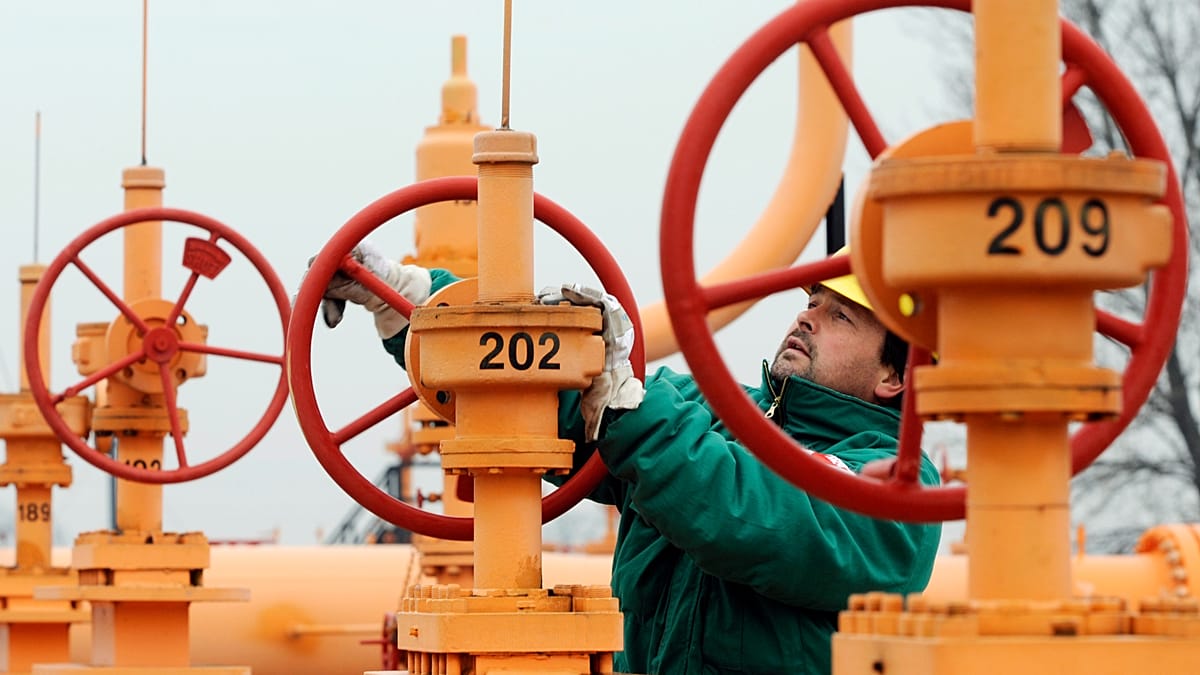
As temperatures drop across Europe, the European Union is entering the heating season with a thinner buffer of natural gas than it would like. Storage caverns from the Netherlands to Germany are sitting at levels that have prompted the European Commission to relax its usual refilling requirements, hoping to avoid a bidding war for cargoes that would push already high prices even higher.
In a letter to EU capitals, Energy Commissioner Dan Jørgensen warned that stocks remain “exceptionally low” after a summer of intense heat and drought that forced power plants to burn more gas for electricity, leaving less time and capacity to refill underground reserves. The letter, seen by Euronews, stresses that the bloc is not facing an immediate supply emergency, but the margin for error is thinner than in recent years.
Why storage levels matter
Under EU rules adopted after Russia’s full-scale invasion of Ukraine, member states are obliged to fill their gas storage facilities to 90% of capacity by 1 November in a typical year. These facilities – often depleted gas fields or salt caverns – act as a seasonal buffer, absorbing gas when demand is low and releasing it when heating demand spikes.
This year, however, the Commission has given capitals the flexibility to aim for just 75% to 80% filling, acknowledging that chasing the full target would force them to pay exorbitant prices on the spot market. “Making use of the flexibility provided by the Gas Storage Regulation and reducing the filling target to 80% can help alleviate immediate pressure on prices and refilling costs,” Jørgensen wrote.
Nine member states – Cyprus, Estonia, Finland, Greece, Ireland, Lithuania, Luxembourg, Malta and Slovenia – have no storage facilities of their own. They are instead required to make solidarity arrangements with other countries to secure their supplies.
Current stock levels and the outlook
According to industry data from mid-September, EU storage is averaging around 70% full. That is lower than the 94.9% average recorded in November 2022, when the bloc had just weathered the first winter without Russian pipeline gas. Latvia (47.1%), the Netherlands (52.1%) and Germany (55.6%) are among the weakest performers.
Germany’s economy ministry said in late August that it does not expect shortages this winter, despite its storage lagging behind the EU average. But analysts are less sanguine. Emil Constantinescu, founder of EnergyRiskIQ, notes that “the physical buffer is improving, but the market is still attaching a substantial premium to future gas availability and external supply risk.”
The real test will come on 8 October, when ENTSO-G, the association of Europe’s transmission system operators, publishes its winter supply outlook.
Prices and the global context
The price of gas on the Dutch TTF benchmark, Europe’s reference, has more than doubled since before the Middle East conflict escalated. It now trades around €72–74 per megawatt-hour, having briefly spiked above €80–89 in early September. The disruption to LNG flows through the Strait of Hormuz – down to 15–25% of pre-war levels – has tightened the global market, and Qatar has extended force majeure on shipments to both Asian and European buyers for another month.
This has reignited concerns about Europe’s dependence on imported LNG, particularly from the United States and Qatar. The Netherlands, which has some of the lowest storage levels in the bloc, is already pushing back against the EU’s mandatory filling targets. Dutch Climate Minister Stientje van Veldhoven has argued that forcing countries to fill their reserves to set levels places an unfair burden on them, and Gasunie, the Dutch grid operator, has echoed that view, recommending that policymakers prepare for a crisis that could last several months.
What could go wrong
Analysts warn that a combination of a severe cold snap and continued closure of the Strait of Hormuz could push global LNG prices to nearly double current levels, forcing Europe to outbid Asian buyers for US cargoes. Because many power plants run on gas, a supply shortfall would quickly translate into higher electricity bills and potential grid strain.
Ronald Pinto, principal insight analyst at Kpler, says shortages are not currently forecast, but the power sector would be the first to feel the impact. “Gas often ends up as the marginal producer, particularly in winter; a gas shortage could propel a TTF rally, which could in turn lead to high power prices across Europe,” he said.
For now, the EU is hoping that a mild winter and continued diplomatic efforts to de-escalate the Middle East will keep the system afloat. But with storage levels below the historical norm and prices elevated, the margin for error is uncomfortably thin.