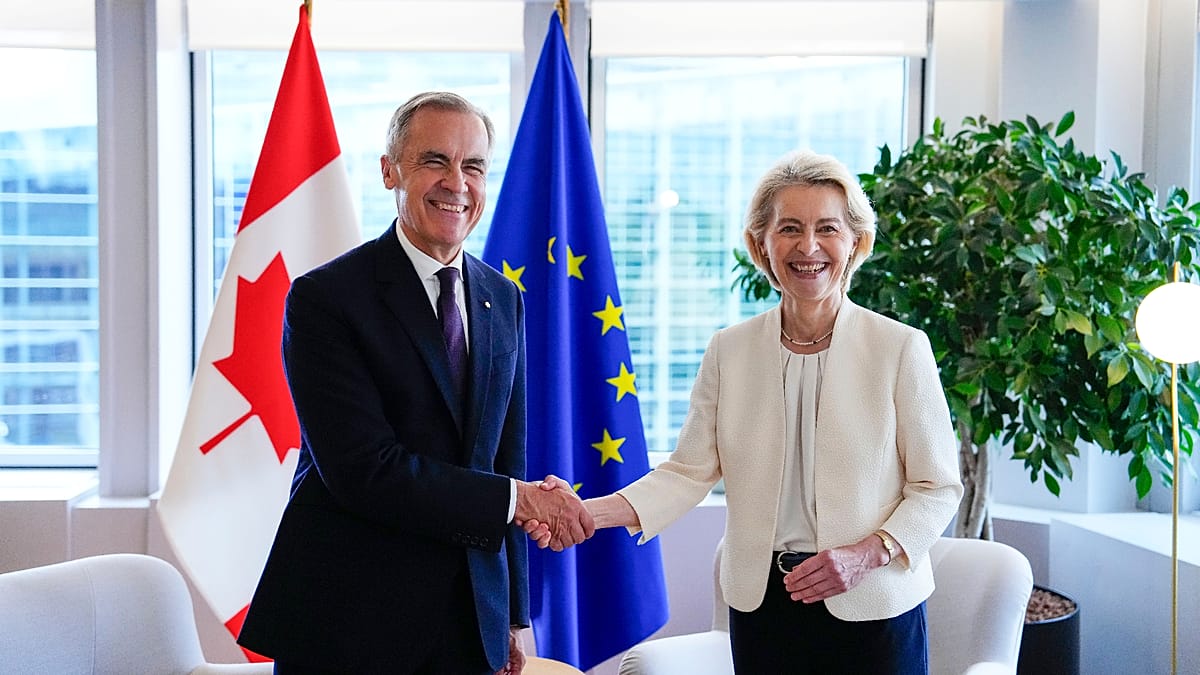
In her annual State of the Union address delivered in Strasbourg on 16 September, European Commission President Ursula von der Leyen raised the possibility of Canada becoming the EU's first-ever “associate member.” The proposal, unprecedented for a non-European country, signals a strategic shift in how Brussels views its partnerships beyond the continent.
If the 27 member states give their backing, the EU would need to craft a new legal category, as the current treaties contain no provision for associate membership. This would involve defining the rights and obligations that come with such a status, a process that could take years of negotiation.
A partnership beyond trade
The associate membership would not mean Canada joining the EU. Instead, it would formalise a deeper relationship that goes beyond existing agreements such as the Comprehensive Economic and Trade Agreement (CETA) and the military mobility projects under Permanent Structured Cooperation (PESCO). Von der Leyen described the goal as an “Alliance for the Future to create a common prosperity and economic security space.”
The proposed partnership would span a wide range of policy areas, including manufacturing, energy, critical minerals, artificial intelligence, quantum computing, cybersecurity, and the Arctic. It would also aim to integrate defence industrial bases and establish a joint technology alliance.
This is not the first time the EU has sought to deepen ties with Canada. The CETA trade pact has been provisionally applied since 2017, but full ratification has stalled in several national parliaments. The new proposal could breathe fresh life into the relationship, though it remains unclear how it would interact with the existing trade framework.
Reducing dependence on the US
The timing is no coincidence. Both Brussels and Ottawa are grappling with an increasingly unpredictable Washington. For the EU, stronger ties with Canada offer a way to diversify its sources of energy, technology, and defence equipment. For Canada, the partnership provides a like-minded ally as it faces a tariff dispute with the US, which since August 2026 has imposed duties of up to 50% on some Canadian goods.
Canadian Prime Minister Mark Carney has been a vocal advocate of closer EU ties, and his government has already taken steps such as joining the EU's €90 billion loan package for Ukraine. The associate membership proposal aligns with Carney's broader strategy of reducing Canada's economic reliance on its southern neighbour.
However, not everyone is convinced. Some analysts point out that the EU has offered similar partnership frameworks to other countries, such as Australia, which has cooled talk of associate membership in favour of a straightforward trade deal. The legal and political hurdles for Canada could be substantial, and the concept remains vague in many respects.
What happens next?
The proposal is still in its early stages. The European Commission would need to draft a formal mandate, and the Council of the EU would have to approve it unanimously. Even then, the European Parliament and national parliaments would likely have a say, given the constitutional implications.
For now, the idea remains a political signal rather than a concrete plan. But it reflects a broader trend: as the transatlantic alliance becomes less predictable, the EU is looking to build new alliances with trusted partners beyond its immediate neighbourhood. Canada, with its shared values and complementary economic strengths, is an obvious candidate.
Whether the associate membership becomes a reality will depend on the willingness of both sides to navigate the complexities of EU law and the sensitivities of national sovereignty. But the very fact that it is being discussed marks a notable shift in European foreign policy.