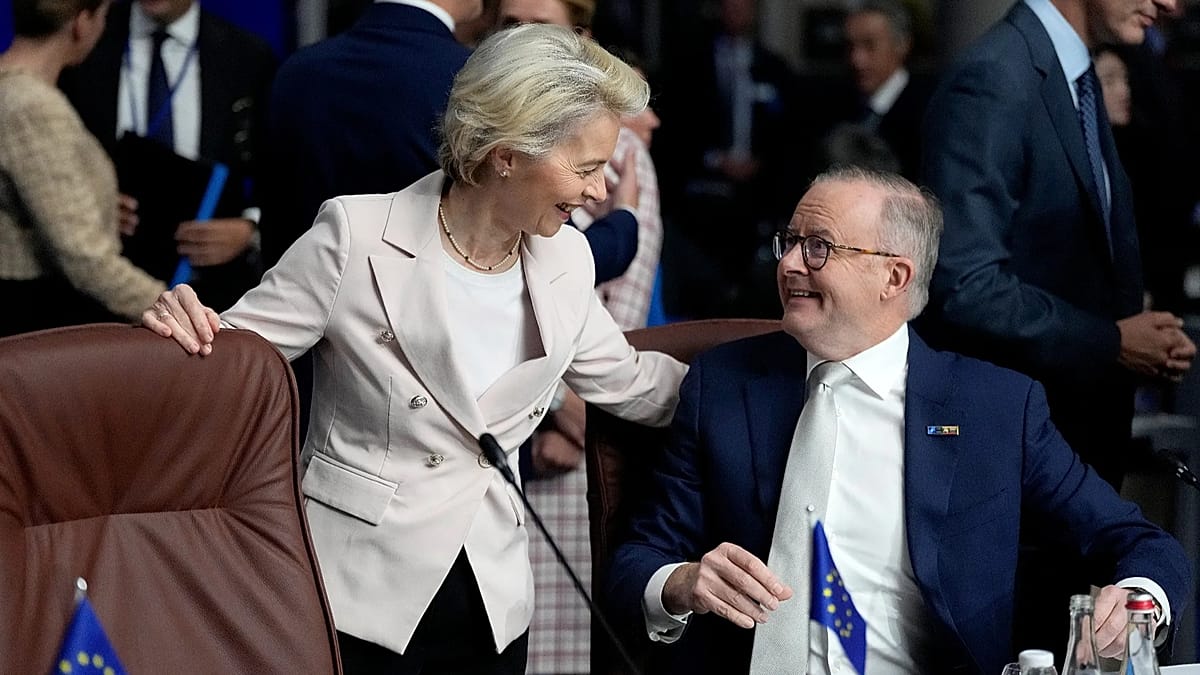
Canberra has moved to dampen speculation that it might follow Canada in seeking a new "associate member" status within the European Union, insisting that its immediate focus remains the long-negotiated bilateral trade agreement.
In exclusive comments to Euronews, an Australian government spokesperson said the relationship with the EU has "never been stronger or more important," but stressed that the government is concentrating on finalising the EU-Australia trade deal, which "will bring us even closer together."
"This once-in-a-generation deal gives our farmers, exporters, producers and businesses access to 27 EU countries and 450 million consumers," the spokesperson said. "Australia is a trading nation, and in a time of global uncertainty, deepening our trading partnerships makes economic sense."
The remarks come after European Parliament President Roberta Metsola hinted that Australia and New Zealand could also be invited to become associate members, following European Commission President Ursula von der Leyen's landmark State of the European Union address in Strasbourg, where she opened the door to Canada. Canada's potential associate status has already sparked debate across the Atlantic, with some in Washington viewing it as a challenge to US influence.
A spokesperson for the New Zealand government also clarified to Reuters that "there have been no discussions with the EU about New Zealand becoming an associate member."
Trade deal still the priority
The EU-Australia trade agreement, concluded in March after years of talks, still faces a ratification process that could be complicated by agricultural sensitivities on both sides. The deal sets annual quotas for Australian beef (30,600 tonnes) and mutton and lamb (25,000 tonnes), figures that have drawn criticism from European farmers who argue that these quotas, combined with preferential access granted in other agreements such as the Mercosur deal, could flood the market.
Australian beef producers had originally sought a quota of around 50,000 tonnes, and the compromise has not satisfied all parties. The opposition Liberal-National Coalition has called on Trade Minister Don Farrell to renegotiate the terms, adding a layer of domestic political pressure.
For Brussels, the associate membership concept is still taking shape. While Canada is seen as the first candidate for this new status, the idea has raised questions about the EU's future relations with other like-minded democracies. Canadian Prime Minister Mark Carney has embraced the idea while ruling out full membership, and the European Commission has sought to reassure the United States that the initiative is not a hostile act. Brussels has explicitly told the Trump administration that the move is about deepening cooperation, not undermining transatlantic ties.
Australia's cautious response suggests that, for now, it prefers to consolidate its economic relationship with Europe through the trade deal rather than venture into uncharted political territory. The government in Canberra appears to view the associate membership idea as a longer-term possibility, but not something to pursue while the trade agreement remains unratified.
Analysts note that the EU's associate membership concept is still vague, with no clear definition of what it would entail in practice. For Australia, a country that has traditionally looked to the Asia-Pacific for its economic and security partnerships, the idea of closer political integration with Europe may hold less appeal than the concrete benefits of a trade deal.
As the ratification process moves forward, both sides will need to navigate the concerns of farmers and politicians. The outcome will determine whether the EU-Australia relationship deepens in the coming years, and whether Canberra eventually reconsiders the associate membership option.