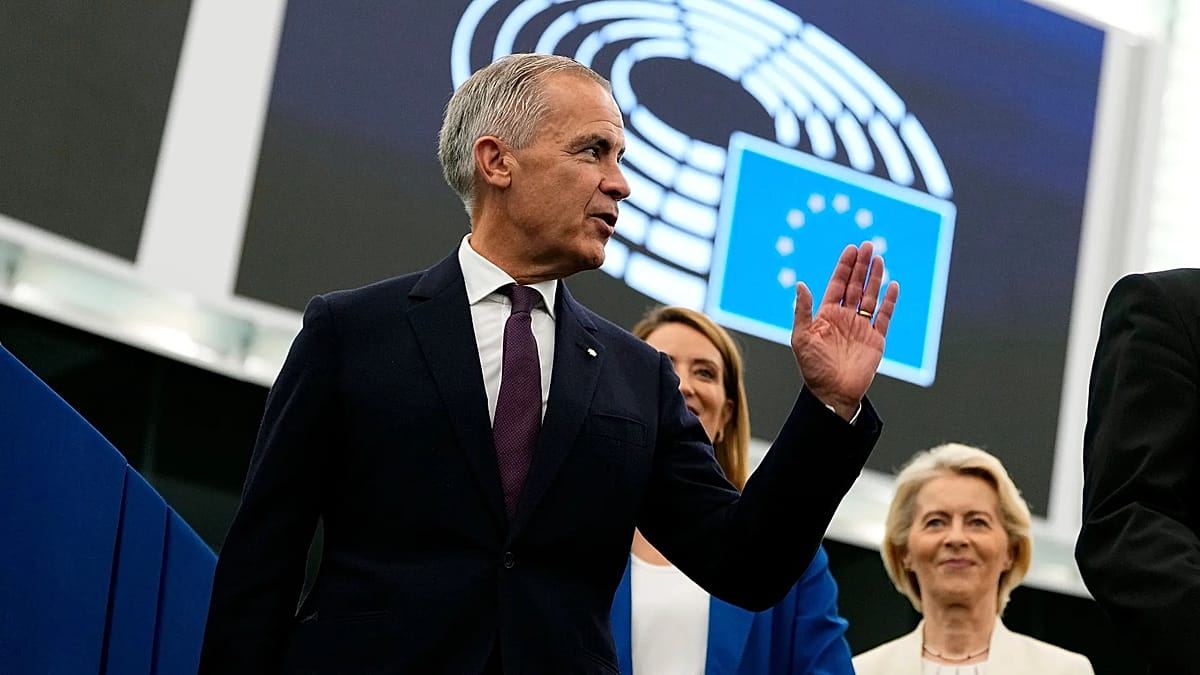
Canadian Prime Minister Mark Carney has welcomed European Commission President Ursula von der Leyen's proposal to make Canada the first "associate member" of the European Union, while drawing clear red lines on sovereignty and full membership.
Speaking in Strasbourg before the European Parliament, Carney acknowledged the invitation as a historic step in transatlantic relations, pointing to opinion polls that show a strong majority of Canadians favour deeper ties with Brussels. Yet he was quick to temper expectations about how far Ottawa is prepared to go.
"Canada is not in a position nor seeking to become a full member of the European Union," Carney said. "Therefore, it's a different framework. It's a framework that is relevant for a country that shares deep bonds with Europe."
When asked whether he was comfortable with the term "associate member," Carney deferred to European terminology, saying "the precise nomenclature is a question for Europe," and stressed that the substance of the relationship matters more than the label.
Defining the limits of partnership
Carney also signalled that Canada would not accept any arrangement that compromises its sovereignty. "We are looking for partnerships that are complementary, that reinforce our sovereignty," he insisted, drawing a line that will shape negotiations over the new status.
The move comes as Canada finds itself locked in a trade war with the United States after bilateral talks collapsed. Ottawa has increasingly looked to Brussels as a counterweight, and Carney sees the EU as a model for how democracies can cooperate without merging into a single political entity.
In his address, Carney outlined several areas where he believes collaboration could deepen, including critical minerals, defence industrial capacity, artificial intelligence and computing, energy security, space, and payments. He framed the alliance as a positive project: "An alliance is not defined by what we oppose, but by what we are for: freedom, solidarity, prosperity, sustainability."
Carney was careful to reject any notion that Canada and the EU were forming a bloc to challenge the great powers. "We do not seek power to dominate others," he said. "On the contrary, we are pursuing resilience so that no one can control our open markets, impair our sovereignty, threaten our territorial integrity, or undermine our freedoms, our democracies, our rule of law."
The proposal has already drawn reactions from Washington, with President Donald Trump threatening tariffs in response to the EU's overture. European officials have insisted the associate membership is not a hostile act, as Brussels has sought to reassure the US. Meanwhile, European Parliament President Roberta Metsola has defended the plan, and Carney received a standing ovation after his speech, as reported earlier.
The exact contours of the associate membership remain undefined, but the political signal is clear: Canada is pivoting towards Europe. For European industry, this could open new doors, as analysts have noted. Talks are also underway for Canada to join the Erasmus+ student exchange programme, a sign of the breadth of the emerging partnership.
Carney's visit to the European Parliament marks a milestone in EU-Canada relations, but it also underscores the limits of integration. As he put it, the goal is not to merge but to build a resilient partnership that respects each side's autonomy.